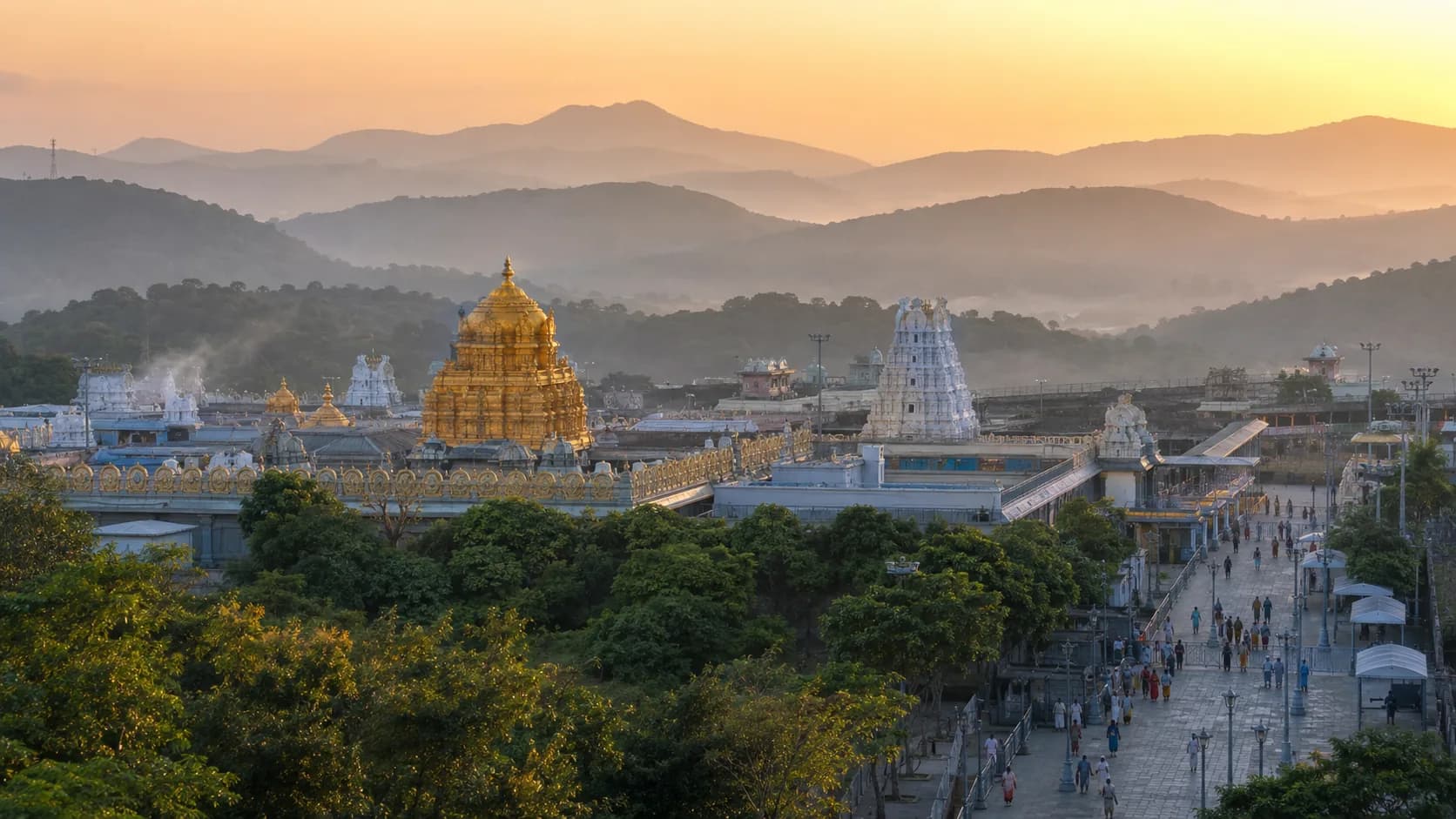
One of the 108 sacred Divya Desams, located in the heart of Thiruvananthapuram, where Lord Vishnu is enshrined in the eternal yogic slumber (Anantha Sayana) upon the five-hooded serpent Adi Shesha, visible through three distinct sanctum doorways.
अनंत शयन — तीन द्वारों से प्रभु के दिव्य दर्शन
The Anantha Sayana Vision Across Three Doorways
Sree Padmanabhaswamy Temple is situated within the historic East Fort of Thiruvananthapuram—a capital city whose very name means 'The Holy Abode of Lord Anantha.'
The presiding deity of the temple is Lord Vishnu in the sublime posture of Anantha Sayana (eternal yogic sleep), reclining upon the coiled body of the divine five-hooded serpent, Adi Shesha. The massive idol stretches 18 feet in length and is composed of a complex traditional Ayurvedic medicinal plaster known as Katu-Sarkara-Yogam, encasing an inner core of 12,008 sacred Shaligram stones brought on elephant-back across thousands of miles from the Gandaki river in Nepal.
Because of its immense length, the full form of the deity cannot be taken in from a single vantage point. The sanctum features three separate doorways (Thiruvathil): - **First Doorway**: Reveals the sacred face, chest, and the right hand of Lord Vishnu resting upon a consecrated Shiva lingam. - **Second Doorway**: Reveals the navel, from which Brahma emerges seated upon a golden lotus (Padma-nabha, 'He whose navel bears the lotus'), flanked by the deities Sridevi and Bhudevi. - **Third Doorway**: Reveals the sacred lotus feet (Charana Kamala) of the Lord, where devotees bow in surrender.
पद्मनाभ दास — राज्य समर्पण की ऐतिहासिक परंपरा
The Kingdom Dedicated to the Divine: Padmanabha Dasa
In the annals of world history, Sree Padmanabhaswamy Temple is famous for an extraordinary constitutional act known as the Thrippadidanam.
In January 1750 CE, the visionary king Maharaja Anizham Thirunal Marthanda Varma—who had unified the sovereign state of Travancore—walked to the temple accompanied by his royal family, court ministers, and chieftains. In front of the sanctum, Marthanda Varma laid his royal sword on the temple steps and solemnly surrendered his entire kingdom, wealth, and sovereign authority to Lord Padmanabhaswamy.
From that day onward, the rulers of Travancore ceased to reign as absolute monarchs. Instead, they governed the state solely as 'Padmanabha Dasa'—the humble servant and trustee of the deity. Even in the modern era, the titular heads of the Travancore royal family begin each morning with quiet personal prayers at the shrine before undertaking any public duties, maintaining an unbroken tradition of spiritual custodianship.
द्राविड़ गोपुरम और काष्ठ कला का अनुपम संगम
Dravidian Gopuram and Kerala Timber Architecture
Architecturally, the temple represents an extraordinary fusion of two distinct South Indian building styles: the grand granite masonry of Dravidian temple architecture and the elegant, climate-responsive sloping wooden roofs of indigenous Kerala temple design.
The temple is entered from the east through a soaring seven-tier, 100-foot-tall Rajagopuram built in the 16th century, adorned with hundreds of expressive stone sculptures of Vishnu's avatars and celestial musicians.
Directly in front of the inner sanctum lies the celebrated Ottakkal Mandapam—a monumental ceremonial platform carved out of a single enormous slab of granite measuring 2.5 feet in thickness and 20 feet square. Devotees stand upon this single stone to view the three doors of the sanctum.
Encircling the inner sanctum is the famous Kulasekhara Mandapam, a long corridor supported by 365 intricately sculpted granite pillars—each chiseled with dynamic depictions of yakshis holding oil lamps, riders upon rearing yalis, and musicians, symbolizing each day of the solar year.
पद्मतीर्थम और सख्त वैदिक आचार
Padmatheertham Tank and Rigorous Vedic Protocols
Directly outside the eastern gopuram lies the expansive Padmatheertham (Lotus Spring), one of the oldest sacred water tanks in Kerala, where priests and devotees take purification baths before temple entry.
The rituals of Sree Padmanabhaswamy are conducted under the hereditary supervision of the Thazhamon Madhom and Pushpanjali Swamiyars, following orthodox Vedic and Tantric traditions preserved for centuries. The temple observes legendary discipline: modern electronic gadgets, mobile phones, leather belts, and footwear are strictly forbidden within the perimeter walls.
Every six years, the temple hosts the legendary Murajapam festival—a 56-day continuous recitation of the Rigveda, Yajurveda, and Samaveda by hundreds of learned Vedic scholars gathered from across South India. The ritual culminates on Makara Sankranti with Lakshadeepam ('The Hundred Thousand Lamps'), when the entire gopuram, stone corridors, and courtyard walls are illuminated by over 100,000 flickering oil lamps, transforming the complex into a radiant sea of golden fire.
दर्शन और यात्रा की जानकारी
Electronic devices, smartwatches, cameras, mobile phones, and leather goods must be deposited in the official locker cloakrooms outside the North and East gates.
मंदिर कैसे पहुँचें
Vehicular access inside East Fort is regulated; walking through the historic stone fort gateways is the customary approach.
आस-पास के पवित्र स्थल
The historic lotus-shaped temple tank reflecting the towers of the temple; central to pre-darshan purification.
A 19th-century teakwood palace built by Maharaja Swathi Thirunal, showcasing royal Travancore heritage and traditional Kerala architecture.
Renowned Devi temple celebrated for the annual Attukal Pongala, officially recognized as the largest single gathering of women in the world.
A coastal cliff-top temple overlooking the Arabian Sea, featuring a dramatic 58-foot-tall stone sculpture of Lord Shiva.
The southernmost point of the Indian peninsula where the Bay of Bengal, Arabian Sea, and Indian Ocean meet; home to Bhagavati Amman and Vivekananda Rock.
स्रोत
- Sree Padmanabhaswamy Temple Official Administration(official)
- Government of Kerala, Cultural Affairs Department(government)
- Srimad Bhagavata Purana (Canto 10, Chapter 79)(scripture)
- Nalayira Divya Prabandham (Hymns of Nammalvar)(scripture)
- Travancore Archaeological Series, Vols. I–VII(historical)
त्वरित लिंक और संबंधित तीर्थ
अन्य प्रमुख पवित्र धाम, ज्योतिर्लिंग एवं तीर्थ यात्राओं का अन्वेषण करें।