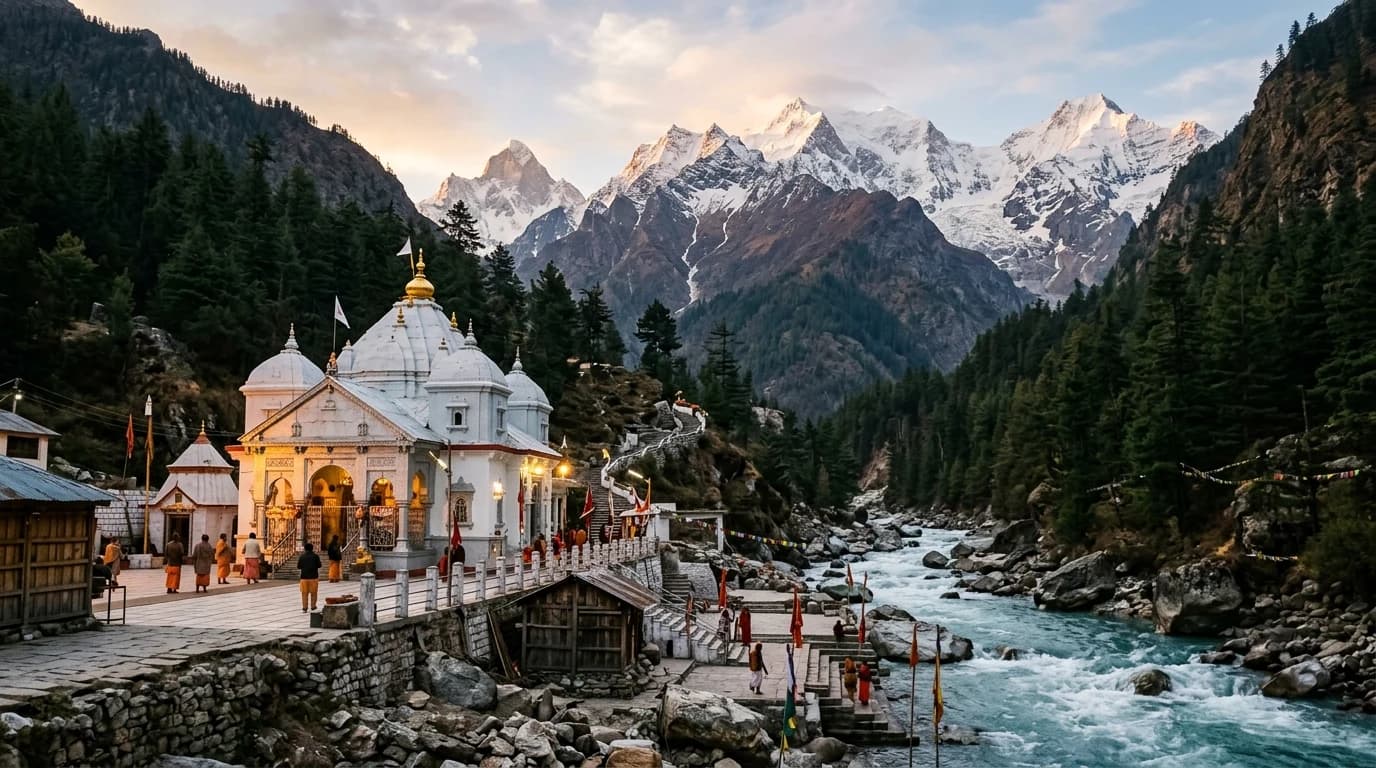
Perched at an altitude of approximately 3,100 metres along the rushing Bhagirathi river in the Greater Himalayas, Gangotri is the revered seat of Goddess Ganga and the second traditional shrine of the Chota Char Dham circuit.
हिमालय की गोद में मां गंगा का पावन धाम
The Himalayan Sanctuary of the Sacred River
Gangotri is located in the Uttarkashi district of Uttarakhand at an elevation of 3,100 metres (10,170 feet) above sea level. The temple sits on the right bank of the roaring Bhagirathi River—the primary source stream of the holy Ganga—framed by dense forests of deodar cedar and towering granite peaks of the Greater Himalayas.
The atmosphere at Gangotri is defined by the thunderous roar of the glacial river rushing over polished grey boulders, the crisp scent of alpine pines, and the pristine mountain sunlight reflecting off the temple's white granite domes.
The shrine marks the point where the celestial river is traditionally worshipped in human accessibility; the physical glacial snout where the river emerges (Gaumukh) lies another 18 kilometres further up the gorge across challenging alpine terrain.
भगीरथ की तपस्या और गंगा का अवतरण
The Penance of Bhagiratha and Shiva's Locks
The origin of Gangotri is deeply embedded in the narrative of King Bhagiratha, recounted in both the Valmiki Ramayana and the Bhagavata Purana.
Bhagiratha's ancestors—the 60,000 sons of King Sagara—had been burned to ashes by the wrathful gaze of Sage Kapila when they falsely accused the meditating hermit of stealing their sacrificial horse. Their souls could not attain liberation (moksha) without the purifying water of the celestial river Ganga, which then flowed only through the heavenly realms.
King Bhagiratha renounced his throne and performed thousands of years of intense austerities on a sacred rock near present-day Gangotri (now preserved as the Bhagirath Shila). Moved by his devotion, Goddess Ganga agreed to descend to earth, but cautioned that the sheer momentum of her torrential fall from heaven would shatter the earth into pieces.
To prevent universal destruction, Lord Shiva stepped forward and caught the cascading torrent within his boundless matted hair (Jata). Taming her pride and wild force, Shiva released the sacred waters gently in several tranquil mountain streams, with the Bhagirathi flowing down to wash over the ashes of the sons of Sagara, liberating their souls.
गोरखा सेनापति अमर सिंह थापा और मंदिर निर्माण
The White Granite Temple and Amar Singh Thapa
Before the early 19th century, pilgrims worshipped the goddess at the open-air Bhagirath Shila and an ancient stone platform.
The present white stone temple was erected in the early 18th century (traditionally dated around 1807 CE) by Amar Singh Thapa, the celebrated Gorkha commander who administered the Garhwal region. Built of local white granite with five elegant dome-like shikharas crowned with gilded brass finials, the design blends traditional Pahari stone-masonry with North Indian temple aesthetics.
The temple underwent careful restoration in the early 20th century under the patronage of the Maharaja of Jaipur. Within the inner sanctum, a small golden idol of Goddess Ganga is flanked by icons of Goddess Yamuna, Goddess Saraswati, Goddess Annapurna, and King Bhagiratha.
गोमुख ग्लेशियर और मुखबा का शीतकालीन प्रवास
The Gaumukh Source and Winter Abode at Mukhba
For pilgrims capable of high-altitude trekking, Gangotri serves as the gateway to Gaumukh ('The Cow's Mouth') and Tapovan. Gaumukh is the dramatic terminus of the 30-kilometre-long Gangotri Glacier, situated at an altitude of 3,890 metres inside Gangotri National Park. Here, the river emerges as a torrent of icy turquoise meltwater from beneath a soaring wall of blue ice.
Like Badrinath and Kedarnath, Gangotri experiences extreme sub-zero temperatures and several feet of snow during the winter. Each year on the day of Diwali (Kartik Amavasya), following special aarti ceremonies, the temple gates are formally sealed for the season.
The sacred silver utsava idol of Mother Ganga is placed in an ornate palanquin (Doli) and carried down the valley in a joyous musical procession by the Semwal Brahmin priests to Mukhba village near Harsil. At Mukhba, the Goddess resides and receives daily devotion throughout the winter until Akshaya Tritiya, when she is triumphantly returned to Gangotri for the opening of the summer yatra.
दर्शन और यात्रा की जानकारी
Trekking beyond Gangotri to Gaumukh requires an advance inner-line forest permit from the Uttarkashi Forest Department, capped at 150 visitors per day.
मंदिर कैसे पहुँचें
The drive through the Bhagirathi river valley passes the renowned apple orchards of Harsil and the picturesque wooden homes of Dharali.
आस-पास के पवित्र स्थल
The ancient sacred stone slab near the temple where King Bhagiratha sat in intense penance to bring Ganga down to earth.
Spectacular rocky gorge waterfalls where the Bhagirathi River cascades through natural cylindrical stone whirlpools.
A natural cave in the pine forest traditionally held to be the resting place of the Pandavas during their journey to Kailash.
The physical snout of the Gangotri Glacier and the geological origin of the Bhagirathi river at 3,890 m altitude.
A legendary high-altitude meadow at 4,460 m directly beneath the iconic pyramidal peak of Mount Shivling; an ancient haven for meditating sadhus.
The tranquil village across the Bhagirathi river near Harsil that serves as the revered winter home of Goddess Ganga.
स्रोत
- Shri 5 Mandir Samiti Gangotri(official)
- Uttarakhand Tourism Development Board (UTDB)(government)
- Bhagavata Purana (Canto 9, Chapter 9)(scripture)
- Valmiki Ramayana (Bala Kanda, Ganga Avataran)(scripture)
- Archaeological Survey of India (ASI), Dehradun Circle(government)
त्वरित लिंक और संबंधित तीर्थ
अन्य प्रमुख पवित्र धाम, ज्योतिर्लिंग एवं तीर्थ यात्राओं का अन्वेषण करें।