Srisailam, Nandyal District, Andhra Pradesh
मल्लिकार्जुन (श्रीशैलम)
Mallikarjuna (Srisailam)
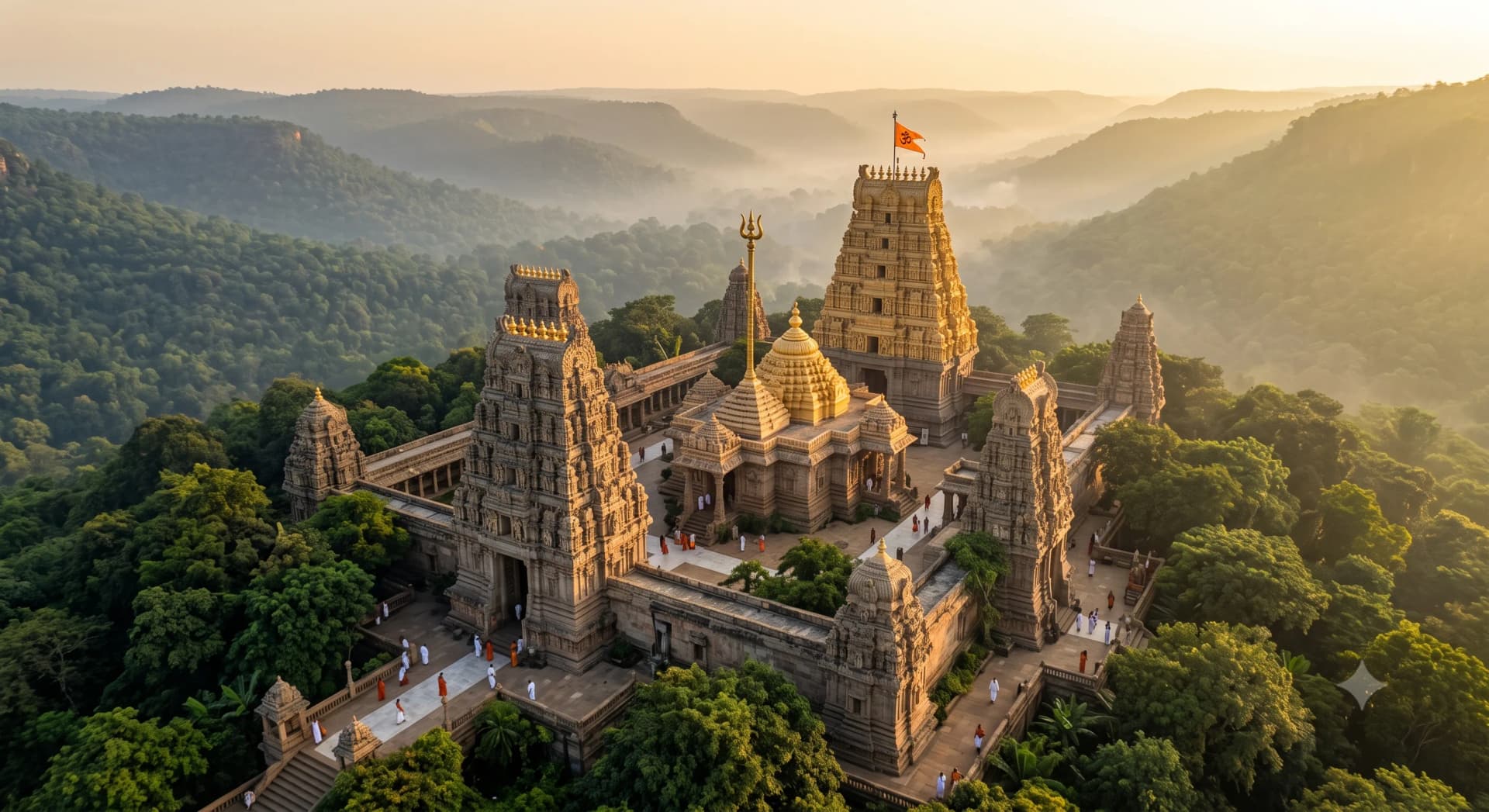
Revered as the second Jyotirlinga and simultaneously one of the eighteen Maha Shakti Peethas, situated atop the Srisailam hill in the Nallamala forest overlooking the sacred Krishna River.
श्रीशैल पर्वत और पाताल गंगा का पावन संगम
The Sacred Mountain Overlooking Patalaganga
Mallikarjuna Temple crowns the flat summit of Rishabhagiri hill (part of the Srisailam mountain range) at an elevation of approximately 457 metres in the Nallamala forest tract of Andhra Pradesh. The sacred Krishna River curves dramatically through a deep rock canyon along the northern base of the mountain, where it is known locally as the Patalaganga.
Srisailam occupies a unique place in Indian sacred geography: it is one of only three places in the entire subcontinent where a Jyotirlinga and a Maha Shakti Peetha reside within the exact same temple precinct (the others being Ujjain and Varanasi).
The shrine is praised extensively across multiple literary traditions: the Mahabharata (Vana Parva) extols Srisailam as a sanctuary that dispels all sins; the Skanda Purana devotes an entire section (Srisaila Khanda) to its praise; and the classical Tamil Shaivite saints (Nayanmars) celebrated its sanctity in the 7th-century Tevaram hymns.
मल्लिका पुष्प और स्कंद का निवास
The Divine Jasmine and the Return of Kartikeya
Scriptural tradition in the Shiva Purana links Srisailam to the divine family of Shiva and Parvati. Following the celestial race between Ganesha and Kartikeya (Skanda) around the universe, Kartikeya felt aggrieved that Ganesha had been married first and departed Kailash to live in solitude on Mount Krauncha (identified with Srisailam).
Heartbroken by their son's departure, Shiva and Parvati followed him to this sacred hill, assuming resident forms here to remain near him. Shiva took the form of the self-manifested lingam, while Parvati dwelt beside Him.
A parallel regional legend recounts that a devout princess named Chandravati discovered her cow daily shedding its milk over an uncarved stone in the forest. In a vision, Shiva revealed Himself, and Chandravati worshipped Him daily with garlands of wild white jasmine flowers (Mallika). Pleased by her devotion, Shiva manifested as Mallika-Arjuna—the Lord crowned with white jasmine blossoms. To this day, wild jasmine offerings remain central to Srisailam's daily puja rituals.
भ्रमराम्बा महाशक्ति पीठ — देवी का दिव्य धाम
The Maha Shakti Peetha of Bhramaramba Devi
Within the inner courtyard, just behind the main Jyotirlinga shrine, stands the celebrated sanctum of Goddess Bhramaramba Devi. In Shakta theology, Srisailam is revered as the Maha Shakti Peetha where the neck (Greeva) of Sati fell following the Daksha Yajna immolation.
The name 'Bhramaramba' means 'Mother of the Black Bees.' Classical legend in the Devi Bhagavata Purana recounts that a powerful demon named Arunasura had obtained a cosmic boon protecting him from death at the hands of any two-legged or four-legged being, any weapon, or any mortal creature. Becoming invincible, he tormented the worlds.
Goddess Parvati manifested an extraordinary cosmic form, sending forth billions of giant black bees (bhramaras) from her hands and body. The stinging swarms overwhelmed and destroyed the demon, liberating the universe. Devotees visiting the rear of the Bhramaramba sanctum traditionally press their ears against a small stone window in the rock wall, listening for the faint, resonant hum said to sound like circling bees.
आदि शंकर की तपस्या और विजयनगर स्थापत्य
Adi Shankara's Shivananda Lahari and Royal Heritage
During the early 9th century CE, Adi Shankaracharya resided at Srisailam for a prolonged period of meditation at Paladhara Panchadhara, a tranquil natural spring near the temple. While seated here overlooking the Krishna canyon, he composed the renowned devotional masterpiece, the 'Shivananda Lahari' (Waves of Auspicious Bliss), in praise of Mallikarjuna.
The physical architecture of Srisailam reflects centuries of royal devotion. The temple complex is fortified by high rectangular stone ramparts measuring 600 by 500 feet, known as the Prakara Wall, adorned with thousands of individual stone relief sculptures depicting scenes from the Ramayana, Mahabharata, and Puranas.
Major dynasties contributed to its grandeur: the Kakatiya queen Rudrama Devi patronized the shrine in the 13th century; the Vijayanagara emperor Sri Krishnadevaraya personally visited in 1516 CE after his victory over the Gajapatis, constructing the monumental Mukhamandapa and the eastern rajagopuram; and the Maratha king Chhatrapati Shivaji Maharaj visited in 1677 CE, building the northern gopuram and installing an endowment for the feeding of pilgrims.
दर्शन और यात्रा की जानकारी
Pilgrims can descend to the Patalaganga riverbank by walking down 852 ancient stone steps or by using the modern ropeway (cable car) system operated by APTDC.
मंदिर कैसे पहुँचें
Night driving through the core forest gates of the Srisailam-Nallamala reserve is regulated to safeguard wildlife.
आस-पास के पवित्र स्थल
Mallikarjuna is the second sacred Jyotirlinga in the pan-Indian 12 Jyotirlinga circuit.
One of the 18 Maha Shakti Peethas; home of the Mother who manifested as bees to liberate the worlds.
The sacred Krishna river ghat where pilgrims take a ritual bath before darshan; accessible by 852 steps or ropeway.
An ancient shrine where Lord Ganesha is traditionally believed to keep a written record (sakshi) of every pilgrim visiting Srisailam.
A peaceful forest gorge with perpetual natural springs where Adi Shankaracharya performed penance and composed the Shivananda Lahari.
The highest mountain peak of Srisailam (2,835 ft); tradition holds that viewing the Mallikarjuna temple shikhara from here frees the soul from rebirth.
Historic natural limestone caves along the Krishna river where the 12th-century Veerashaiva mystic poetess Akka Mahadevi performed deep meditation.
स्रोत
- Sri Bhramaramba Mallikarjuna Swamy Devasthanam(official)
- Andhra Pradesh Tourism Development Corporation (APTDC)(government)
- Skanda Purana, Srisaila Khanda(scripture)
- Archaeological Survey of India (ASI), Hyderabad Circle(government)
- Epigraphia Indica, Vol. XXXVI (Inscriptions of Srisailam)(historical)
त्वरित लिंक और संबंधित तीर्थ
अन्य प्रमुख पवित्र धाम, ज्योतिर्लिंग एवं तीर्थ यात्राओं का अन्वेषण करें।