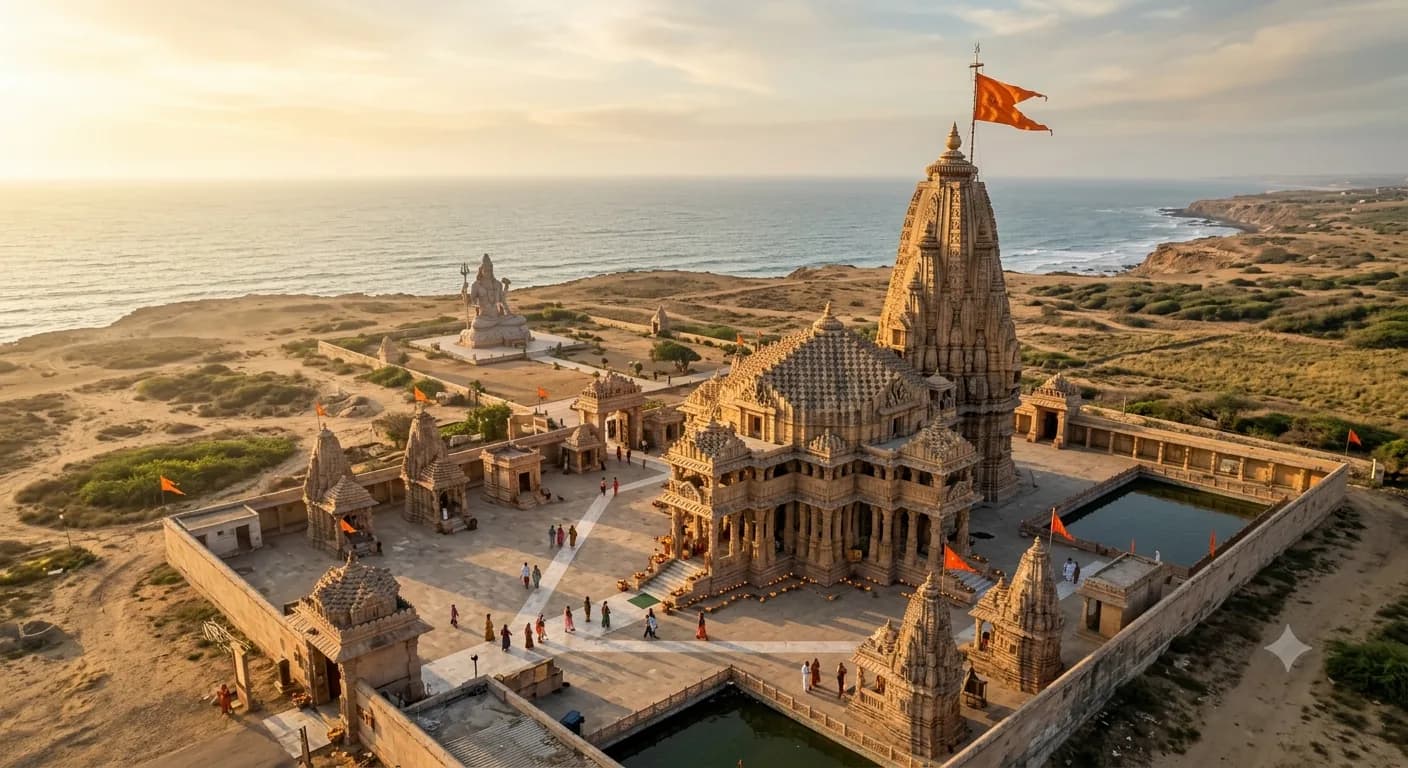
Near Dwarka, Devbhumi Dwarka District, Gujarat (with Aundha Nagnath, Maharashtra tradition)
नागेश्वर ज्योतिर्लिंग मंदिर (दारुकावन)
Nageshwar Jyotirlinga Temple
द्वादश ज्योतिर्लिंगों में दसवां पावन धाम, जो पौराणिक दारुकावन क्षेत्र (द्वारका के समीप) में स्थित है। यहां भगवान शिव ने अपने अनन्य भक्त सुप्रिय की रक्षा हेतु असुर दारुक का संहार किया था। मंदिर परिसर में भगवान शिव की 85 फुट ऊंची भव्य ध्यानस्थ प्रतिमा स्थित है।
दारुकावन में स्थित पावन ज्योतिर्लिंग
The Sanctum of the Lord of Serpents
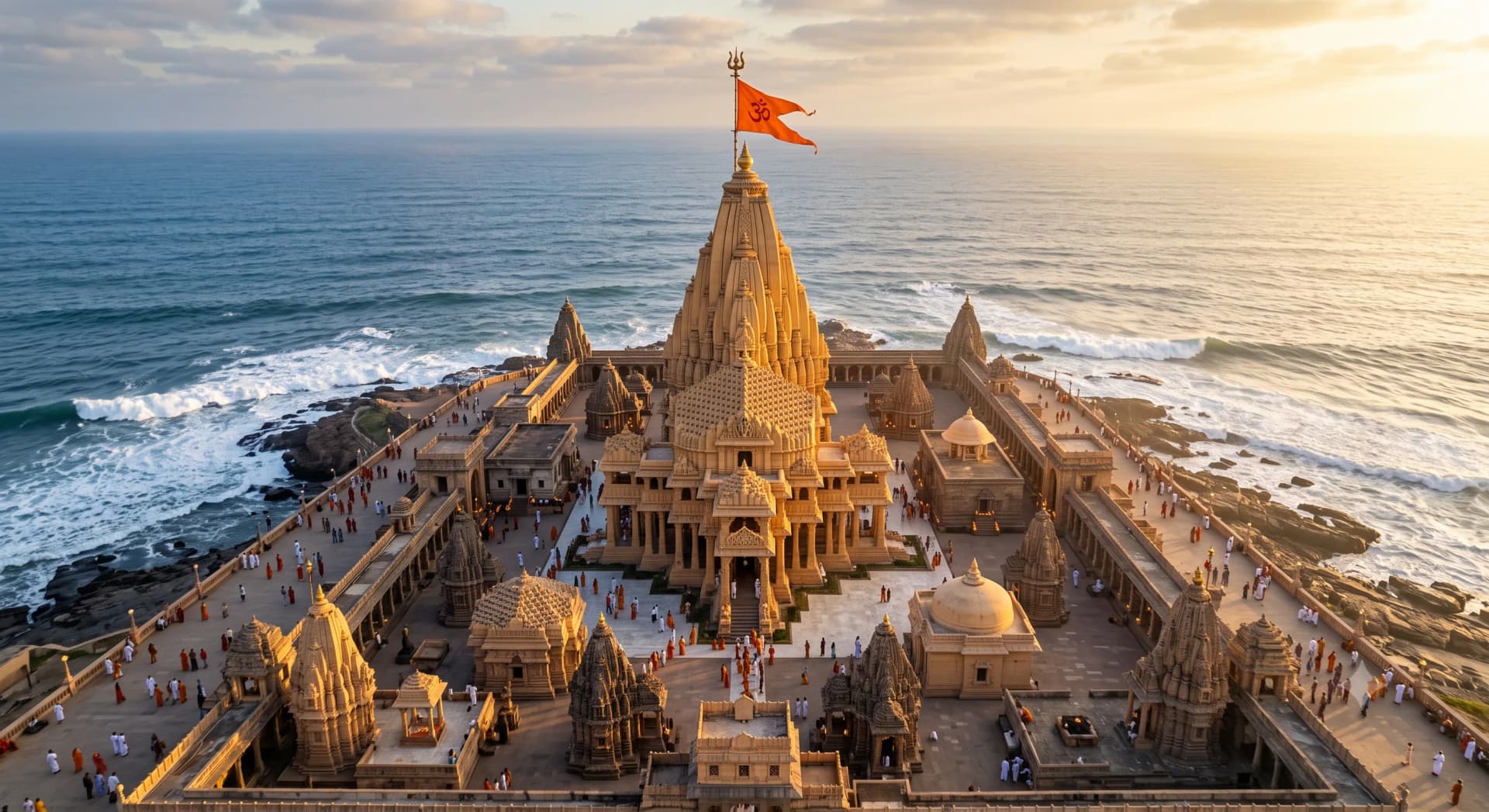
Nageshwar Jyotirlinga Temple is situated approximately 17 kilometres northeast of the ancient pilgrimage city of Dwarka in the Devbhumi Dwarka district of Gujarat, on the coast of Saurashtra. The geographical sanctuary is traditionally identified with the mythological forest of **Darukavana** ('the forest of deodar / daru trees') mentioned in classical Puranic literature.
Approaching the temple, the skyline is commanded by a monumental, 85-foot (26-metre) tall seated murti of Lord Shiva in deep meditative posture, beautifully painted in copper-bronze tones and surrounded by serene open gardens.
The inner sanctum (Garbhagriha) is built below the ground level, requiring pilgrims to descend a short flight of stone steps. Inside sits the Swayambhu (self-manifested) Jyotirlinga, fashioned from a smooth, tripartite rounded stone known as the **Dwaraka Shila**, embedded with small natural chank-like impressions. The lingam is unique for facing the South (*Dakshinabhimukha*), while the drainage spout (Gomukhi) flows toward the East. In Tantric and Vedic traditions, a south-facing deity is considered exceptionally potent, symbolizing mastery over death (Yama) and total protection for surrendered seekers.
असुर दारुक, अनन्य भक्त सुप्रिय और पाशुपतास्त्र का प्राकट्य
The Puranic Legend: Demon Daruka and the Devotee Supriya
The narrative of Nageshwar's manifestation is preserved across chapters 29 and 30 of the Koti Rudra Samhita of the Shiva Purana.
According to scripture, the coastal forest of Darukavana was ruled by a fearsome demon named Daruka and his consort, Daruki. Daruki had propitiated Goddess Parvati and obtained a cosmic boon enabling her to transport the entire forest wherever she pleased. Using this celestial power, the demon couple terrorized the surrounding coastal settlements and the sages living in hermitage.
One day, the demons intercepted a merchant fleet carrying a saintly merchant named **Supriya**, a householder renowned for his unstinting devotion to Lord Shiva. Daruka cast Supriya and his crew into a deep subterranean prison. Undeterred by shackles and darkness, Supriya continued his daily meditation, fashioning a clay Shiva lingam and teaching his fellow prisoners to recite the five-syllable Panchakshari mantra: > *"Om Namah Shivaya"*
The reverberation of the holy name transformed the prison into an ashram. When informers reported that the captives were chanting prayers of liberation, Daruka rushed into the dungeon with a drawn scimitar, threatening to execute Supriya on the spot.
Closing his eyes, Supriya surrendered his life entirely to Mahadeva. Instantly, the subterranean rock cracked open with the roar of thunder. Lord Shiva manifested in a blazing pillar of cosmic radiance seated upon a resplendent throne, armed with the invincible **Pashupatastra**. With a single glance, Shiva vanquished Daruka and the demonic host, instantly freeing all captives.
At the prayer of Supriya and the rishis, Shiva established Himself in the fractured rock as the **Nageshwar Jyotirlinga** ('Lord of Serpents'). As serpents represent venom, attachment, and the cyclical coils of time, Shiva's supremacy as Nageshwar signifies the ultimate transcendence of worldly poison and fear.
दारुकावन की दो प्रमुख मान्यताएं — द्वारका एवं औंढा नागनाथ
Scriptural Traditions: Dwarka and Aundha Nagnath
The geographical identification of the scriptural 'Darukavana' has inspired two authentic, deeply respected traditions in Indian pilgrimage history:
1. **Nageshwar near Dwarka (Gujarat)**: - Celebrated throughout northern and western India and integrated into the primary Saurashtra pilgrimage circuit alongside **Dwarkadhish Jagat Mandir**, **Bet Dwarka**, and **Somnath**. - Traditional folklore identifies this coastal region with Darukavana, supported by ancient marine records and the widespread reverence of the Kathiawar peninsula. - Preserves the celebrated subterranean sanctum with south-facing lingam.
2. **Aundha Nagnath (Hingoli District, Maharashtra)**: - Deeply revered across Maharashtra, Telangana, and Karnataka as an ancient candidate for the eighth/tenth Jyotirlinga. - Distinguished by magnificent 13th-century Seuna (Yadava) dynasty **Hemadpanthi stone architecture** constructed entirely without mortar from interlocking dark basalt blocks. - Closely associated with the 13th-century Varkari saint-poet **Sant Namdev**: according to Marathi hagiography (*Bhaktavijaya*), when upper-caste priests forbade Namdev from singing bhajans in front of the sanctum, Namdev sat singing behind the temple; miraculously, the entire stone temple is said to have rotated to face the humble saint. - Its Garbhagriha lies nearly 20 feet deep underground in a natural rock cellar.
Scholars and traditional acharyas affirm that both sites embody the authentic sanctity of Naganath. Many devout pilgrims visiting the western subcontinent ensure their yatra includes both Gujarat's Nageshwar and Maharashtra's Aundha Nagnath.
दर्शन विधान, अभिषेक और दैनिक पूजा
Rituals and Pilgrim Experience
Nageshwar is renowned for its welcoming and accessible spiritual atmosphere. Unlike many high-volume urban shrines, devotees visiting Nageshwar during regular hours are permitted to approach the sanctum for personal Rudrabhisheka: - **Dudh & Jalabhisheka**: Pilgrims may offer sacred cow's milk and holy water directly over the lingam while priests chant the Rudra Suktam and Maha Mrityunjaya Mantra. - **Sparsha Darshan**: Devotees wearing traditional unstitched attire (dhotis for men) can touch the sacred lingam and offer bilateral bilva leaves. - **Bhasma & Bilva Archana**: Offering three-leaved bilva patra smeared with holy vibhuti (sacred ash) is believed to dissolve generational doshas (especially *Kalsarpa Dosha* and afflictions related to Rahu and Ketu).
Because Nageshwar is situated just 25 minutes from the sacred city of Dwarka, most pilgrims integrate both shrines on the same day—worshipping Lord Krishna (Dwarkadhish) in the morning and Lord Shiva (Nageshwar) in the afternoon.
दर्शन और यात्रा की जानकारी
Photography is strictly prohibited inside the inner sanctum, though allowed in the outer garden complex featuring the giant Shiva statue.
मंदिर कैसे पहुँचें
Pilgrims usually take a circular day-tour from Dwarka covering Nageshwar Jyotirlinga, Gopi Talav, Bet Dwarka (via the new Sudarshan Setu cable bridge), and Rukmini Devi Temple.
आस-पास के पवित्र स्थल
The premier western Char Dham and supreme temple dedicated to Lord Krishna, the King of Dwarka.
Nageshwar is the tenth sacred Jyotirlinga in the traditional pan-Indian circuit of 12 luminous Shiva shrines.
The revered 13th-century Hemadpanthi seat of Nagnath in Hingoli, Maharashtra, celebrated in the Sant Namdev tradition.
The sacred island kingdom of Krishna, now connected by India's longest cable-stayed bridge (Sudarshan Setu).
The sacred lake where Krishna is said to have sported with the Gopis; source of the yellow-colored sacred Gopi Chandan paste.
Ancient 12th-century carved stone shrine dedicated to Krishna's chief queen Rukmini.
स्रोत
- Shree Dwarka-Nageshwar Temple Trust(official)
- Gujarat Tourism (TCGL), Government of Gujarat(government)
- Archaeological Survey of India (ASI), Vadodara Circle(government)
- Shiva Purana, Koti Rudra Samhita (Chapters 29–30)(scripture)
- Gazetteer of the Bombay Presidency: Kathiawar (1884)(historical)
त्वरित लिंक और संबंधित तीर्थ
अन्य प्रमुख पवित्र धाम, ज्योतिर्लिंग एवं तीर्थ यात्राओं का अन्वेषण करें।