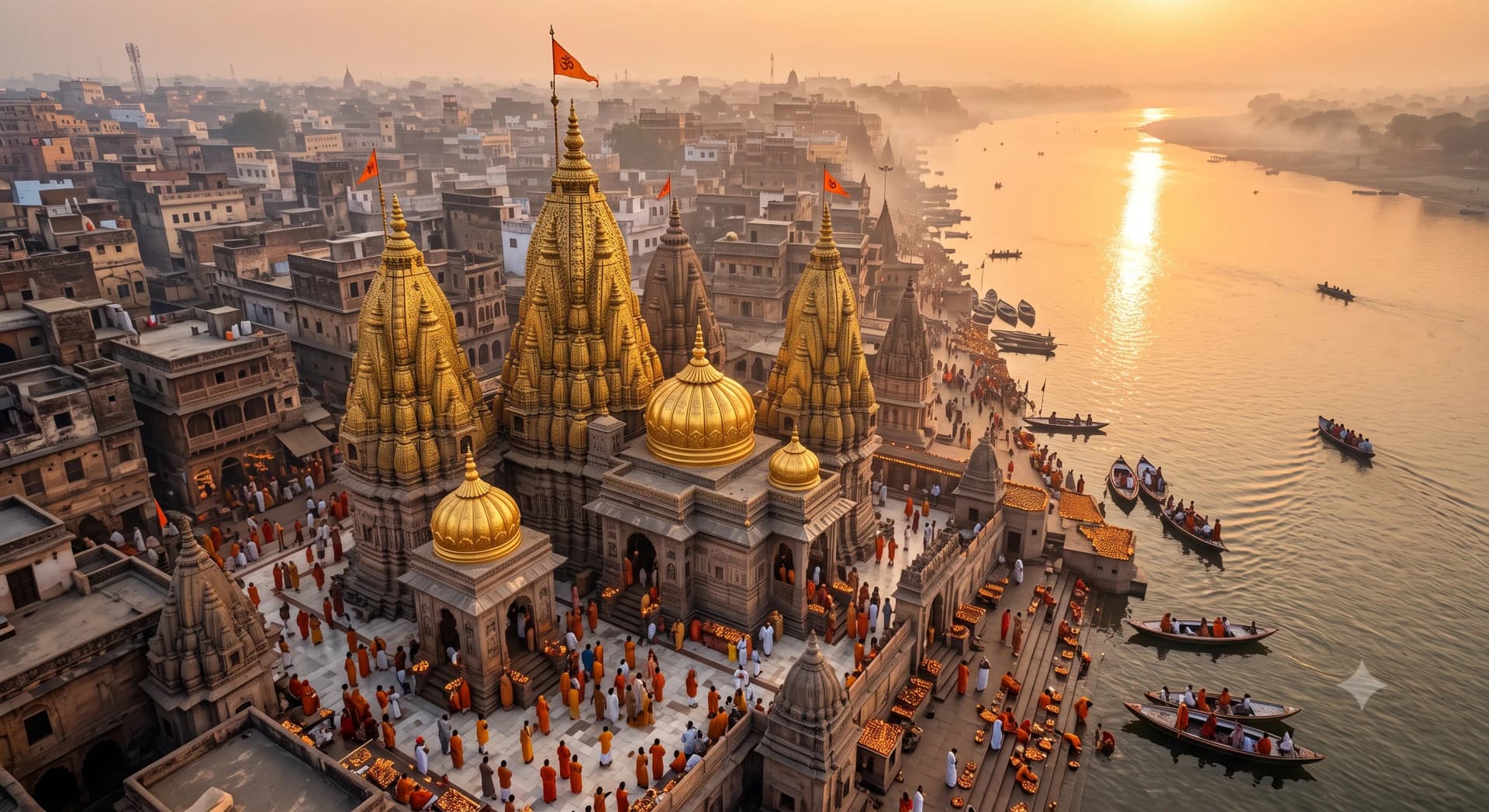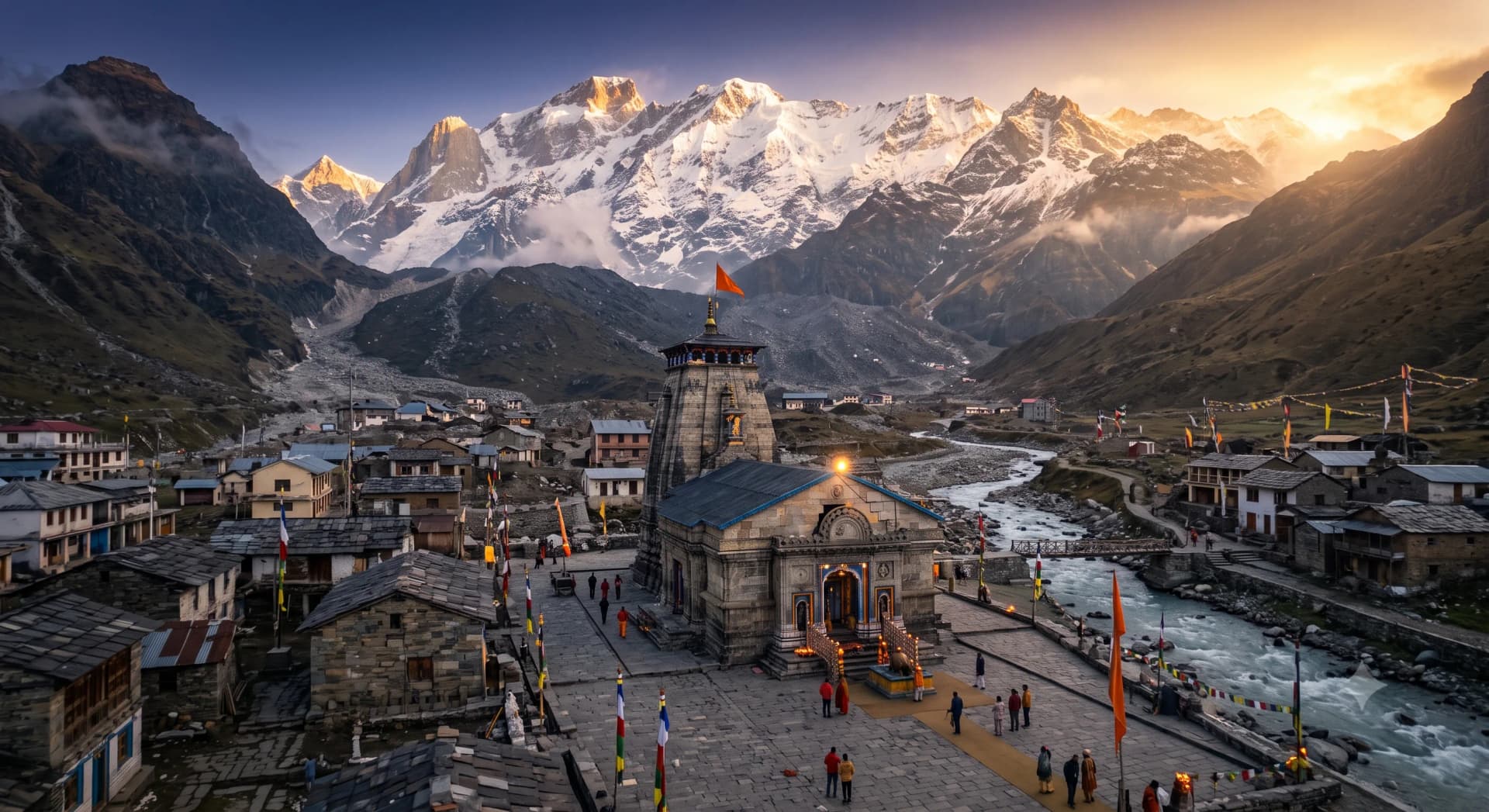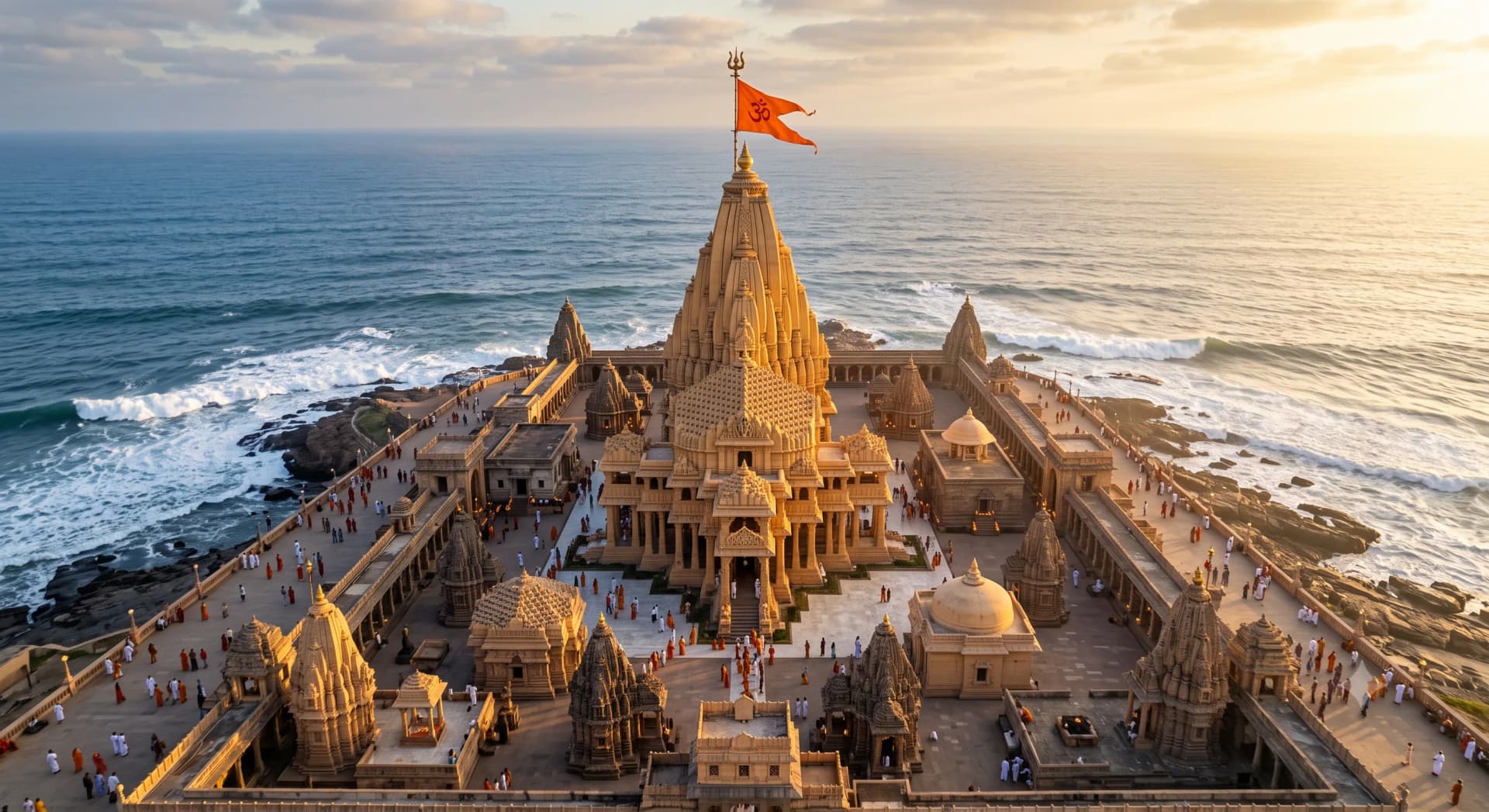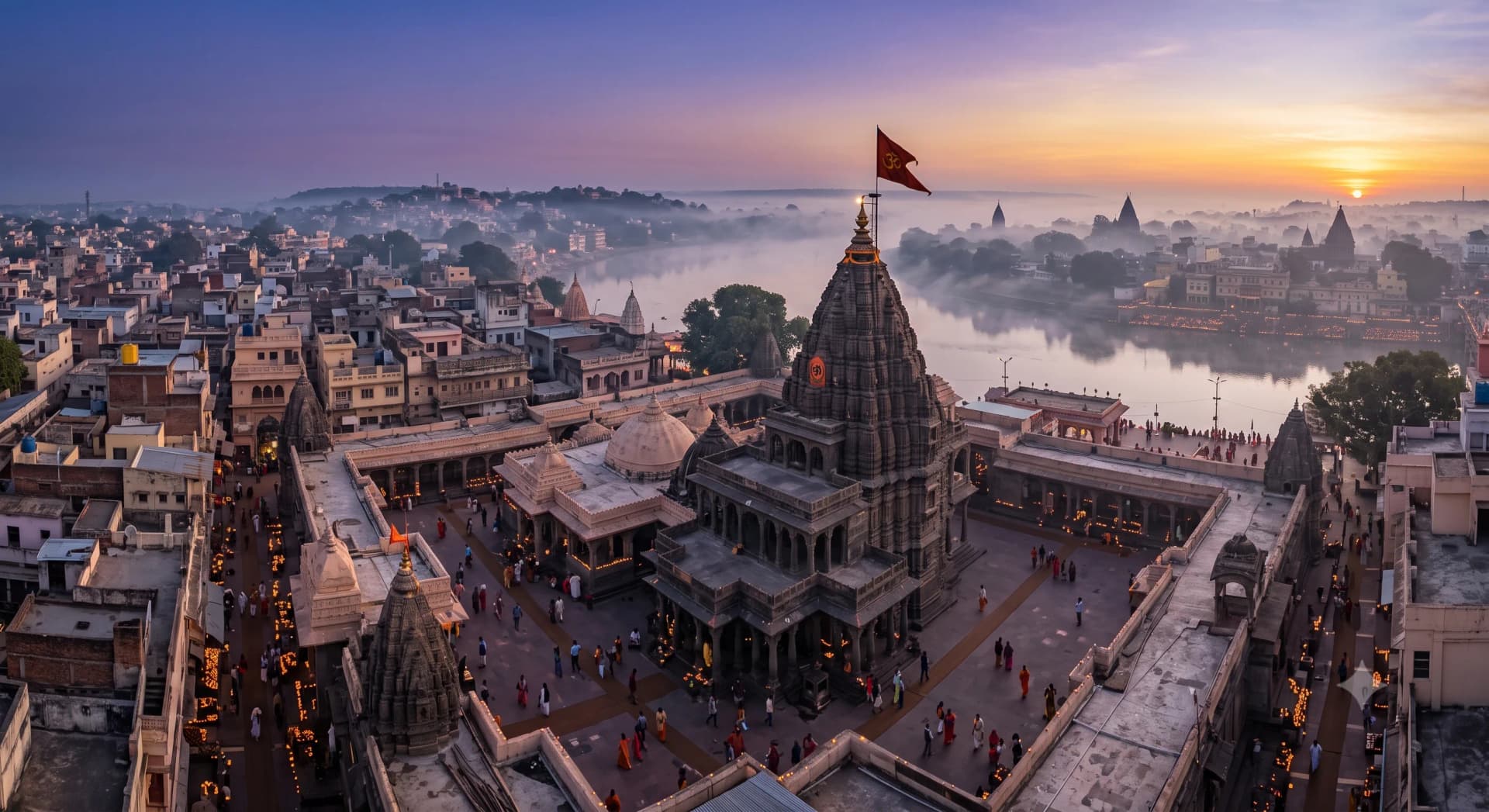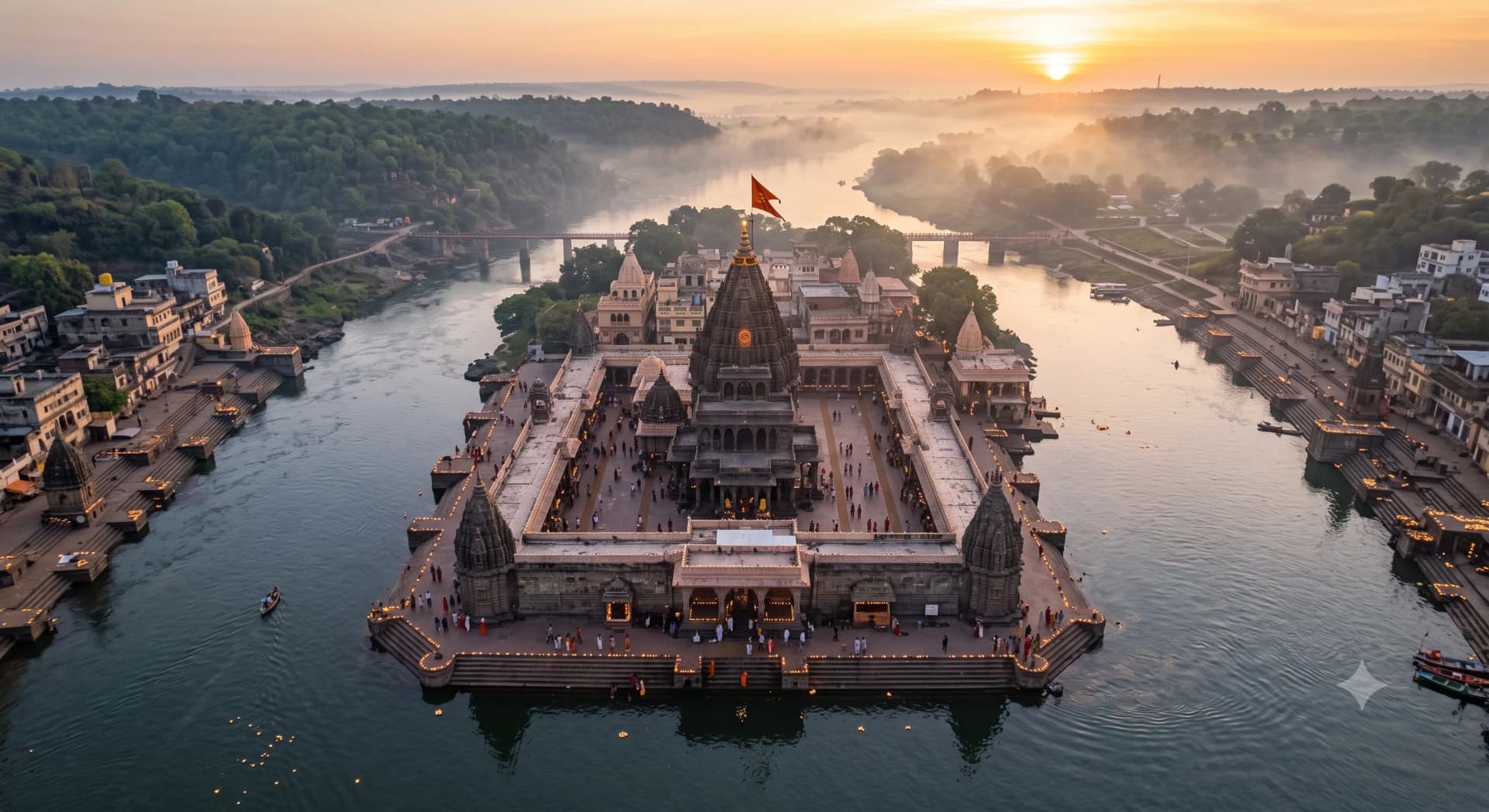
Revered as the fourth Jyotirlinga, situated on the sacred Mandhata island in the holy Narmada river, where the island's natural topography and intersecting river channels form the shape of the sacred Devanagari syllable 'ॐ'.
प्रणव रूप मांधाता द्वीप और नर्मदा तट
The Island Shaped as the Cosmic Syllable
Omkareshwar is situated approximately 80 kilometres south of Indore in the Khandwa district of Madhya Pradesh. The temple rests on Mandhata Island (also known as Shivpuri), an island approximately 2.6 kilometres long and 1.5 kilometres wide formed by the Narmada River and an offshoot stream traditionally designated as the Kaveri.
When viewed from the surrounding sandstone cliffs or aerial perspectives, the island's perimeter and the curving waterway trace a natural contour that closely resembles the sacred Devanagari character 'ॐ' (Om or Pranava). For this reason, the hill is revered as the living embodiment of the primal sound, and the presiding manifestation of Shiva is celebrated as Omkareshwar—'The Lord of the Om Sound.'
The Narmada River itself holds a unique status in Hindu hydrology: unlike other rivers where bathing alone confers purification, traditional texts record that the mere sight (darshana) of the Narmada is spiritually purifying ('Narmada darshanat punyam').
मांधाता की तपस्या और ओंकार-ममलेश्वर युग्म
King Mandhata's Tapasya and the Twin Shrines
The narrative of Omkareshwar is recounted in the Shiva Purana (Koti Rudra Samhita) and the Skanda Purana. According to scriptural tradition, King Mandhata of the solar (Ikshvaku) dynasty—an ancestor of Sri Rama—performed severe austerities on this mountain. Pleased by his devotion, Shiva manifested Himself on the island.
At the behest of the gods and sages who sought His continuous presence in both transcendent and earthly spheres, Shiva divided Himself into two co-equal lingams: 1. **Omkareshwar** (the Pranava form), presiding on the northern island of Mandhata. 2. **Mamleshwar** (also known as Amareshwar, 'Lord of the Immortals'), situated on the southern mainland bank opposite the island.
Traditional pilgrimage practice holds that the Jyotirlinga darshan is complete only when a devotee visits both shrines—crossing the river to worship at both Omkareshwar and Mamleshwar. The Mamleshwar complex preserves an extraordinarily ancient collection of carved stone mandapas and inscriptions, including 11th-century hymns to Shiva composed by the Paramara rulers.
आदि शंकराचार्य की गुफा और अद्वैत दीक्षा
The Sacred Cave of Adi Shankaracharya
Omkareshwar holds historic significance in the history of Indian philosophy as the sacred site where Adi Shankaracharya met his preceptor, Govinda Bhagavatpada.
Having journeyed on foot from Kalady in Kerala in search of an enlightened teacher, the young Shankara discovered his Guru in a natural rock-cut cave along the Narmada riverbank below the Omkareshwar temple hill. Classical biographies recount that when Govinda Bhagavatpada asked from within the cave, 'Who are you?', Shankara uttered the celebrated verses of the Nirvana Shatakam ('Mano buddhi ahankara chittani naaham...'), declaring his identity not as a mortal individual, but as the changeless Atman.
Govinda Bhagavatpada initiated Shankara into the four Mahavakyas and directed him to Varanasi and Badrikashrama to compose commentaries (bhashyas) on the Brahma Sutras, Upanishads, and Bhagavad Gita. The cave has been preserved for centuries as a site of quiet contemplation.
मांधाता परिक्रमा और नर्मदा आरती
The Mandhata Parikrama and Island Shrines
A core practice of the Omkareshwar pilgrimage is the 7-kilometre circumambulation (Parikrama) around the perimeter of Mandhata Island. The walking path winds through rocky terrain, past the ancient Gauri Somnath temple—featuring an imposing six-foot-tall lingam of smooth black stone—and the 13th-century Siddhanath temple, renowned for its finely sculpted elephant friezes on the high plateau.
At the easternmost point of the island lies the Sangam, where the waters of the Kaveri and Narmada re-converge. Pilgrims frequently gather along the stone ghats—notably Koti Tirtha and Nagar Ghat—at twilight, when the river reflects the glowing lamps of the evening Narmada Aarti, accompanied by the sonorous ringing of brass bells across the gorge.
दर्शन और यात्रा की जानकारी
The island is connected to the mainland via two pedestrian suspension bridges (Jhula Pul) as well as continuous ferry boat services operating across the river.
मंदिर कैसे पहुँचें
Pilgrims combining Ujjain and Omkareshwar can complete the two Jyotirlingas over a weekend journey via Indore.
आस-पास के पवित्र स्थल
Omkareshwar & Mamleshwar form the fourth sacred Jyotirlinga on the Om-shaped island in the holy Narmada.
The co-equal southern Jyotirlinga on the mainland; essential companion shrine to Omkareshwar.
The historic rock cave on the riverbank where Shankara met his Guru Govinda Bhagavatpada and received Advaita sannyasa.
A unique three-story temple atop the island housing a massive six-foot-tall black stone Shiva lingam.
A 13th-century architectural monument situated on a high plateau of Mandhata island with intricate stone-carved elephant friezes.
The confluence at the eastern tip of Mandhata island where the two arms of the sacred river rejoin.
The sister Jyotirlinga of Malwa, traditionally visited in sequence with Omkareshwar.
स्रोत
- Shri Omkareshwar Temple Management Trust(official)
- Madhya Pradesh Tourism Board (MPTB)(government)
- Shiva Purana, Koti Rudra Samhita (Chapter 18)(scripture)
- Skanda Purana, Reva Khanda(scripture)
- Archaeological Survey of India (ASI), Bhopal Circle(government)
त्वरित लिंक और संबंधित तीर्थ
अन्य प्रमुख पवित्र धाम, ज्योतिर्लिंग एवं तीर्थ यात्राओं का अन्वेषण करें।