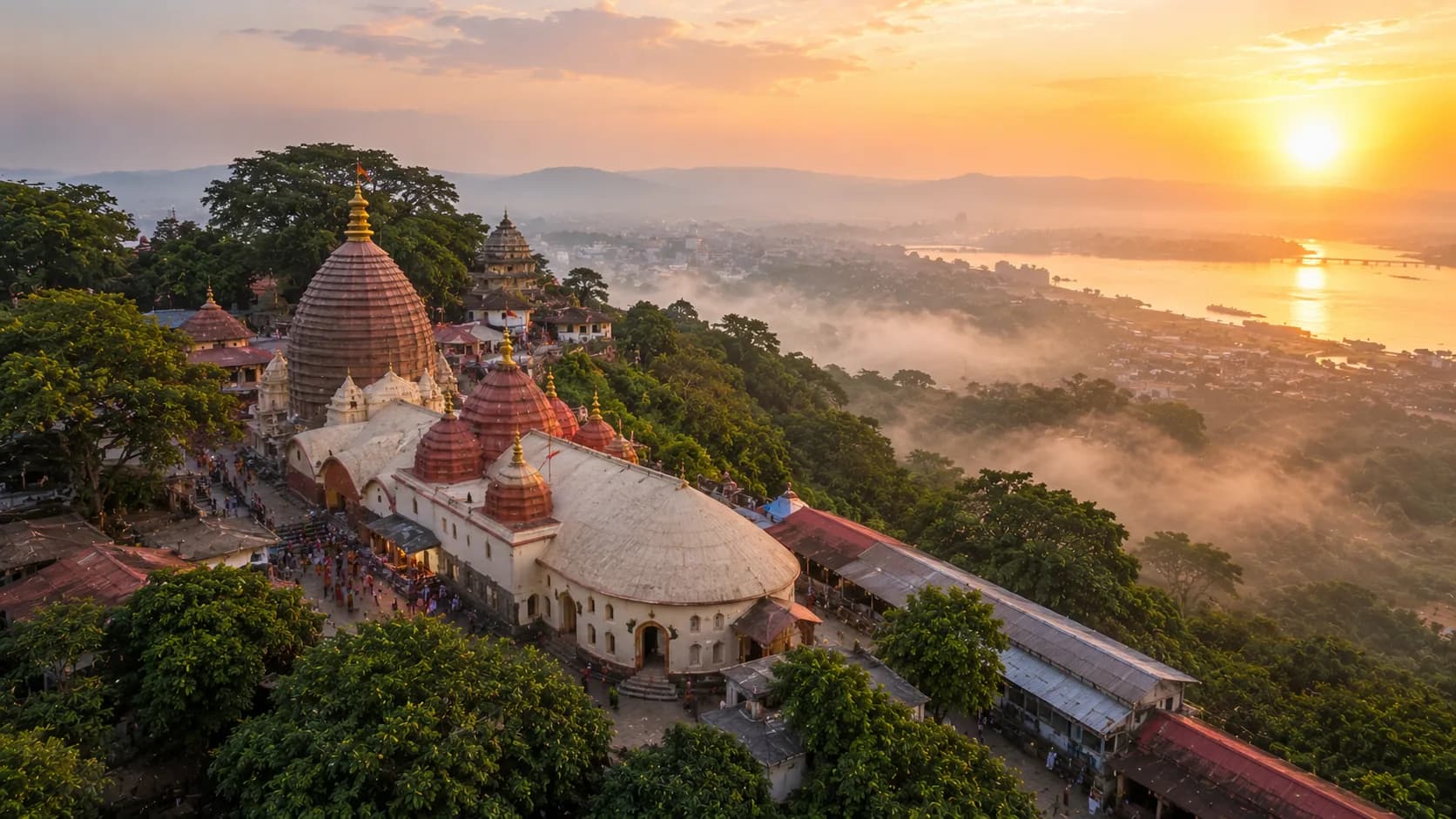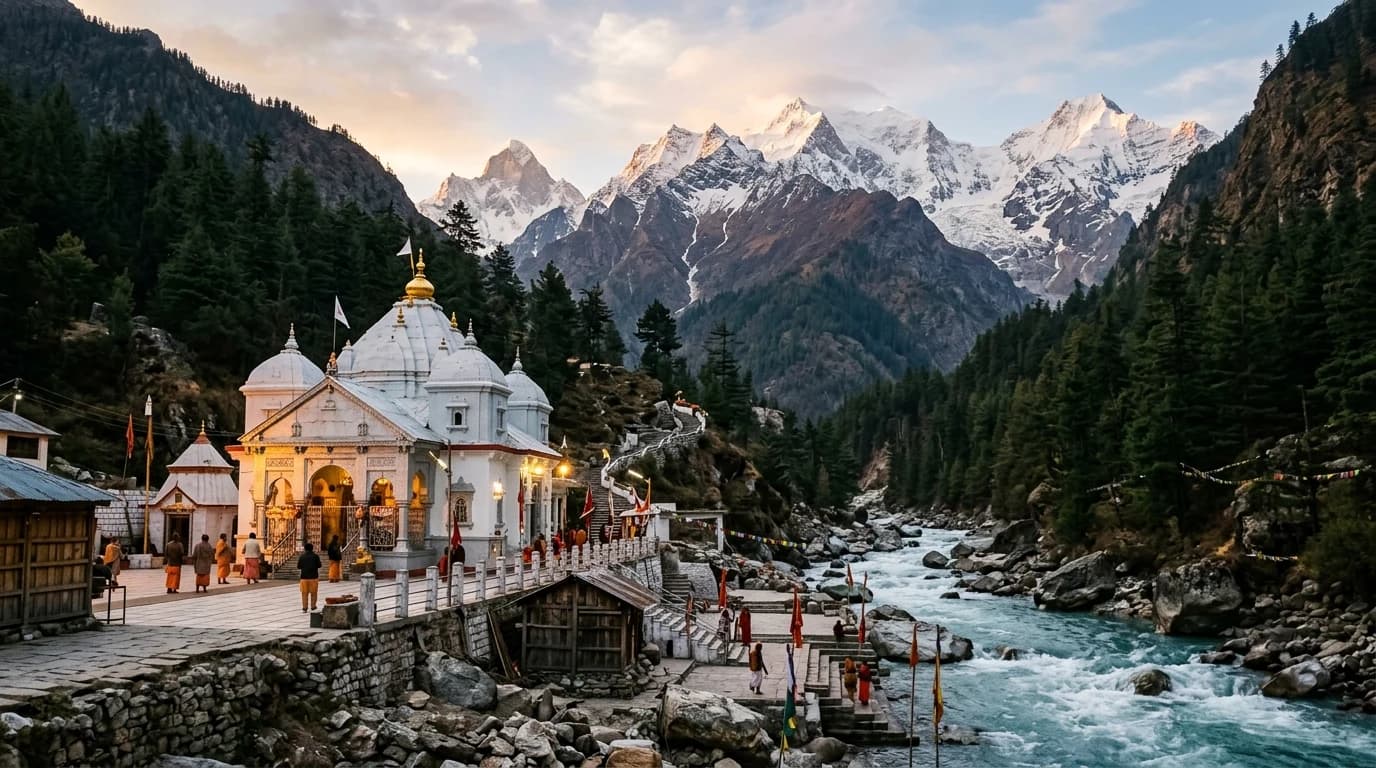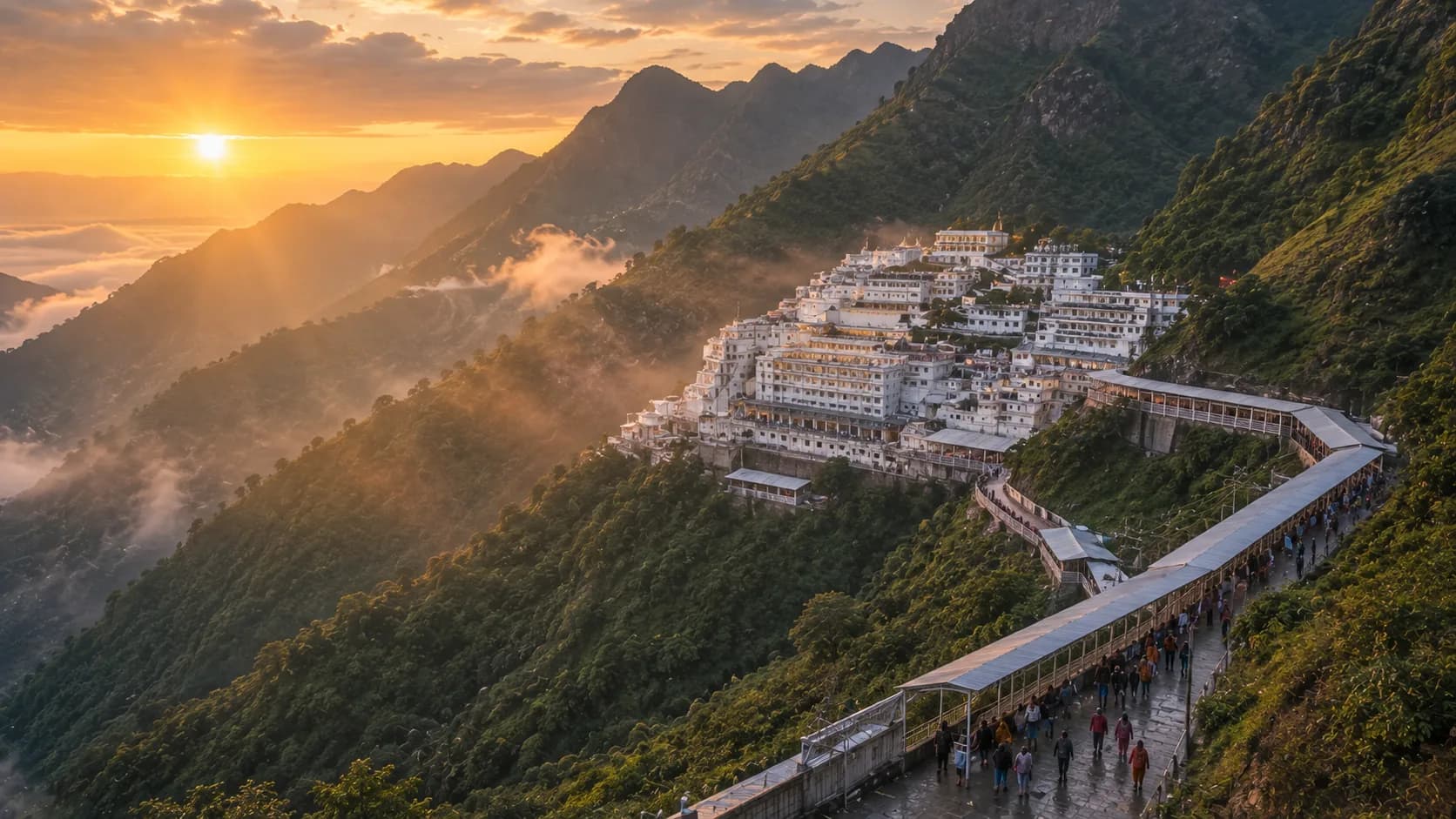
A cave shrine at 5,200 feet in the Trikuta Hills, where the goddess is worshipped not as an idol but as three natural rock formations (pindis). One of India's most visited pilgrimages — approximately 8–10 million pilgrims annually — the yatra has the quality of a mountain journey as much as a temple visit.
The Trikuta Hills
The shrine of Vaishno Devi is set in the Trikuta mountain range in the Reasi district of Jammu and Kashmir, at an altitude of approximately 5,200 feet (1,585 m) above sea level. The town of Katra (2,700 feet) is the base camp and the point of registration for the yatra.
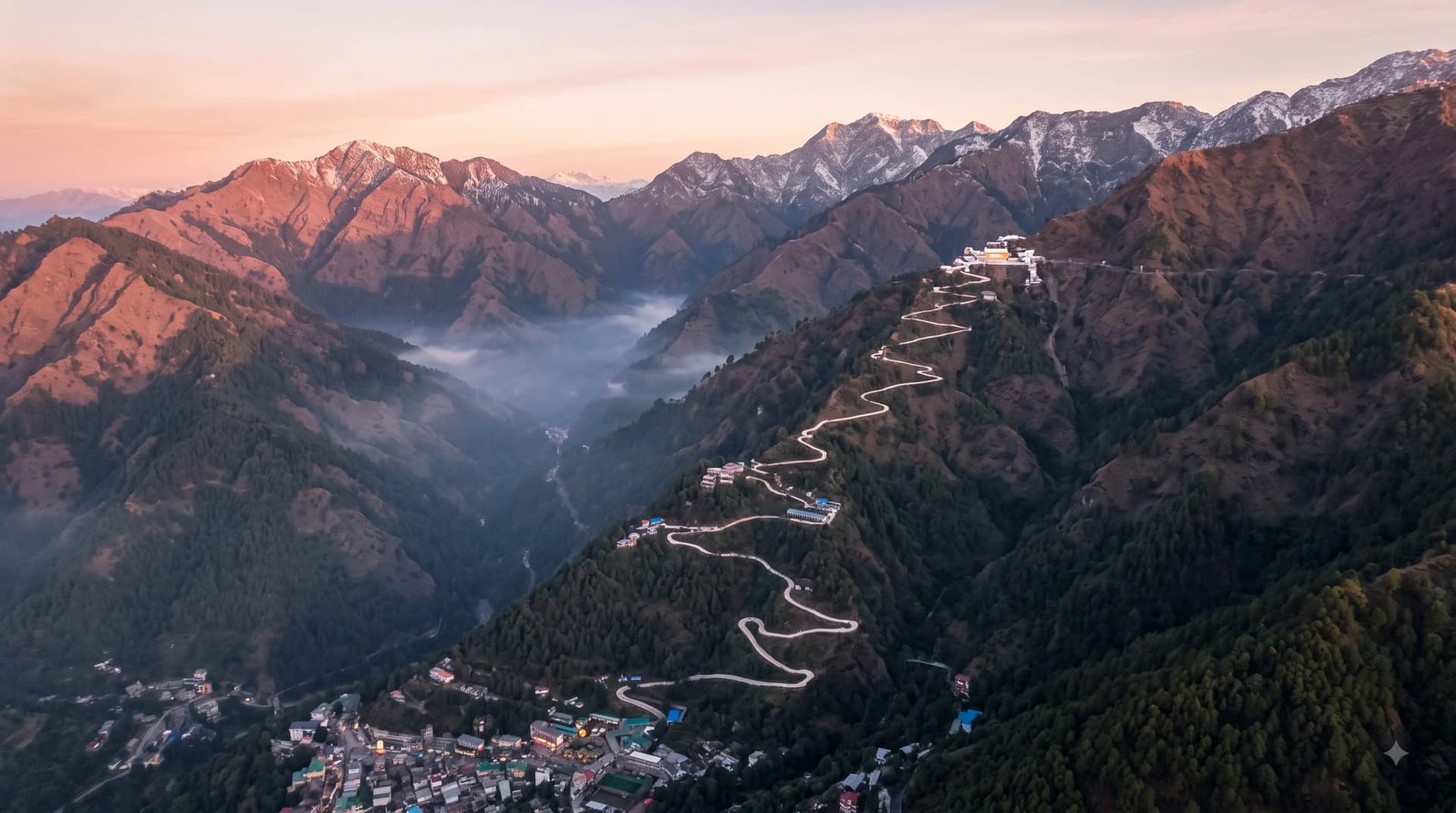
The traditional yatra route (now managed by the Shri Mata Vaishno Devi Shrine Board) runs approximately 14 km one way from Katra to the Bhawan (the main shrine complex). The path ascends through mountain terrain, passing through Banganga, the Ardhkuwari cave (a significant halt point), Sanjichhat, and finally the Bhawan. A newer route via Tarakote (7.5 km from Katra to Bhawan via Sanjichhat) is also available. Helicopter services connect Katra to Sanjichhat.
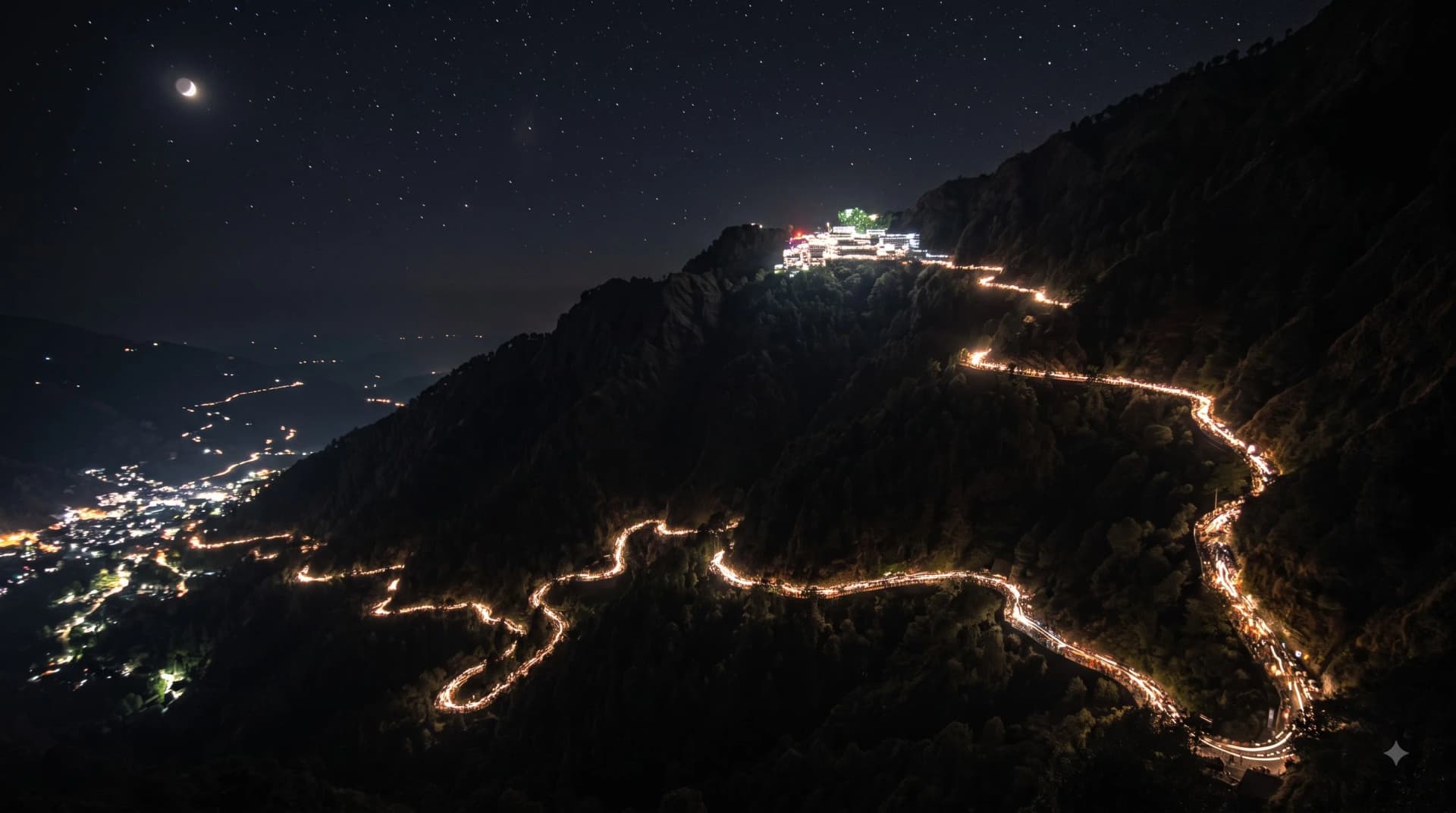
The path is busy at all hours — the yatra runs twenty-four hours a day, every day of the year. In peak seasons (Navratri in October, Navratri in April, the summer months) the path is alive with pilgrims at midnight as readily as at noon.
The Three Pindis
The presiding deity of Vaishno Devi is not represented by a sculpted idol. Within the ancient cave at the Bhawan (the Bhawan is the name for the main shrine complex, though the actual cave is a few hundred metres further), the goddess manifests as three natural rock formations called Pindis — self-existing forms without human craftsmanship.
The three Pindis represent the three primary aspects of the goddess: Mahakali (the fierce, transformative aspect), Mahalakshmi (the aspect of abundance and beauty), and Mahasaraswati (the aspect of wisdom and learning). These three are also sometimes interpreted as Brahma (Saraswati), Vishnu (Lakshmi), and Shiva (Kali) — making Vaishno Devi a site where the goddess herself encompasses the entire Trinity.
The name Vaishno (or Vaishnavi) connects the deity to the Vaishnava tradition — she is described in local tradition as a devotee of Vishnu who achieved such power that she is now worshipped as the goddess herself.
The Legend
The local tradition of Vaishno Devi preserves a narrative about the origin of the shrine.
The goddess, then known as Vaishnavi, was a young woman of great power and devotion who had been blessed by Vishnu with both martial abilities and spiritual gifts. A saint named Bhairavnath developed an obsession with her — some accounts say he wished to marry her, others that he wished to absorb her power. She fled into the mountains, pursued by him.
Taking refuge in the Trikuta Hills, she eventually confronted Bhairavnath at the mouth of the cave where she now resides. She beheaded him. His severed head flew to a hilltop some distance away. Bhairavnath, in the moment of his death, attained liberation through her grace — and is worshipped to this day at a temple on that hilltop called Bhairavnath Temple.
In the Vaishno Devi pilgrimage tradition, darshan at Bhairavnath Temple after the main shrine is considered essential for the yatra to be complete — one must honour the defeated pursuer who ultimately attained liberation through the goddess's grace.
The Yatra
The Vaishno Devi yatra is as much about the mountain journey as about the destination. Pilgrims typically walk the 14 km path through the night to reach the Bhawan by morning, then join the queue for the cave darshan. Waiting times for the cave vary from two hours to over twelve depending on the season.
The yatra sequence most pilgrims follow: Katra → Banganga (where pilgrims traditionally stop to bathe) → Ardhkuwari (the 'half-way cave,' where the goddess is said to have rested and meditated for nine months — it requires crawling through a narrow passage, and an alternative route around it exists) → Sanjichhat → Bhawan → Cave darshan → Bhairavnath Temple.
The Shrine Board manages accommodation at several points along the route and at Katra. Helicopter service (Katra to Sanjichhat) significantly reduces the walk for those unable to do the full trek.
दर्शन और यात्रा की जानकारी
Children under 12 and those above 65 should consult doctors before attempting the full trek. Helicopter services reduce physical demands. Porters and pony services are available at Katra for the full walk.
मंदिर कैसे पहुँचें
आस-पास के पवित्र स्थल
Completing darshan here is considered essential — the Lord who pursued the goddess and attained liberation through her grace
The cave where the goddess rested for nine months; a significant halt point on the traditional yatra route
The river where pilgrims traditionally bathe before the yatra; associated with the goddess drawing water with an arrow
A natural cave temple with a 150-metre long natural Shivalinga formation
स्रोत
- Shri Mata Vaishno Devi Shrine Board (maavaishnodevi.org)(official)
- Jammu & Kashmir Tourism — Vaishno Devi documentation(government)
- Wikipedia — Vaishno Devi Temple (cross-check; note: Wikipedia's Shakti Peetha classification is contested — see content note above)(reference)
त्वरित लिंक और संबंधित तीर्थ
अन्य प्रमुख पवित्र धाम, ज्योतिर्लिंग एवं तीर्थ यात्राओं का अन्वेषण करें।