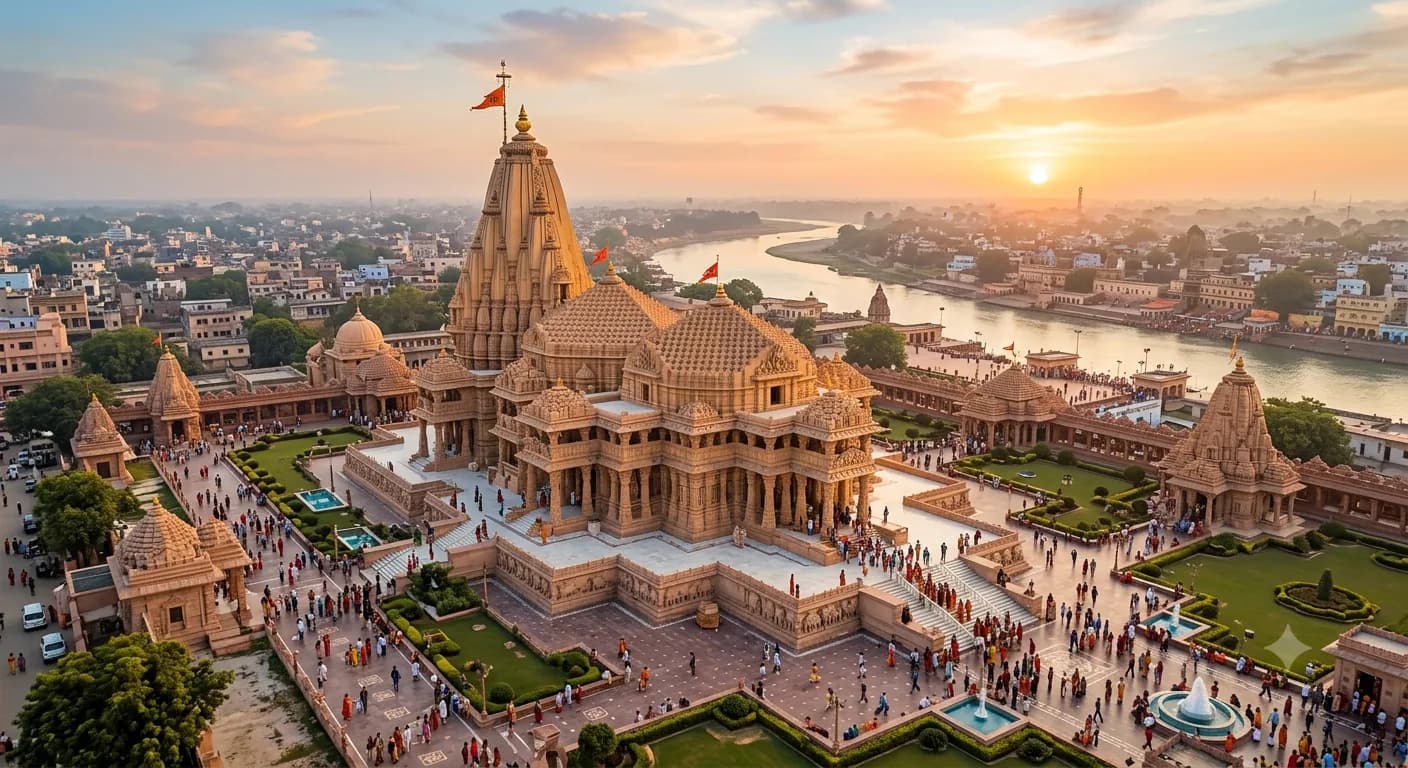
The Ram Mandir opened in January 2024 on the site traditionally identified as the birthplace of Ram in Ayodhya — one of the seven sacred Sapta Puri cities. The presiding form is Ramalla (child Ram). The temple is built in Nagara architectural style with pink sandstone from Rajasthan.
Ayodhya
Ayodhya is one of the seven Sapta Puri — the most sacred cities of Hinduism — and one of the oldest cities of the Indian subcontinent. The Valmiki Ramayana opens with Ayodhya: the capital of the Kosala kingdom, ruled by the Ikshvaku dynasty, the city where Ram was born and to which he returned after fourteen years in exile.
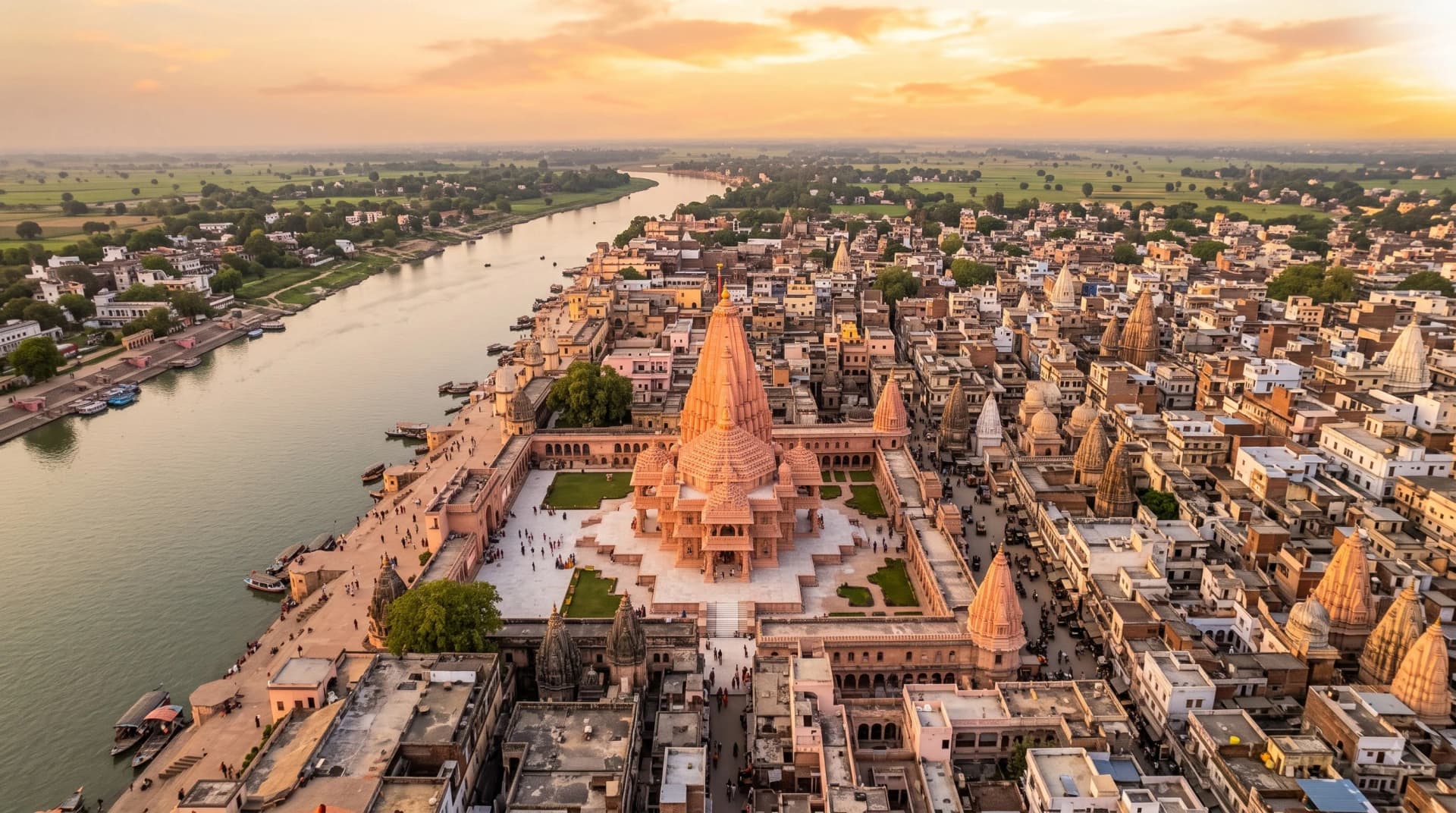
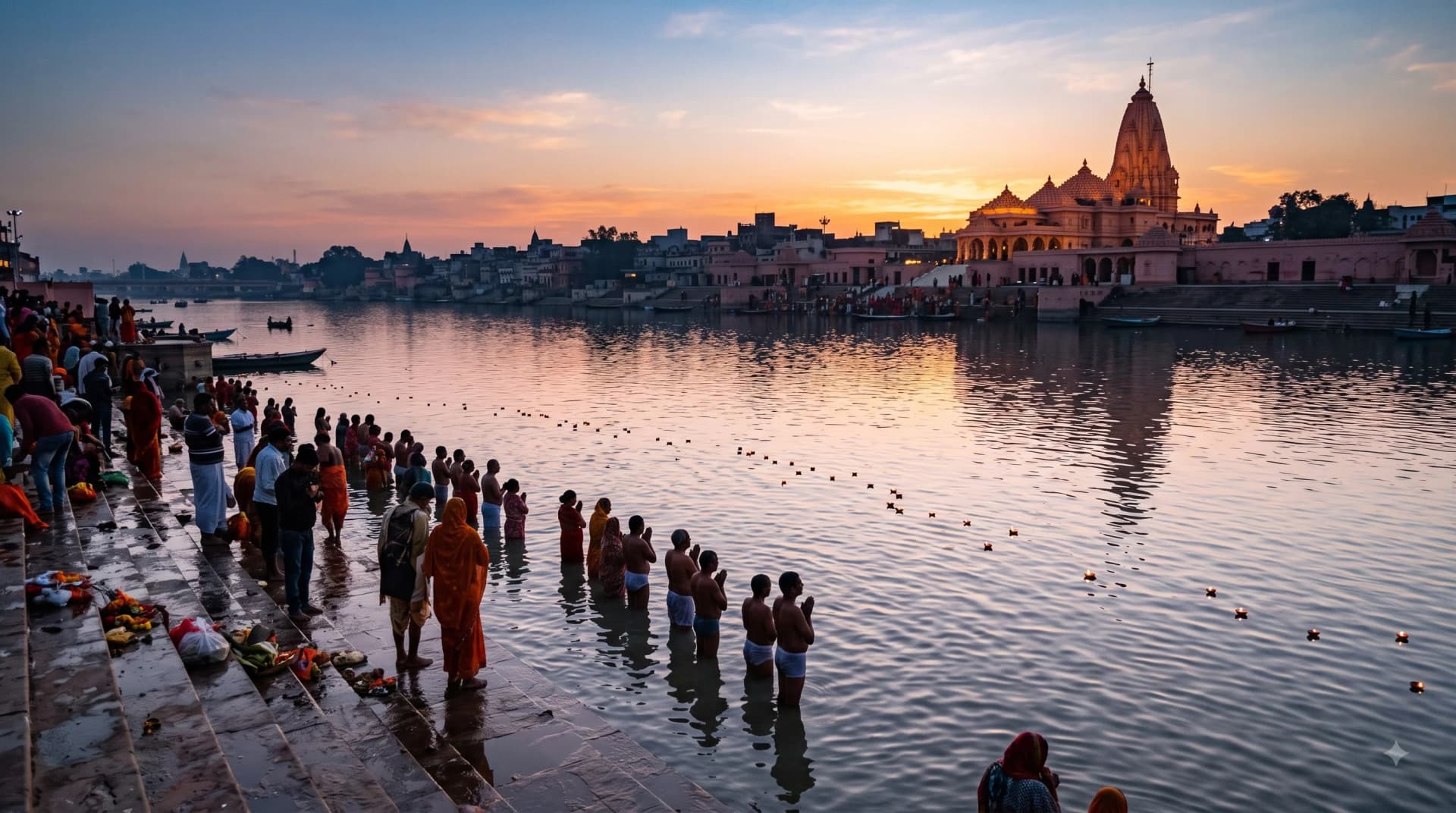
The city's sanctity is inseparable from the Ram tradition. Ayodhya (meaning 'unconquerable') is believed in tradition to be one of the original sacred cities established at the beginning of the present age. Pilgrims have come here for millennia to bathe in the Sarayu river, which runs through the city.
Among the sites traditionally associated with the Ramayana in Ayodhya are: the Ram Janmabhoomi (birthplace of Ram), Kanak Bhawan (the palace given to Sita by Ram's mother Kaikeyi), Hanuman Garhi (a prominent Hanuman temple on a hill above the city), and the ghats of the Sarayu.
Ram Janmabhoomi
The Ram Janmabhoomi — birthplace of Ram — has been a pilgrimage site and a site of contested history for centuries.
The Valmiki Ramayana places Ram's birth in Ayodhya. Devotees have venerated a location within the city as the precise birthplace for many centuries. Archaeological Survey of India excavations at the site (2003) found evidence of a temple structure beneath the ground.
In 1528 CE, a mosque (known as the Babri Masjid) was constructed at this location by Mir Baqi, a general of the Mughal emperor Babur. Whether this construction involved the demolition of a pre-existing temple remains contested among historians, though the ASI excavation report (2003) stated that a large structure of North Indian temple origin existed below. In December 1992, the Babri Masjid was demolished by a crowd — an event of major national consequence.
The legal dispute over the land was decided by the Supreme Court of India in November 2019 (M. Siddiq v. Mahant Suresh Das — the Ayodhya judgment). The court ruled in a unanimous five-judge decision that the disputed 2.77-acre site be given to the Ram Janmabhoomi Nyas (for temple construction), and that an alternative 5-acre site in Ayodhya be provided to the Sunni Waqf Board for a mosque.
The Ram Mandir Trust (Shri Ram Janmabhoomi Teerth Kshetra) was formed in February 2020. The Prime Minister performed the bhumi pujan (ground-breaking) in August 2020. The temple was inaugurated on 22 January 2024.
The Temple
The Ram Mandir is designed in the Nagara style of North Indian temple architecture, by architects Chandrakant Sompura and Ashish Sompura. The primary building material is pink sandstone (Bansi Paharpur stone) from Rajasthan, used without iron and without cement in the traditional ashlar construction method.
The temple complex covers approximately 70 acres in total. The main temple structure — the Garbhagriha (sanctum sanctorum) and its shikhara — rises to approximately 161 feet. The complex is designed to include multiple subsidiary shrines, a museum, a research centre, a pilgrims' facility, and landscaped gardens.
The presiding deity is Ramalla — Ram as a child (as opposed to Ram in his adult, warrior aspect). This is consistent with the Ayodhya tradition, which emphasises the birth and childhood of Ram rather than his exile or conquests. The idol is sculpted in black stone.
The temple consecration (Prana Pratishtha) ceremony was performed on 22 January 2024 in a ceremony attended by political and religious figures, and broadcast nationally. It was one of the most widely watched religious events in India's media history.
Ram — The Ideal King
The Valmiki Ramayana — one of the two great Sanskrit epics (with the Mahabharata) — presents Ram as the ideal of the dharmic king, husband, son, and friend. The story of Ram's fourteen-year exile, his search for Sita (abducted by the demon king Ravana), the building of a bridge across the sea to Lanka, the war, and the eventual return to Ayodhya is among the most widely known narratives in the world.
The Ramayana tradition exists across all of South and Southeast Asia — in Sanskrit, Tamil, Telugu, Malayalam, Kannada, Bengali, Awadhi (Tulsidas's Ramcharitmanas, the most beloved Hindi version), and in Malay, Thai, Indonesian, Lao, and Khmer traditions. Each culture has adapted the narrative; the core — the exile, the abduction, the war, the return — is recognisable across all.
Ayodhya is the beginning and the end of the story: the golden city where Ram was born, which he left, and to which he returned for the Ramrajya — the ideal kingdom. The pilgrimage to Ayodhya connects the devotee to this beginning and end.
Darshan & Visit
The complex is under phased construction as of 2024; some facilities and subsidiary shrines may still be under development. Security protocols and queue management systems are in place for a very large daily pilgrimage.
How to Reach
Nearby Sacred Sites
The major Hanuman temple on a hillock within Ayodhya; traditionally visited before Ram Mandir
Temple at the site of the palace traditionally given to Sita; famous for its richly decorated deities
The sacred river of Ayodhya; bathing here is integral to the pilgrimage
The only original Ayodhya temple believed to have survived from the time of Ram; Shivalinga said to have been installed by Ram's son Kush
The forest where Ram, Sita, and Lakshman spent most of their exile; major pilgrimage site in its own right
Sources
- Valmiki Ramayana (primary scriptural source)(scripture)
- Shri Ram Janmabhoomi Teerth Kshetra Trust (official)(official)
- Supreme Court of India — M. Siddiq v. Mahant Suresh Das (Civil Appeal No. 10866/2010), judgment dated 9 November 2019(government)
- Archaeological Survey of India — Excavation Report at Ram Janmabhoomi (2003)(government)
- Wikipedia — Ram Mandir, Ayodhya (cross-check)(reference)
Quick Links & Sacred Exploration
Explore other revered temples, Jyotirlingas, and sacred pilgrimage routes across India.