Rudraprayag, Uttarakhand
Kedarnath
केदारनाथ
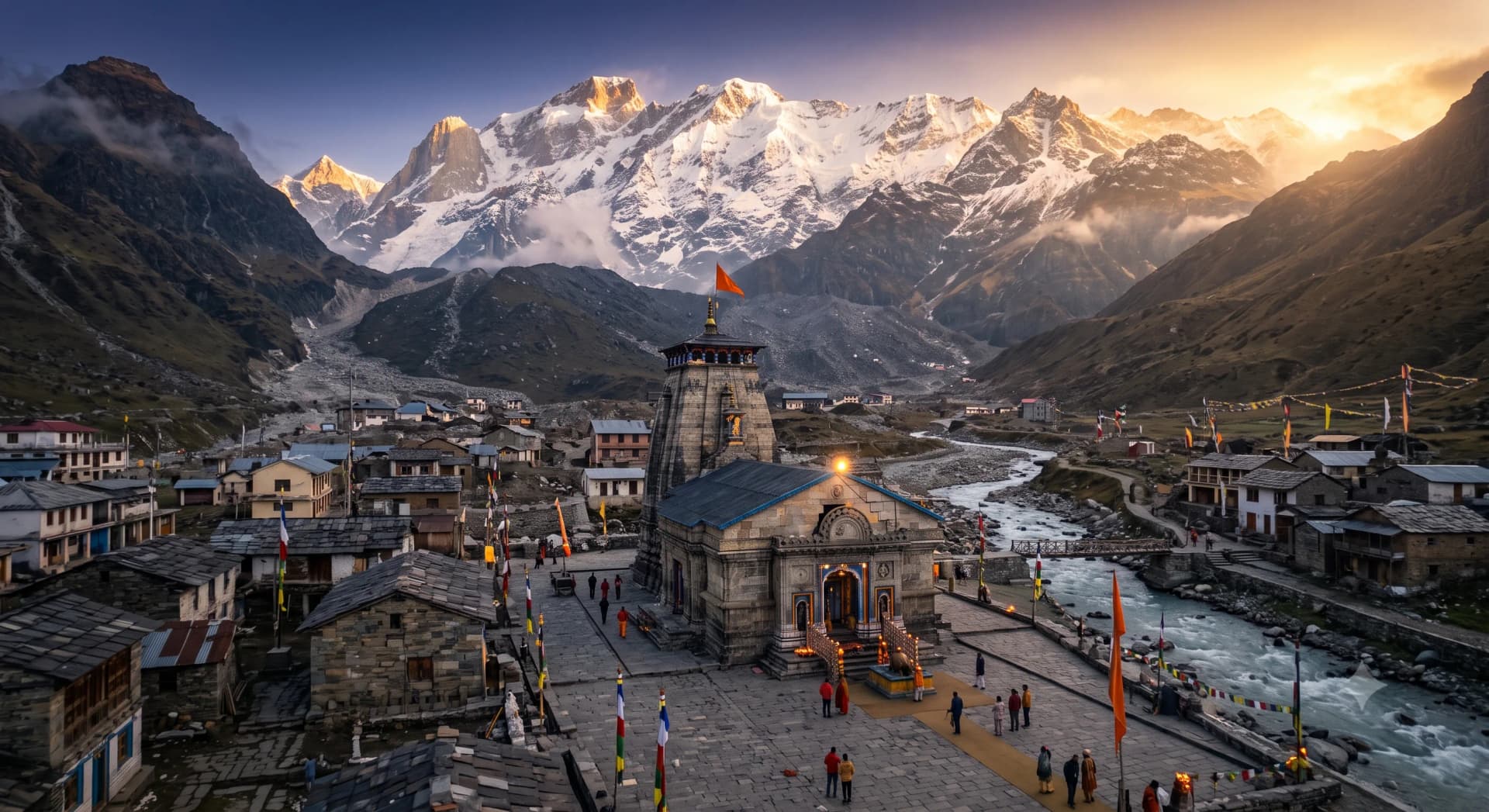
A Jyotirlinga, one of the Pancha Kedar, and part of the Chota Char Dham — situated at 3,583 metres in the Garhwal Himalayas, Kedarnath is one of the most arduous and most revered pilgrimages in Hinduism.
The Himalayan Shrine
हिमालय की गोद में पावन धाम
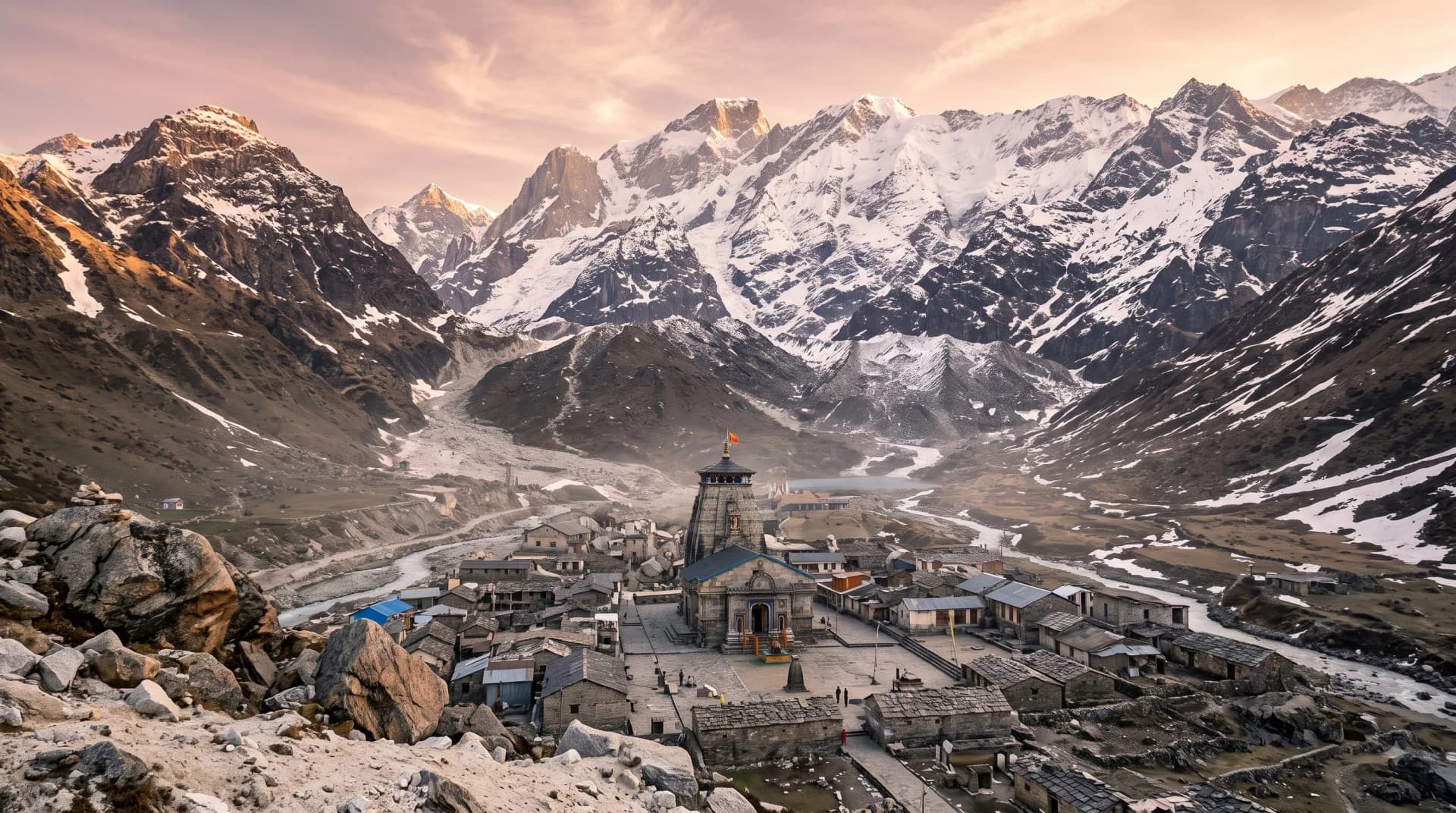
Kedarnath stands at 3,583 metres above sea level in the Rudraprayag district of Uttarakhand, in the high Garhwal Himalayas. The Mandakini river rises from the Chorabari glacier nearby and flows past the temple town below. The peaks of Kedarnath, Kedar Dome, and Bharatekuntha rise above the valley.
The temple is open only from May to November. During winter, heavy snowfall makes the region inaccessible, and the deity is ceremonially moved to Ukhimath in the valley below, where worship continues through the cold months. The reopening of Kedarnath each spring — on Akshaya Tritiya, usually in late April or early May — is itself a major occasion drawing thousands.
The only way to reach the temple is on foot — a trek of approximately 16 kilometres from Gaurikund, the last motorable point, through mountain terrain. Pony and palanquin services are available. A helicopter service connects Phata and Sirsi to a helipad near the temple.
The Legend of the Pandavas
पांडवों की तपस्या और पंच केदार की कथा
The traditional account of Kedarnath's origin is inseparable from the Mahabharata.
After the Kurukshetra war, the Pandavas were consumed with remorse for the killing of their kin — including fellow Kshatriyas, elders, and teachers. To seek absolution, they sought Shiva. But Shiva, unwilling to easily grant pardon for such destruction, evaded them. He took the form of a bull (Nandi) and hid among a herd of cattle near Guptakashi.
Bhima, the second Pandava, recognised the unusual bull and attempted to seize it. The bull dove into the earth to escape. Different parts of its body emerged at five different locations in the Garhwal Himalayas — and these became the five shrines of the Pancha Kedar:
The hump of the bull emerged at Kedarnath. The arms emerged at Tungnath, the face at Rudranath, the navel or torso at Madhyamaheshwar, and the hair (jata) at Kalpeshwar.
Shiva, pleased by the Pandavas' persistence and devotion, accepted their prayers at each of these five locations and granted them liberation from the sin of kin-slaying.
The Pandavas are said to have built the original stone temple at Kedarnath before ascending to heaven from the Himalayas — their departure point traditionally identified as Swargarohini peak near Badrinath.
The Jyotirlinga
स्वयंभू त्रिकोणीय ज्योतिर्लिंग
Kedarnath is one of the twelve Jyotirlingas — the sacred manifestations of Shiva as an infinite column of light. Unlike the other Jyotirlingas, which are typically elongated lingams, the Kedarnath linga is in the form of a natural triangular rock (said to represent the hump of the bull from the Pandava legend). The rock itself is considered the Shivalinga — it is ancient stone, worn smooth by generations of abhisheka and worship.
The natural stone form rather than a crafted idol gives Kedarnath an unusual directness — this is not a representation of Shiva, but, in the tradition's understanding, Shiva himself in a natural self-manifested (swayambhu) form.
The Temple
अद्भुत पाषाण वास्तुकला और आदि शंकराचार्य समाधि
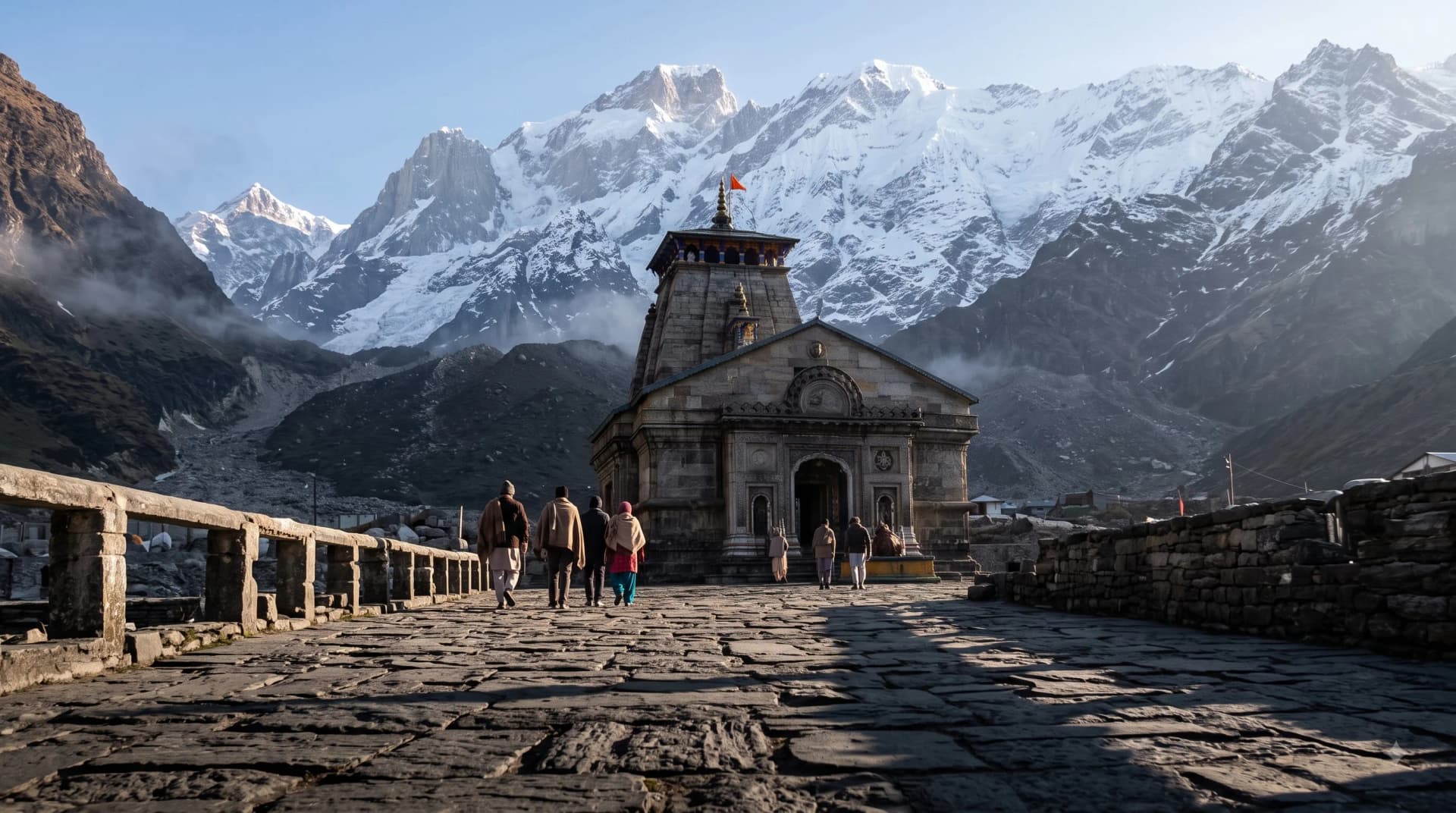
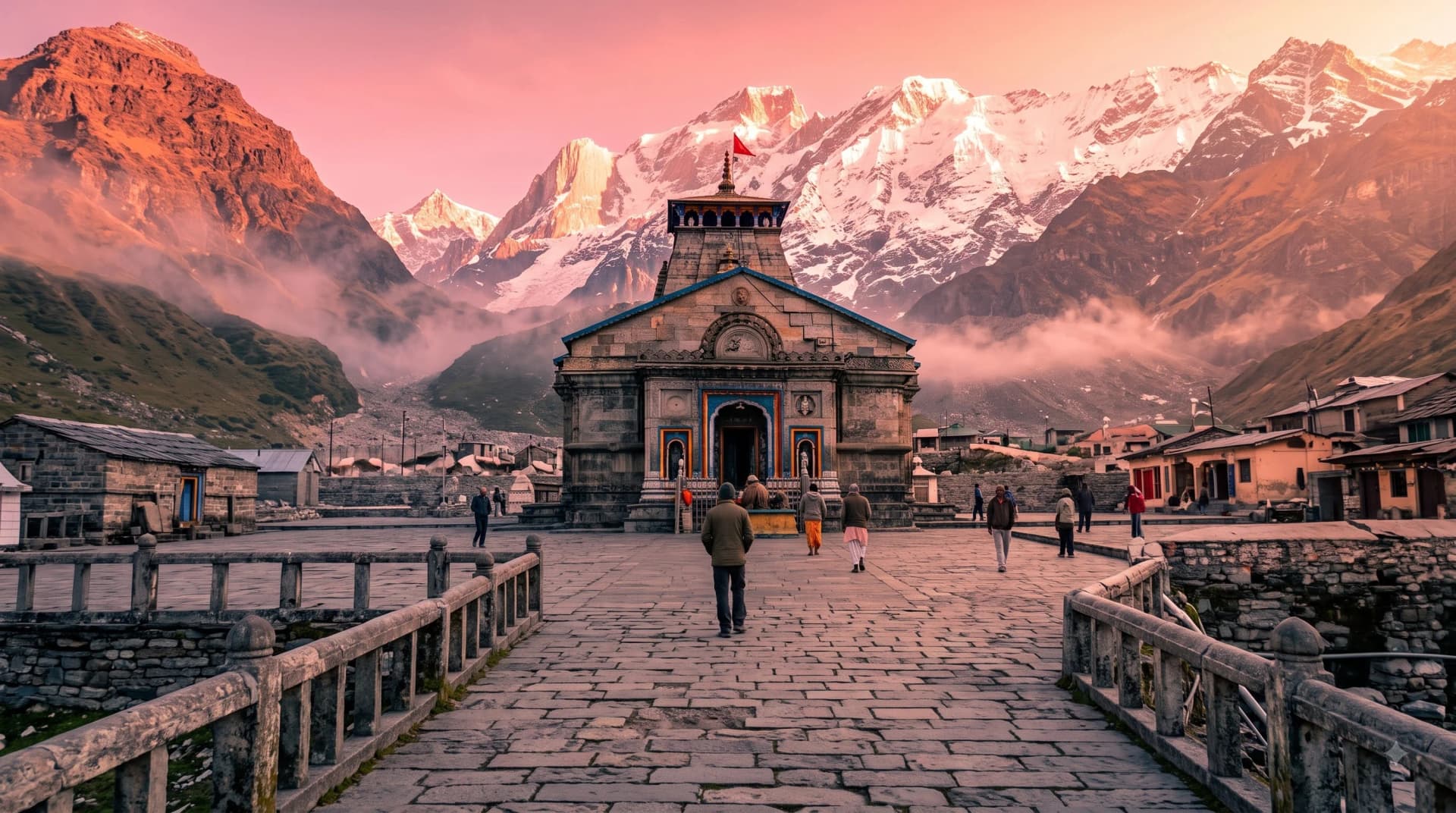
The existing temple structure at Kedarnath is built of large, interlocking grey stone blocks in a Himalayan architectural style — massive, low, and built to withstand the weight of snow. No mortar or lime is traditionally believed to have been used; the stones fit together by their own weight. The walls are thick, the entrance low.
Within is the main sanctum housing the natural triangular linga. Behind the temple stands the samadhi of Adi Shankaracharya — the 8th-century philosopher-saint who, according to tradition, reformed and revitalised the temple after centuries of neglect, and who is said to have attained samadhi (liberation from the physical body) at Kedarnath himself. His statue and shrine behind the main temple are an integral part of the site.
The age of the current stone structure is debated by scholars; some suggest parts of it date to the 12th century CE. What is not debated is that it has stood through extreme winters, avalanches, and floods for many centuries.
2013 — The Flood
2013 की आपदा और आस्था की विजय
On 16–17 June 2013, catastrophic cloudbursts triggered glacial lake outbursts and debris flows that swept through the Kedarnath valley. The town below the temple was largely destroyed; thousands of pilgrims and residents lost their lives. It remains one of the worst natural disasters in the history of Indian hill states.
The Kedarnath temple itself sustained remarkably limited damage. A large boulder lodged against the back wall of the temple, diverting the floodwaters around the structure. The sanctum and the triangular linga were unharmed. For many pilgrims, the temple's survival was itself miraculous — a testament to Shiva's presence in the stone.
Reconstruction of the pilgrimage route, the town, and access infrastructure took several years. The restored Kedarnath reopened to pilgrims in 2014 and has since returned to near pre-flood pilgrimage numbers. A new township plan with improved drainage and regulated construction zones was put in place.
This history is part of Kedarnath now — the immovable temple and the altered landscape around it.
Darshan & Visit
The trek (approximately 16 km one way, altitude gain ~1,800 m from Gaurikund) is physically demanding. Those with heart conditions or unacclimatised to altitude should consult a doctor before attempting. Altitude sickness is common above 3,000 m.
How to Reach
Do not attempt the trek during or immediately after heavy rain, especially in July–August when the monsoon is active and landslide risk is high.
Nearby Sacred Sites
Kedarnath is the highest (3,584 m) and northernmost of the 12 Jyotirlingas.
The foremost of the five Himalayan Kedar shrines where the hump of Shiva manifested.
Part of the sacred Uttarakhand circuit alongside Yamunotri, Gangotri, and Badrinath.
The guardian deity of the Kedarnath valley, worshipped especially when the main temple closes.
A glacial lake above Kedarnath, where Mahatma Gandhi's ashes were partially immersed.
A high-altitude glacial lake at 4,135 m, a challenging trek from Kedarnath.
Where Parvati is said to have performed penance; thermal springs and the traditional start of the trek.
The village where Shiva and Parvati were traditionally married in the presence of Vishnu.
Sources
- Kedar Khanda, Skanda Purana(scripture)
- Badrinath Kedarnath Temples Committee (badrinath-kedarnath.gov.in)(official)
- Archaeological Survey of India (Dehradun Circle)(government)
- Wadia Institute of Himalayan Geology (scientific study on the 2013 flood and terrain stability)(reference)
- Wikipedia — Kedarnath Temple (cross-check)(reference)
Quick Links & Sacred Exploration
Explore other revered temples, Jyotirlingas, and sacred pilgrimage routes across India.