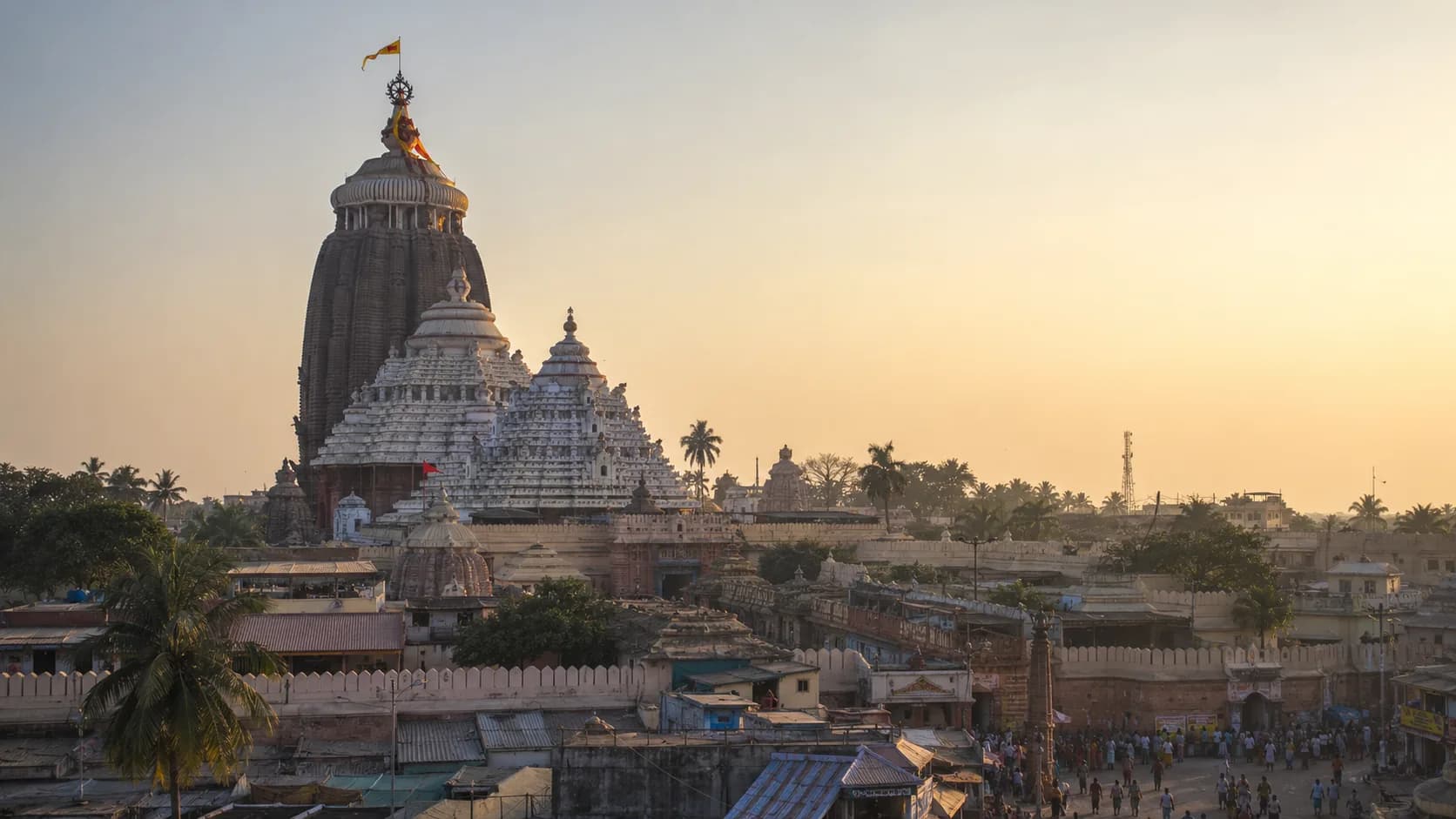
One of the four sacred Char Dhams, Jagannath Puri is the seat of Lord Jagannath — a form of Vishnu/Krishna revered across traditions. Famous for the annual Rath Yatra, the largest chariot procession in the world, and for the unique wooden form of the deity that transcends conventional iconography.
Lord of the Universe
Jagannath — Lord of the Universe — is worshipped at Puri in a form that is unlike any other major Hindu deity. The three presiding deities of the temple — Jagannath, his elder brother Balabhadra (Balarama), and their sister Subhadra — are represented as wooden idols without conventional human proportions. Their arms are stubbed rather than full-length; their eyes are large, round discs; their faces circular and flat. The forms are striking, even startling to eyes accustomed to classical Hindu iconography.
Traditional accounts explain this form differently across texts. One widespread narrative: a king asked a divine carpenter (Vishwakarma, disguised as an old man) to carve the deity from a sacred log — on the condition that he not be disturbed until the work was complete. The king violated this agreement before the carving could be finished, and the deity emerged in this incomplete but sacred form.
What is unusual about Jagannath is the degree to which the tradition transcends sectarian boundaries. The deity is simultaneously worshipped by Vaishnavas (as Krishna or Vishnu), Shaivas (as a manifestation of Shiva, since the Utkal Khanda identifies Jagannath with Purusottama, a name that crosses traditions), and by Saktas (Subhadra being identified with Devi). Buddhist and Jain traditions have also historically claimed connection with the site. The Puri temple is one of the few places in India where devotees of different Hindu traditions worship at the same shrine without distinction.
The Rath Yatra
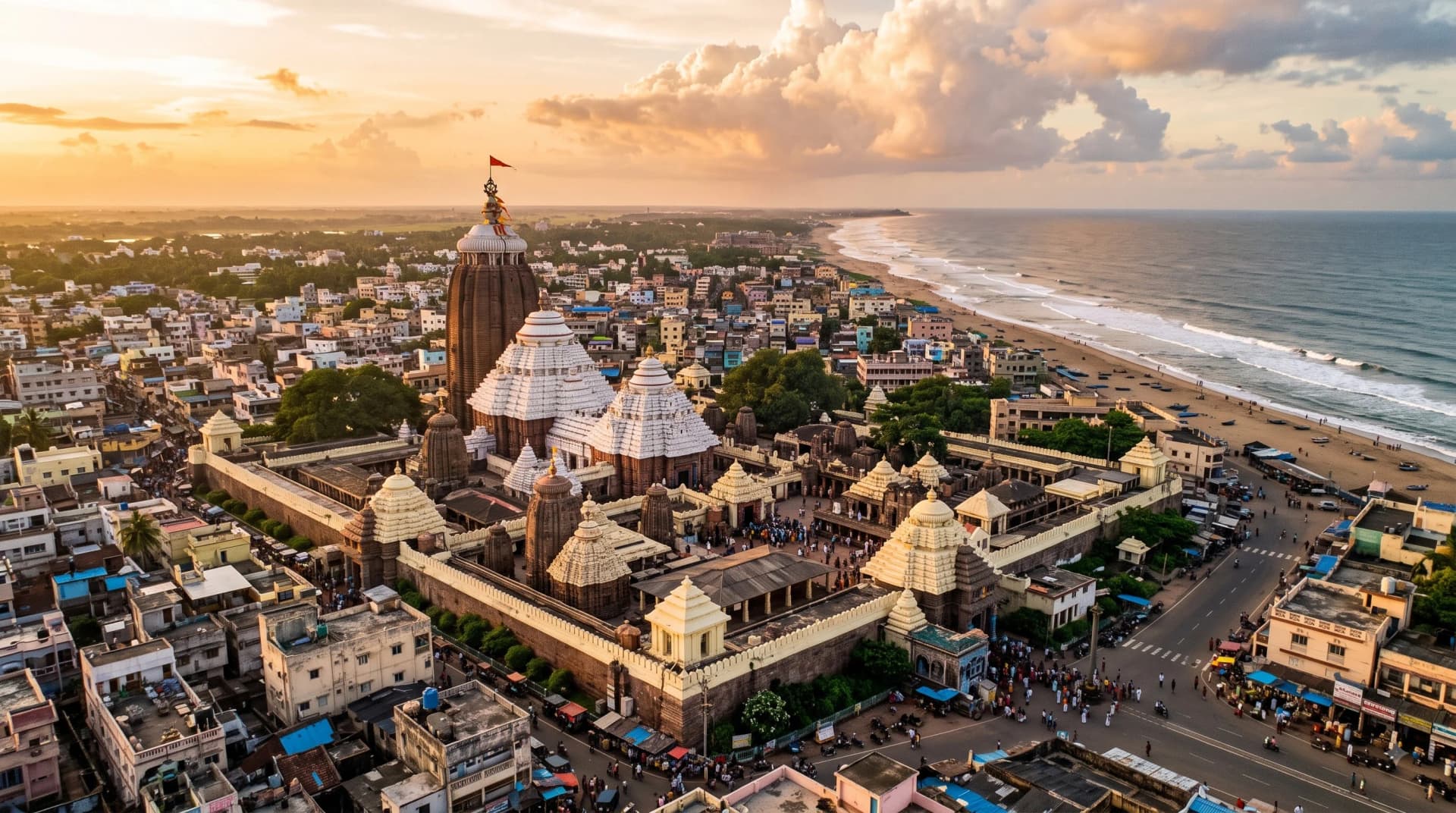
The Rath Yatra — chariot festival — of Jagannath Puri is one of the largest religious gatherings in the world. Each year, on the second day of the bright fortnight of Ashadha (usually June or July), the three deities are placed on three enormous wooden chariots and pulled by thousands of devotees through the main road (Grand Road / Bada Danda) of Puri, approximately 3 kilometres to the Gundicha Temple — the residence of their aunt — where they remain for nine days before returning.
The chariots are newly built each year from selected trees, to a traditional design. Jagannath's chariot — Nandighosh — rises to approximately 14 metres. Balabhadra's chariot is Taladhwaja; Subhadra's is Darpadalana. The pulling ropes are of thick rope; the chance to pull the chariot is considered highly meritorious.
The procession was witnessed and described by the Moroccan traveller Ibn Battuta in the 14th century — one of the earliest detailed non-Indian accounts of the festival. European travellers in subsequent centuries also documented it; the English word "juggernaut" (an unstoppable force) derives from a colonial-period description of the chariot procession, though the word's violent connotations are a misrepresentation of the festival's nature.
Navakalevara — The Secret Renewal
Every 8, 12, or 19 years (according to a complex lunar calendar calculation, triggered when Ashadha has two months in a leap lunar year — an Adhika Ashadha), the wooden idols of Jagannath, Balabhadra, and Subhadra are replaced in a ceremony called Navakalevara (New Body).
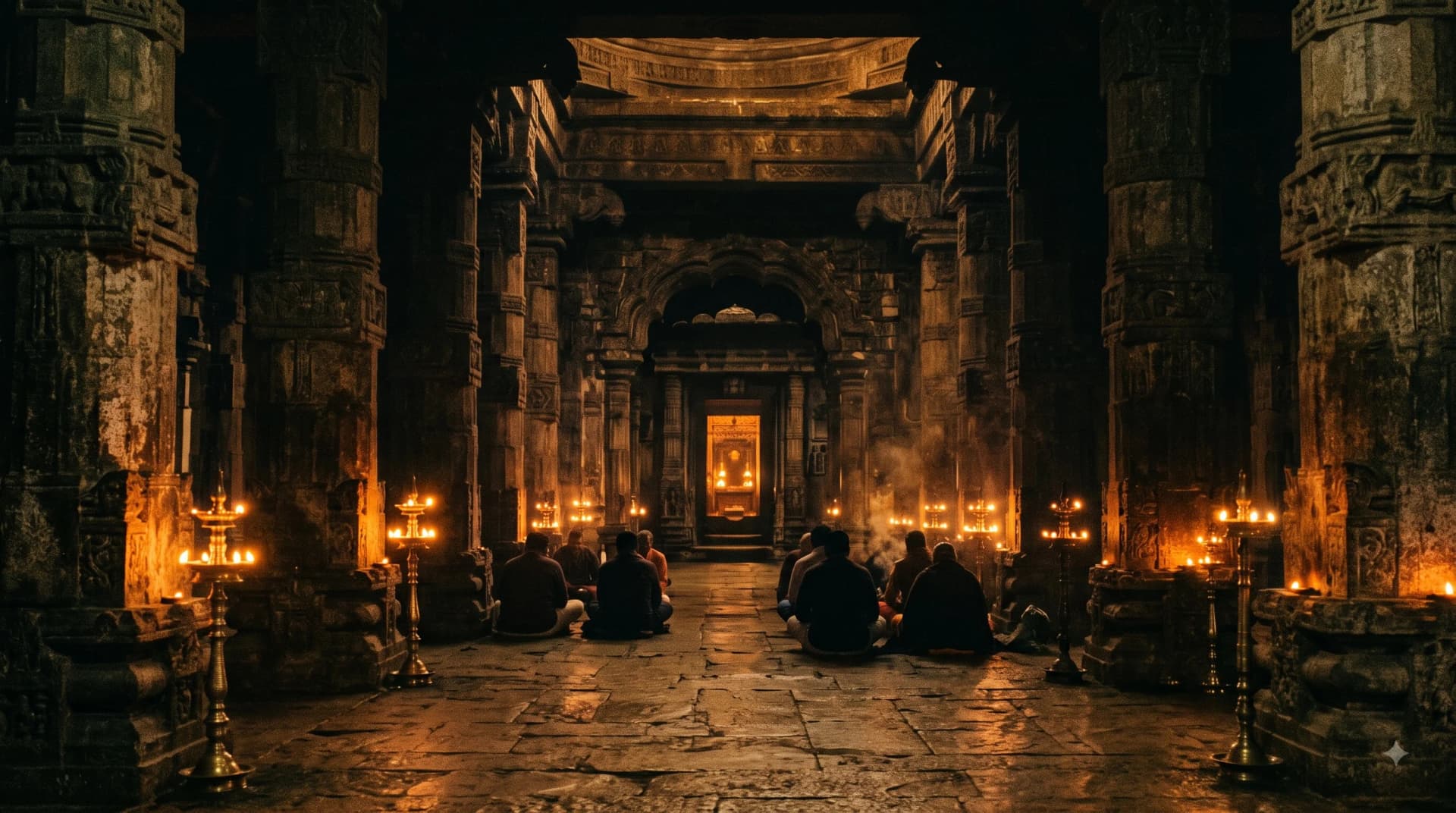
The process is elaborate and secret. Priests called Daitapatis (believed to be descendants of the original non-Brahmin keepers of the deity) venture into the forest to find specific Neem trees bearing particular signs — they are said to be guided to them. The trees are felled under specific ritual conditions. New idols are carved in complete secrecy inside the workshop within the temple complex; no photographs or outside observation is permitted.
The old idols are buried in a marked location within the temple precincts. The transfer of the life force (Brahma Padartha — traditionally said to be a sacred object inside the idol) from old to new takes place at midnight, performed blindfolded to protect the priests. The priests involved observe specific purity rules throughout.
The Navakalevara is one of the most unusual ritual traditions in any major world religion — a periodic, planned death and rebirth of the divine form itself.
History
The main temple structure at Puri was built by King Anantavarman Chodaganga Deva of the Eastern Ganga dynasty in the 12th century CE (c. 1135–1150 CE). The shikhara of the main temple rises approximately 65 metres. The complex includes four main structures: Vimana (main sanctuary), Jagamohan (audience hall), Natamandir (dance hall), and Bhogamandap (offering hall), arranged sequentially from west to east.
Earlier temples may have existed at this site. The Utkal Khanda of the Skanda Purana records the sanctity of Puri as Purusottama Kshetra in terms suggesting an ancient tradition. The Eastern Ganga king Anangabhima Deva III in the 13th century made further major renovations. The temple was attacked by Kala Pahar (the general of Sulaiman Karrani of Bengal) in 1568 CE, and by Marathas and Mughals at various times. Despite these incursions, the temple and the Rath Yatra tradition continued with relatively few interruptions.
The Kitchen of Jagannath
The Mahaprasad of Jagannath Puri is among the most unusual temple kitchens in India. The temple kitchen (Roshaghara) is one of the largest in the world by capacity, feeding tens of thousands of pilgrims daily. The food is cooked in clay pots, stacked seven tiers high over wood fires — tradition holds that the pot on top always cooks first, an inversion of physical expectation held as a sign of the deity's presence.
The Mahaprasad is notable for its pan-sectarian acceptance: unlike other major temple prasadams, the Puri Mahaprasad is regarded as acceptable to and equalising across caste distinctions within the Jagannath tradition. This egalitarian quality has been commented upon by scholars of Indian religious history.
Non-Hindus are not permitted to enter the main temple — a long-standing and famous restriction. However, the Mahaprasad is sold outside the temple and is accessible to all.
Darshan & Visit
Pandas (temple guides/priests) attached to specific family traditions may approach visitors; it is acceptable to engage them or politely decline. Mahaprasad is available in the designated Anand Bazar (bazaar) within the outer temple complex — accessible to all.
How to Reach
Puri is part of the Odisha 'Golden Triangle': Bhubaneswar (Lingaraja Temple) → Puri (Jagannath) → Konark (Sun Temple). All three are frequently visited together.
Nearby Sacred Sites
Enshrining the navel/relic of Sati in the inner Jagannath precinct; food offered to Jagannath becomes Mahaprasad only upon offering to Vimala.
The 'aunt's house' — the destination of the Rath Yatra chariot procession
The 13th-century Sun Temple; a UNESCO World Heritage Site and one of the most remarkable temple complexes in India
Ancient Shiva temple within Puri — considered part of the complete Puri pilgrimage
The great Shaiva temple of Odisha; 11th century CE
The Bay of Bengal at Puri's shore — a sacred site for the ashes of the deceased
Sources
- Utkal Khanda, Skanda Purana(scripture)
- Jagannath Temple Administration (jagannath.nic.in)(official)
- Odisha State Archives — Navakalevara documentation(government)
- Archaeological Survey of India, Odisha Circle(government)
- Wikipedia — Jagannath Temple, Puri (cross-check)(reference)
Quick Links & Sacred Exploration
Explore other revered temples, Jyotirlingas, and sacred pilgrimage routes across India.