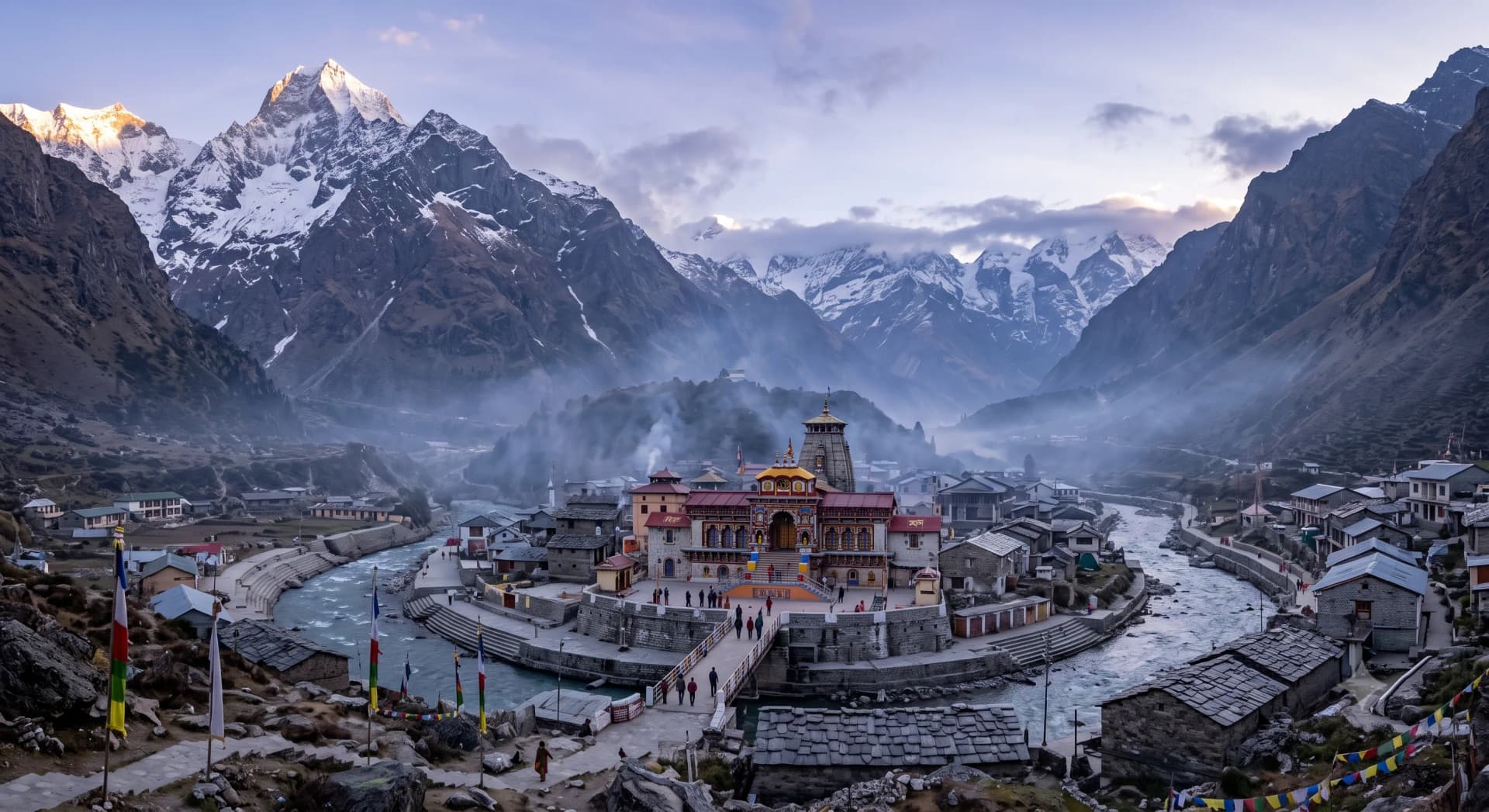
Pilgrimage
Panch Kedar
पंच केदार (गढ़वाल हिमालय)
1. Kedarnath (The Hump) · 2. Tungnath (The Arms) · 3. Rudranath (The Face) · 4. Madhyamaheshwar (The Navel) · 5. Kalpeshwar (The Matted Locks)
The sacred Garhwal Himalayan circuit dedicated to the five parts of Lord Shiva's celestial bull manifestation, sought by the Pandavas for absolution after the Kurukshetra war: Kedarnath (the hump), Tungnath (the arms), Rudranath (the face), Madhyamaheshwar (the navel), and Kalpeshwar (the matted hair).
The Pandava Legend of Atonement
महाभारत कालीन आख्यान — पांडवों का पश्चाताप
The sacred origin of the Panch Kedar is rooted in the aftermath of the epic Kurukshetra War recounted in the Mahabharata and detailed in the Kedarkhanda of the Skanda Purana.
Having emerged victorious in the devastating fratricidal war, the five Pandava brothers—distressed by the death of their kinsmen (Gotra-hatya) and the slaughter of teachers and Brahmins (Brahmahatya)—sought the grace of Lord Shiva to atone for their karmic burden.
Shiva, unwilling to grant absolution easily to those who had engaged in slaughter, avoided their approach. When the Pandavas tracked Him to Kashi, Shiva withdrew to the remote Himalayan wilderness of Garhwal. Disguising Himself among a herd of cattle, Shiva assumed the form of a magnificent celestial bull (Nandi).
Recognizing the extraordinary nature of the bull, the mighty Bhima straddled two high mountain ridges and attempted to capture the animal. Realizing he was discovered, the bull dove headlong into the earth to disappear. As Shiva submerged, Bhima lunged forward and held fast to the bull's muscular hump.
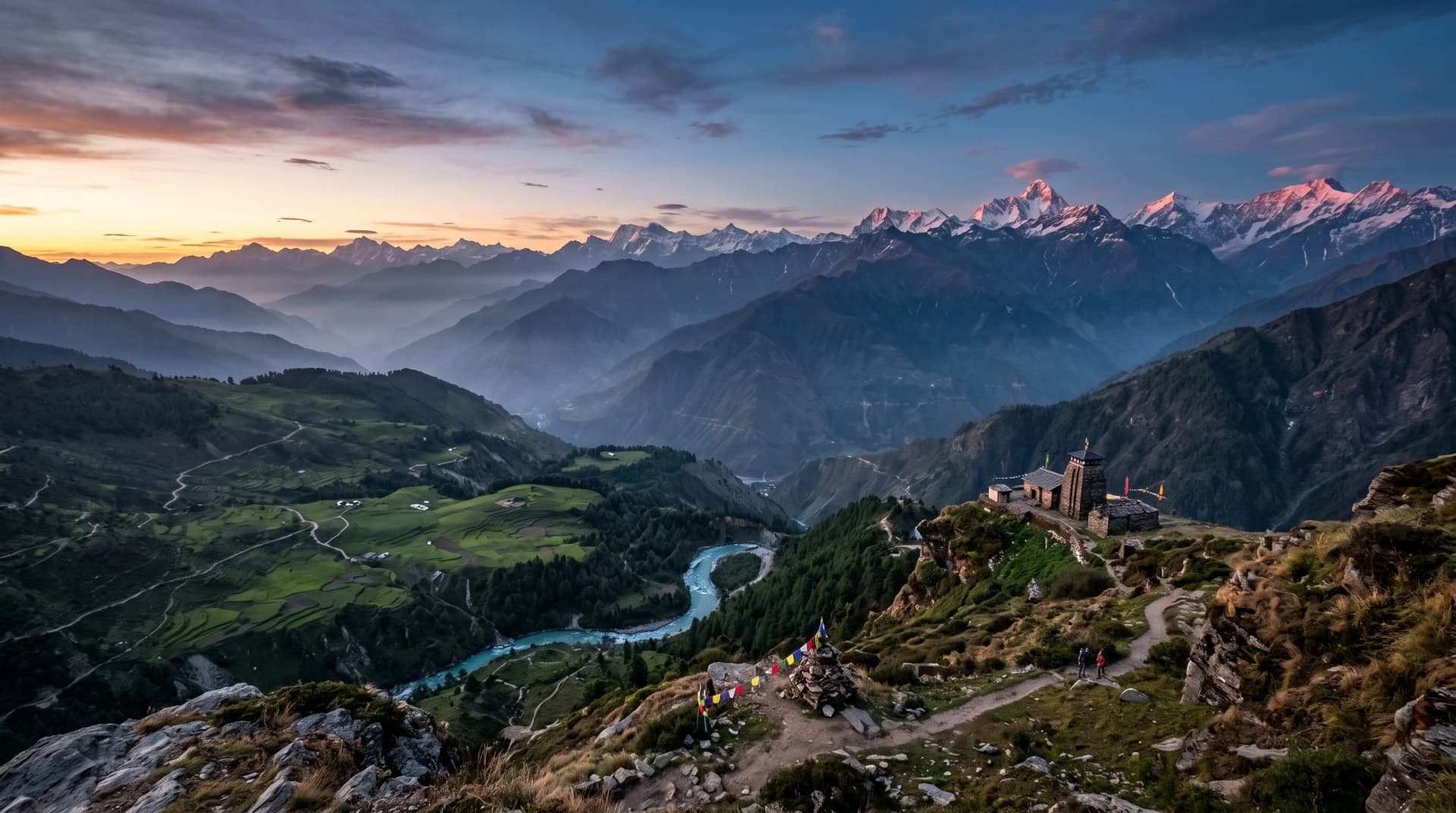
The Five Manifestations Across the Mountains
पांच पावन अंग — पांच दिव्य धाम
According to scriptural lore, as Shiva plunged into the subterranean depths, the distinct parts of His bull-form remanifested at five separate alpine sanctuaries across the Garhwal Himalayas:
1. Kedarnath: The triangular hump (Pitha) remained anchored above the ground, forming the holy Jyotirlinga. 2. Tungnath: The arms (Bahu) appeared high upon Chandranath mountain above the alpine meadows of Chopta. 3. Rudranath: The tranquil face (Mukha) revealed itself within a natural rock grotto overlooking deep valleys. 4. Madhyamaheshwar: The navel and belly (Nabhi) emerged on a meadow plateau directly beneath Mount Chaukhamba. 5. Kalpeshwar: The matted tresses of hair (Jata) appeared in a rock cavern within the Urgam valley.
Impressed by the unyielding perseverance and devotion of the Pandavas, Lord Shiva pardoned their sins and granted them liberation. In deep gratitude, the Pandavas are traditionally believed to have erected the foundational stone temples at all five sanctuaries before departing for heaven via the Swargarohini glacier.
Winter Migrations and the Seasonal Rhythm
शीतकालीन प्रवास और उत्सव मूर्तियां
Four of the Panch Kedar shrines are located at extreme alpine altitudes (between 2,300 and 3,680 metres) and are forced to close for the six winter months due to heavy snowpack and blizzards:
- Kedarnath and Madhyamaheshwar deities travel to the ancient Omkareshwar Temple in Ukhimath (the historic winter capital of the Rawal priesthood). - Tungnath is relocated to the scenic village of Makkhumath. - Rudranath moves in a formal palanquin to the historic Gopinath Temple at Gopeshwar. - Kalpeshwar, nestled in the lower Urgam valley at 2,200 metres, is the glorious exception: sheltered from heavy snow, its cave doors never close, allowing devotees to receive darshan 365 days a year.
The reopening of the Kedar shrines in May—marked by the traditional beating of pahadi dhol-damau drums and Vedic chanting—signals the start of the summer trekking season for mountain pilgrims.
The Authentic Trekking Sequence
पारम्परिक पदयात्रा क्रम और दुर्गमता
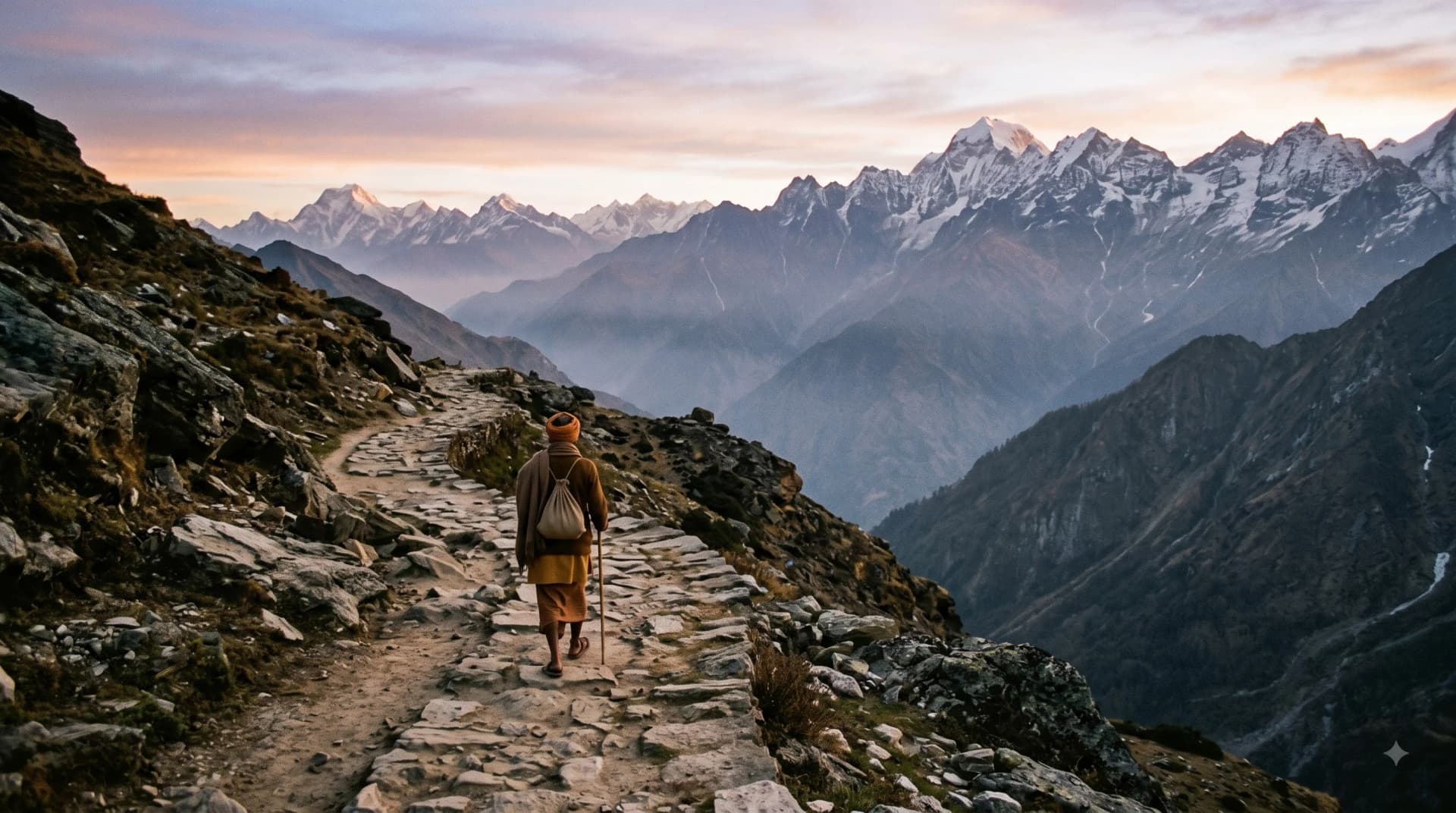
Undertaking the complete Panch Kedar on foot is regarded as one of the most physically demanding and spiritually transformative walking pilgrimages in the Hindu world, requiring approximately 150 to 170 kilometres of mountain road travel coupled with roughly 65 to 70 kilometres of strenuous high-altitude trekking.
The traditional scriptural order follows: 1. Kedarnath: 16 km trek from Gaurikund. 2. Madhyamaheshwar: 16 km trek from Ransi village. 3. Tungnath: 3.5 km steep ascent from Chopta (highest point of the circuit). 4. Rudranath: 20 km trek from Sagar village across high bugyals (Panar and Pitradhar). 5. Kalpeshwar: Gentle 1–2 km walk from Helang / Devgram in the Urgam valley.
Completing the full circuit on foot traditionally takes between 14 and 16 days, demanding good cardiovascular fitness, high-grip trekking boots, proper rain protection, and respect for the fragile Himalayan ecosystem.
The Destinations
1. Kedarnath (The Hump)
केदारनाथ (पृष्ठ / कूबड़)
At 3,584 metres in the Mandakini valley. The foremost Kedar and Jyotirlinga, where Shiva's triangular hump remained above ground as He plunged into the earth. Reached by a 16 km mountain trek from Gaurikund. Winter seat at Omkareshwar Temple, Ukhimath.
2. Tungnath (The Arms)
तुंगनाथ (भुजाएं)
At 3,680 metres (12,073 ft) on Chandranath mountain above Chopta. The highest Hindu temple and highest Shiva shrine in the world, where Lord Shiva's arms (bahu) manifested. Reached by a scenic 3.5 km stone-paved trek through rhododendron forests. Winter seat at Makkhumath.
3. Rudranath (The Face)
रुद्रनाथ (मुख)
At 2,286 metres in dense rhododendron and alpine meadows (bugyals). Here, the peaceful, serene face of Shiva (Neelkanth Mahadeva) is worshipped in a natural rock cave. The most physically demanding trek among the five (approx. 20–22 km from Sagar village or Helang). Winter seat at Gopinath Temple, Gopeshwar.
4. Madhyamaheshwar (The Navel)
मध्यमहेश्वर (नाभि)
At 3,497 metres beneath the towering Chaukhamba peaks in the Mansuna valley. Here, the navel and stomach (nabhi) of the divine bull manifested. Reached by a 16 km trek from Ransi village through pristine oak forests and along the Madhu Ganga. Winter seat at Ukhimath.
5. Kalpeshwar (The Matted Locks)
कल्पेश्वर (जटाएं)
At 2,200 metres in the picturesque Urgam valley. Here, the matted hair locks (jata) of Lord Shiva are venerated inside a natural stone cave. Uniquely, because of its lower valley elevation, Kalpeshwar is the only one of the Panch Kedar that remains accessible and open throughout all twelve months of the year.
Yatra Guidance
The full circuit is traditionally approached from Rishikesh via the route: Rishikesh → Guptkashi/Gaurikund (Kedarnath) → Ukhimath/Ransi (Madhyamaheshwar) → Chopta (Tungnath) → Sagar village (Rudranath) → Helang/Urgam (Kalpeshwar) → Rishikesh. A complete pilgrimage requires 14 to 16 days of mountain travel and trekking. Individual Kedars (especially Tungnath and Kedarnath) can be visited separately during shorter weekend trips from Chopta or Guptkashi.
Mid-May to June (spring alpine flowers, clear mornings) and September to October (crisp post-monsoon views of Chaukhamba and Nanda Devi peaks). Avoid July and August due to severe monsoon landslides in the Mandakini and Alaknanda valleys.
14 to 16 days for the complete five-shrine trekking circuit.
Related Temples
Sources
- Shri Badrinath-Kedarnath Temple Committee (BKTC)(official)
- Uttarakhand Tourism Development Board (UTDB)(government)
- Skanda Purana, Kedarkhanda (Panch Kedar Mahatmya)(scripture)
- Mahabharata (Mahaprasthanika Parva & Vana Parva)(scripture)
- Archaeological Survey of India (ASI), Dehradun Circle(government)