What is Narak Chaturdashi?
Narak Chaturdashi, widely celebrated as Chhoti Diwali, falls on the fourteenth lunar day (Chaturdashi) of the dark fortnight (Krishna Paksha) in the month of Kartik. It is the second day of the five-day Diwali festival. Across India, the day is known by several regional names: Roop Chaudas or Roop Chaturdashi in northern and western regions, Kali Chaudas in Gujarat, and the primary day of Deepavali in many southern states. The central religious ritual of this day is Abhyanga Snan—a sacred pre-dawn bath taken with sesame oil and herbal paste (ubtan) before sunrise.
Why is it observed?
The Srimad Bhagavatam (10.59) tells how Narakasura, also called Bhaumasura, ruled from Pragjyotishpura, seized the earrings of Aditi, mother of the gods, and held thousands of women captive. Lord Krishna flew to his city on Garuda with Queen Satyabhama, defeated him, and freed the captives. A later and widely told tradition adds that Narakasura, a son of Bhudevi (Mother Earth), could fall only at his mother's hand, and that Satyabhama, regarded as her incarnation, struck the final blow. Popular belief also holds that Krishna bathed with fragrant oil before sunrise after the battle, and this is given as the origin of the pre-dawn bath.
How is it observed?
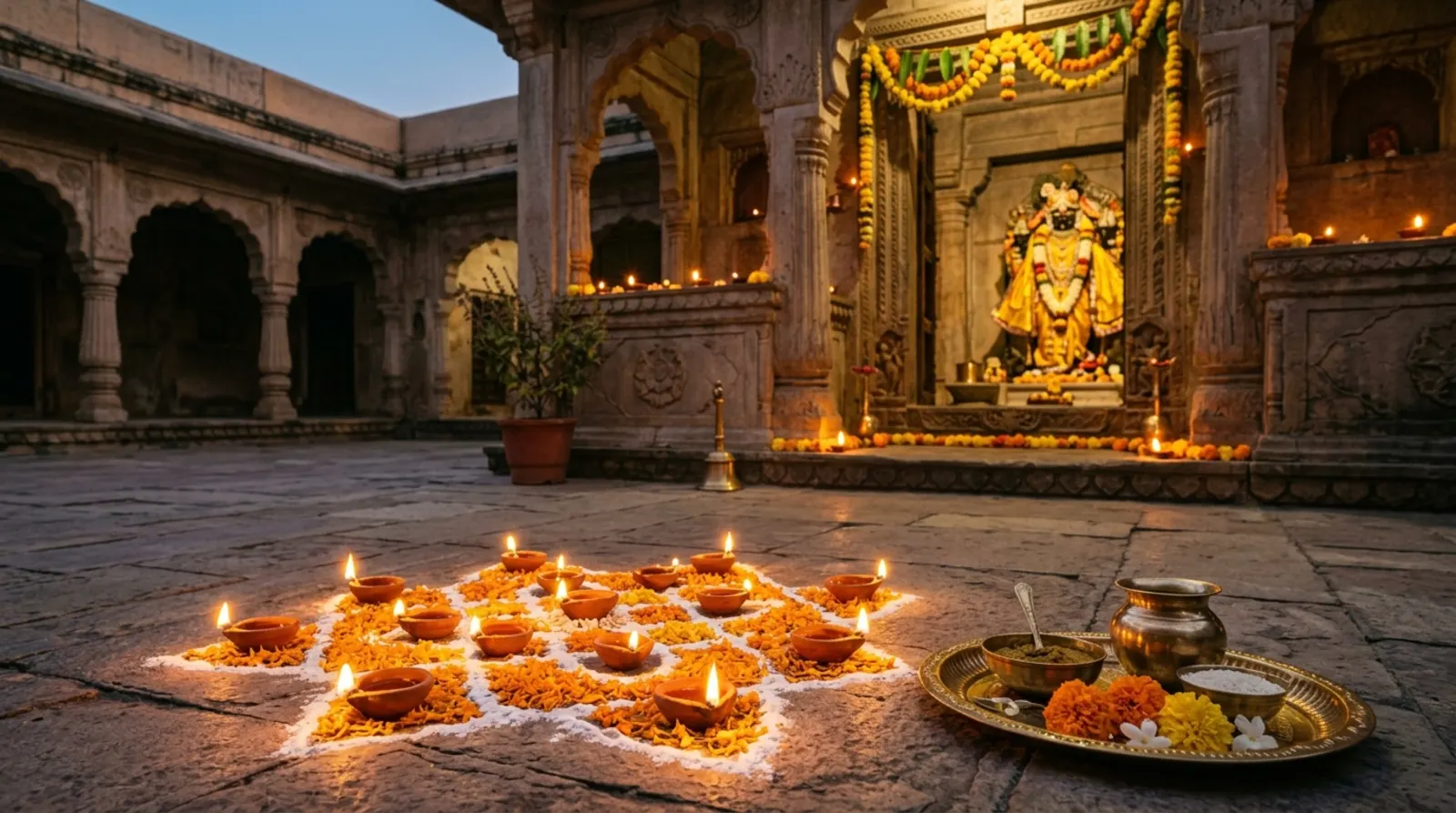
The day begins before sunrise during Arunodaya (pre-dawn twilight). Devotees massage the body with pure sesame oil followed by ubtan (a traditional paste made of gram flour, turmeric, sandalwood, and herbs) before taking a purifying bath. In many homes, people circle an Apamarga (prickly chaff) twig over the head to symbolize washing away negative influences. In the evening, families light rows of earthen oil lamps—traditionally fourteen diyas (Chaudas ke Diye)—at the entrance of the house, near the Tulsi plant, and around the courtyard. Sweets are shared with neighbors, and in southern states, new garments are worn immediately after the dawn bath.
When does it occur?
Narak Chaturdashi is observed on Kartik Krishna Chaturdashi. The Abhyanga Snan is timed before sunrise while Chaturdashi tithi prevails: in Arunodaya Kaal (four ghatikas, about 96 minutes, before sunrise), and many panchangs fix it by moonrise within that time. Because the bath follows the pre-dawn tithi, in some years it falls on the same morning as Lakshmi Puja day. The evening lamps are lit at dusk.
Key Highlights
Slaying of Narakasura
Remembers Lord Krishna's victory over Narakasura, with Satyabhama at his side, and the freeing of thousands of captives.
Abhyanga Snan
A sacred pre-dawn bath with sesame oil and herbal ubtan during Arunodaya Kaal, symbolizing physical cleansing, vitality, and inner renewal.
Fourteen Diyas (Chaudas Deepak)
A folk custom of lighting fourteen earthen lamps in the evening at the doorway, near the Tulsi plant and around the home, as a sign of light over darkness.
Regional Traditions
Observed as Roop Chaudas in the North for natural radiance, Kali Chaudas in Gujarat for protection, and the primary Deepavali dawn in South India.
Frequently asked questions
Why is Abhyanga Snan performed before sunrise on Narak Chaturdashi?
A traditional verse cited in the dharma texts says that on this morning Lakshmi dwells in oil and Ganga in water, so a bath with sesame oil before sunrise is held to be especially sacred. By tradition this bath is also said to spare a person from naraka (hell), which is one explanation of the name of the day. Popular belief links it to Lord Krishna's bath after his victory over Narakasura.
Why did Satyabhama go with Lord Krishna to fight Narakasura?
In the Srimad Bhagavatam, Satyabhama rides with Krishna on Garuda and Krishna defeats Narakasura. A later, widely told tradition says that Narakasura, a son of Bhudevi (Mother Earth), could die only at his mother's hand, and that Satyabhama, regarded as Bhudevi's incarnation, struck the final blow. Both tellings are current today.
Why are fourteen lamps lit on Narak Chaturdashi?
The festival falls on the fourteenth tithi (Chaturdashi), and it is a folk custom, not a scriptural rule, to light fourteen earthen lamps that evening. Families place them at the main entrance, in the courtyard and near the Tulsi plant, ahead of Diwali the next day. The number and placing vary from home to home.
How does Kali Chaudas differ from Narak Chaturdashi?
Both fall on the same lunar date, but emphasize different devotional moods. While Narak Chaturdashi focuses on Krishna's victory and morning Abhyanga Snan, Kali Chaudas—prevalent in Gujarat and western regions—involves evening or midnight prayers to Goddess Mahakali or Hanuman ji to ward off negative influences and fear.
Why is this day celebrated as the main Diwali in South India?
In southern traditions (Tamil Nadu, Karnataka, Andhra Pradesh), Deepavali celebrates the dawn moment when Lord Krishna eliminated Narakasura. Thus, families wake before sunrise on Chaturdashi for the holy oil bath (Ganga Snanam), wear new clothes, burst fireworks at dawn, and enjoy festive feasts as their primary celebration.