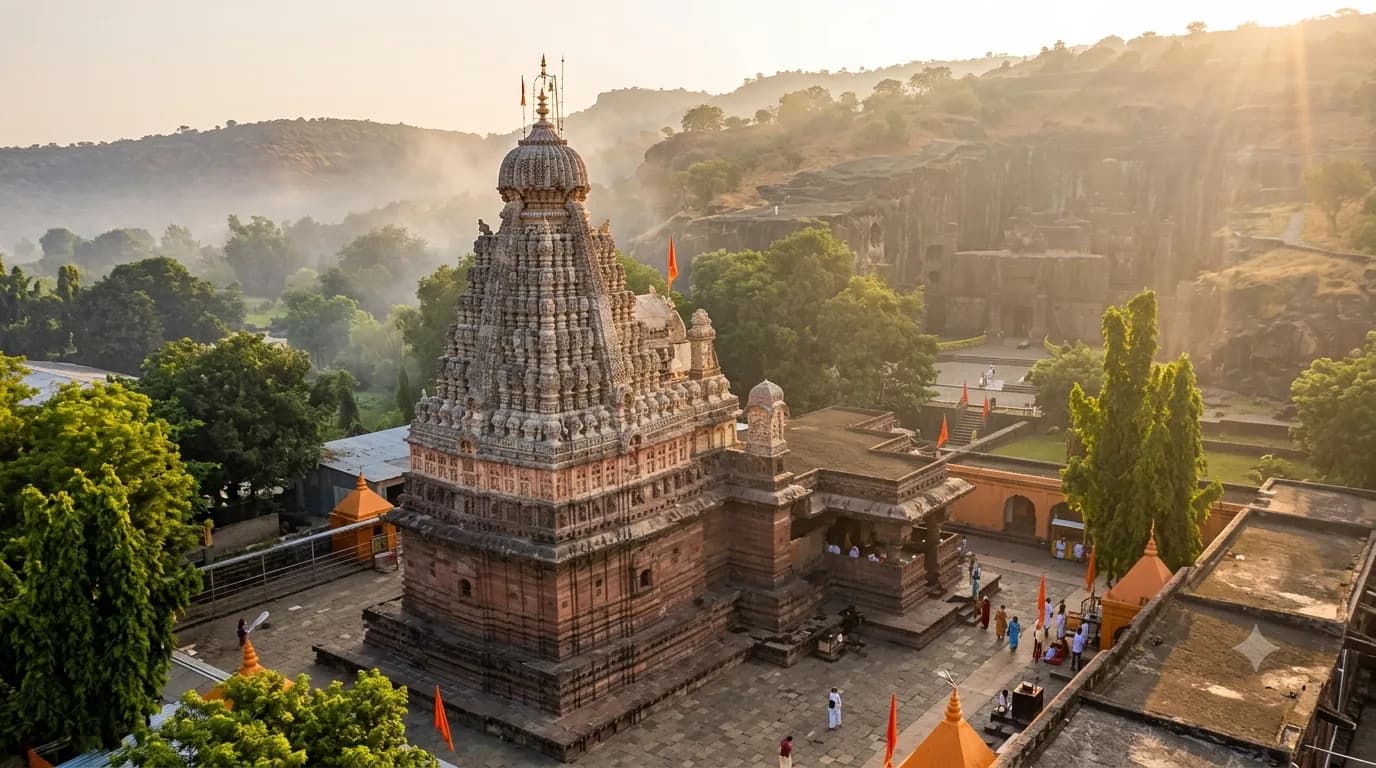
Verul, near Ellora Caves, Chhatrapati Sambhaji Nagar, Maharashtra
घृष्णेश्वर (घुश्मेश्वर) ज्योतिर्लिंग मंदिर
Grishneshwar (Ghushmeshwar) Temple
द्वादश ज्योतिर्लिंगों में बारहवां एवं अंतिम पावन धाम, जो विश्वप्रसिद्ध एलोरा गुफाओं के समीप वेरुल गांव में स्थित है। यह शिवभक्त घुश्मा के अटूट विश्वास, मातृस्नेह और क्षमाभाव की अमर गाथा है। वर्तमान लाल पत्थर के भव्य मंदिर का पुनर्निर्माण इंदौर की पुण्यश्लोका महारानी अहिल्याबाई होल्कर ने कराया था।
वेरुल की पावन धरा पर बारहवां ज्योतिर्लिंग
The Final Pillar of Cosmic Light at Verul
Grishneshwar (also known scripturally as Ghushmeshwar or Kusumeshwar) is situated in the historic village of Verul, approximately 30 kilometres northwest of Chhatrapati Sambhaji Nagar (formerly Aurangabad) in the Marathwada region of Maharashtra.
The temple sits less than a single kilometre from the rock-cut **Ellora Caves**, a UNESCO World Heritage site that houses Cave 16—the breathtaking 8th-century monolithic Kailasa Temple. While Kailasa represents the pinnacle of ancient architectural engineering, Grishneshwar stands as the living, continuously worshipped spiritual heart of the valley.
Enshrined within an intimate subterranean sanctum is the Swayambhu (self-manifested) Jyotirlinga, facing east. The lingam sits within a polished stone argha, perpetually bathed in cool water from natural underground springs. Completing a darshan at Grishneshwar is traditionally considered the concluding pinnacle of the pan-Indian Dwadash Jyotirlinga Yatra, sealing the pilgrim's spiritual vows with the grace of divine forgiveness.
सती घुश्मा की अनन्य भक्ति और क्षमा का दिव्य वरदान
The Legend of Ghushma: Supreme Devotion and Forgiveness
The origin of the Ghushmeshwar Jyotirlinga is lovingly recounted across chapters 32 and 33 of the Koti Rudra Samhita of the Shiva Purana.
A learned and pious Brahmin named Sudharman lived near the Devagiri mountain with his devoted wife, Sudeha. Despite years of righteous living, the couple remained childless. Distressed by societal scorn, Sudeha urged her husband to take a second wife and insisted that he marry her own younger sister, **Ghushma**.
Ghushma was a devotee of unmatched purity and spiritual discipline. Every morning before dawn, she fashioned one hundred and one small Shiva lingams from fresh river clay, worshipped each with bilva leaves and sandalwood paste, and immersed them one by one into the nearby lake (**Shivalaya Sarovar**).
Pleased by her steadfast surrender, Lord Shiva blessed Ghushma with a radiant baby boy. The boy grew into a handsome, virtuous youth and was married into an honorable family. Seeing her sister showered with praise and motherhood while she remained barren, Sudeha's mind became poisoned by bitter jealousy.
One night, while the young man slept, Sudeha slit his throat with a knife and dragged his body to the Shivalaya lake, dumping it into the depths.
The following morning, when the young bride discovered the bloodstained bed, the household was plunged into uncontrollable lamentation. But Ghushma remained extraordinarily composed. Her faith in Lord Shiva was so absolute that she refused to disrupt her morning worship: > *"He who gave me this child is the master of life and death. The Lord giveth, and the Lord taketh away. I shall not abandon His worship."*
With tears quietly rolling down her cheeks, Ghushma completed the shaping of her 101 clay lingams, walked serenely to the Shivalaya lake, and immersed them as she did every single day.
As she turned to walk home, her son emerged alive and unharmed from the waters of the lake, running to embrace her. Simultaneously, Lord Shiva appeared before them in blazing celestial light, His third eye flaring with divine wrath. Shiva raised His trident to strike down the treacherous Sudeha for her horrific crime.
At that supreme moment, Ghushma did something that stunned the gods: falling prostrate at Shiva's lotus feet, she begged for her sister's life: > *"O Lord of Mercy! If Thou art truly pleased with my humble prayers, do not slay my sister. Forgive her ignorance, for it was through her that I became a mother, and through her that I have received Thy divine vision today."*
Overwhelmed by such superhuman compassion and lack of malice, Lord Shiva forgave Sudeha. Turning to Ghushma, Mahadeva proclaimed that He would abide at that sacred lake forever under her name as **Ghushmeshwar**, promising that any devotee who bathes in the Shivalaya tank and worships this Jyotirlinga with an open, forgiving heart will be freed from ancestral grief, washed of sins, and granted progeny and peace.
अहिल्याबाई होल्कर की स्थापत्य देन और भोसले वंश
Architectural Grandeur: The Holkar Legacy
The Grishneshwar temple displays exquisite South-Indian influenced Maratha temple architecture, constructed entirely from high-grade reddish-pink Deccan basalt that gleams with a warm hue in morning and evening light.
The historical trajectory of the temple includes two profound milestones: - **Maloji Bhosale**: In the late 16th century, Maloji Raje Bhosale (the grandfather of the legendary founder of the Maratha Empire, Chhatrapati Shivaji Maharaj) was the Patil of Verul. Tradition holds that while repairing the Shivalaya pond, Maloji discovered a hidden hoard of buried treasure. Viewing it as the grace of Mahadeva, he dedicated the wealth to renovating the temple and expanding the stone water tank, laying the foundation for the family's rise. - **Maharani Ahilyabai Holkar**: The present magnificent structure was constructed in the late 18th century by the saintly queen of Indore, **Punyasloka Rajmata Ahilyabai Holkar**, who rebuilt sacred Hindu sanctuaries from Somnath to Kashi.
The temple features a compact 44.4 ft by 61.2 ft courtyard enclosed by sturdy stone ramparts. The crowning glory is its **five-tier carved shikhara**, rising 24 metres high. The stone exterior is adorned with finely chiseled reliefs depicting: - The ten Avatars of Lord Vishnu (*Dashavatara*) - Lord Shiva playing the Veena (as Vinadhara) and performing the cosmic Tandava - Musicians, celestial dancers (Apsaras), and caparisoned elephants supporting the lower friezes - A magnificent stone Nandi bull seated inside the sabhamandapa facing the Garbhagriha.
पूजा विधान, स्पर्श दर्शन और नियम
Worship Rituals and Pilgrimage Tradition
Grishneshwar preserves an open, deeply intimate worship culture. During normal darshan hours, male devotees who remove their shirts and leather items are permitted to step into the Garbhagriha to perform personal **Sparsha Darshan** and offer Ganga water and bilva patra directly upon the holy Jyotirlinga.
Key daily services: - **Mangal Aarti**: 5:30 AM (waking of the deity) - **Jalabhisheka & Rudrapath**: 6:00 AM to 11:30 AM - **Madhyahna Bhog Aarti**: 12:00 PM (noon meal offering) - **Sandhya Aarti & Shringar**: 7:30 PM (evening decorative darshan with fragrant flowers and chandan) - **Shej Aarti**: 9:30 PM (closing night prayers).
Pilgrims traditionally begin their visit by visiting the **Shivalaya Sarovar** (a short 200-metre walk from the temple), offering arghya water in memory of Ghushma's steadfast faith before entering the temple courtyard.
दर्शन और यात्रा की जानकारी
Because Grishneshwar is located right next to the Ellora Caves, pilgrims typically spend half a day visiting the Jyotirlinga and the other half exploring the rock-cut Kailasa Temple.
मंदिर कैसे पहुँचें
Many pilgrims combine Grishneshwar with the famous Shirdi Sai Baba shrine (105 km west) and the Shani Shingnapur temple (130 km south) into a single 2-day circuit.
आस-पास के पवित्र स्थल
UNESCO World Heritage site featuring 34 rock-cut cave temples; Cave 16 is the world's largest monolithic rock excavation, carved out of a single basalt cliff.
Grishneshwar is the twelfth and final Jyotirlinga in the traditional pan-Indian circuit of 12 luminous Shiva shrines.
World-renowned sanctuary of the revered 19th-century saint Sai Baba, frequently visited alongside Grishneshwar.
One of only three temples in India enshrining Lord Hanuman in a unique reclining (sleeping) posture.
Neighboring Jyotirlinga at the origin of the Godavari river.
Sixth Jyotirlinga in the Sahyadri ranges of Maharashtra.
स्रोत
- Maharashtra Tourism Development Corporation (MTDC)(government)
- Archaeological Survey of India (ASI), Aurangabad Circle(government)
- Shiva Purana, Koti Rudra Samhita (Chapters 32–33)(scripture)
- Gazetteer of the Bombay Presidency: Aurangabad District (1884)(historical)
त्वरित लिंक और संबंधित तीर्थ
अन्य प्रमुख पवित्र धाम, ज्योतिर्लिंग एवं तीर्थ यात्राओं का अन्वेषण करें।