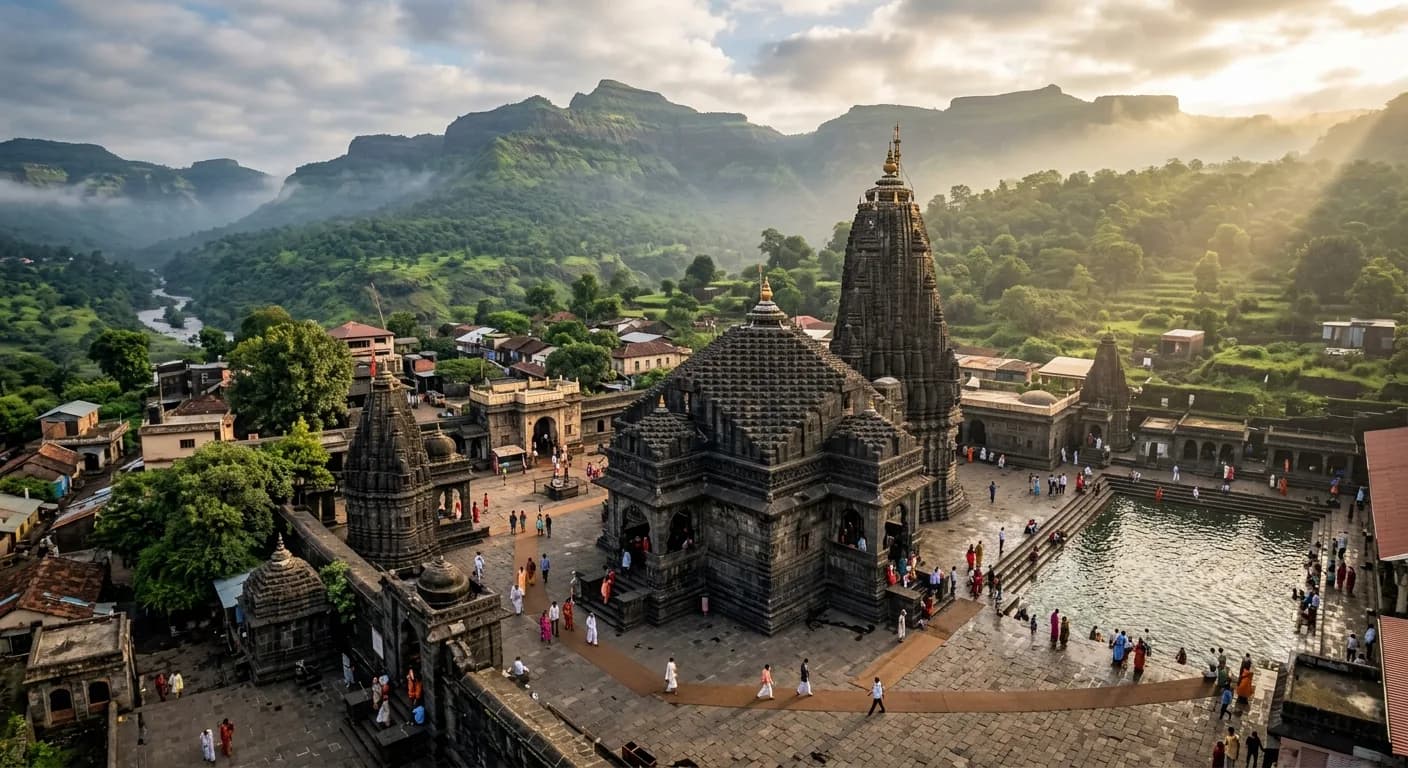
One of the twelve sacred Jyotirlingas, situated at the foothills of Brahmagiri mountain near Nashik where the holy Godavari originates; unique among all Jyotirlingas for its three-faced lingam embodying Brahma, Vishnu, and Rudra.
त्रिमुख स्वरूप — ब्रह्मा, विष्णु और महेश
The Three Faces of the Divine
Trimbakeshwar is situated 28 kilometres southwest of Nashik in Maharashtra, nestled directly beneath the rugged basalt cliffs of Brahmagiri mountain in the Western Ghats.
Unlike every other Jyotirlinga in India where the emblem represents Lord Shiva exclusively, the sanctum sanctorum of Trimbakeshwar houses an extraordinary hollow cavity within the stone yoni (arghya) containing three small thumb-sized natural lingams. These three lingams represent the Hindu Trinity (Trimurti): 1. **Brahma** (the Creator) 2. **Vishnu** (the Sustainer) 3. **Rudra / Shiva** (the Transformer)
Because it embodies all three cosmic principles simultaneously, the shrine is traditionally addressed as Tryambakeshwar—'The Lord of the Three Faces' or 'The Three-Eyed Lord.' A constant flow of natural spring water trickles into the cavity around the three lingams. On special ceremonial occasions, a breathtaking historic gold crown encrusted with diamonds, rubies, and emeralds is ceremonially placed over the lingams during the afternoon darshan.
ऋषि गौतम की तपस्या और दक्षिण गंगा
Sage Gautama and the Descent of the Godavari
The sacred geography of Trimbakeshwar is inseparable from the river Godavari, reverently hailed across peninsular India as the Dakshina Ganga (Ganga of the South).
According to the extensive narrative in the Shiva Purana and the Padma Purana, a catastrophic drought lasting 24 years once parched the subcontinent. Sage Gautama maintained an ashrama here on Brahmagiri, miraculously feeding thousands of sages and seekers through the fruits of his deep penance. When lesser hermits grew envious and plotted against him, an unintended incident caused the death of a cow (Gau-hatya).
Distressed, Gautama undertook severe austerities to propitiate Shiva and requested that the celestial river Ganga descend upon Brahmagiri to purify the land and absolve the blemish. Shiva agreed, descending as the Jyotirlinga, while Goddess Ganga manifested from the mountain rock as the Godavari River. Overwhelmed by the grace, Gautama formed a sacred pool with kusha grass (the Kushavarta Kund) to hold the sacred waters.
कुशावर्त तीर्थ और सिंहस्थ कुंभ
Kushavarta Kund and the Sinhastha Kumbh Mela
Situated just 200 metres from the main temple, Kushavarta Kund is the consecrated rectangular stone tank where the subterranean waters of the Godavari emerge into public access.
Kushavarta is considered one of the holiest tirthas in western India. It was comprehensively reconstructed in 1750 CE by Shrimant Sardar Phadke of the Maratha Empire, featuring broad flights of stone steps, decorative arched verandas, and corner pavilions where pilgrims perform ancestral rites and ritual ablutions.
Trimbakeshwar and nearby Nashik are one of the four traditional hosts of the Kumbh Mela. When the planet Jupiter enters the zodiac sign of Leo (Simha rashi), the grand Sinhastha Kumbh Mela commences. During this sacred celestial alignment, millions of sadhus from the Shaiva Akhadas—led by the Naga babas—take their ceremonial Shahi Snan (royal bath) in Kushavarta Kund before offering worship at the Jyotirlinga.
पेशवा कालीन स्थापत्य और काष्ठ-शिला शिल्प
Peshwa Architecture in Black Basalt
The present magnificent stone temple was constructed under the direct patronage of Shrimant Balaji Baji Rao (Nana Saheb Peshwa), the third Peshwa of the Maratha Empire, between 1755 and 1786 CE at the immense cost of 16 lakh rupees.
Built entirely of finely dressed local black basalt, the temple exhibits the Hemadpanthi architectural tradition adapted to the later Maratha style. The shikhara rises symmetrically with deep vertical flutings and intricate geometric moldings, crowned by a gold kalasha. The temple is protected within an expansive stone courtyard surrounded by a high defensive bastion wall.
The spacious assembly hall (sabhamandapa) features three stone entrance porches (mukhamandapas) oriented toward the cardinal directions, their interiors chiseled with depictions of celestial dancers, musicians, and guardian deities that have weathered centuries of monsoon rains without losing their crisp relief.
दर्शन और यात्रा की जानकारी
Special religious rituals (such as Narayan Nagbali, Kalsarpa Shanti, and Tripindi Shraddha) are conducted in designated ritual halls around Trimbak by authorized family priests.
मंदिर कैसे पहुँचें
During Shravan month, particularly on Mondays, vehicular traffic is regulated outside Trimbak town due to the influx of walking pilgrims (Warkaris).
आस-पास के पवित्र स्थल
Trimbakeshwar is the eighth sacred Jyotirlinga, unique for enshrining the Holy Trinity: Brahma, Vishnu, and Rudra.
The 1,295-metre mountain where the Godavari river originates; Gangadwar features 750 stone steps leading to the natural spring where the river first emerges.
The sacred rectangular stone pond where the subterranean Godavari reappears; central bathing tirtha for the Kumbh Mela.
A picturesque mountain fortress widely revered across Maharashtra as the sacred birthplace of Lord Hanuman.
The sacred forest enclave on the Godavari bank in Nashik where Sri Rama, Sita, and Lakshmana lived during their exile.
Neighboring Jyotirlinga in the Sahyadri ranges, frequently visited together on the Maharashtra Jyotirlinga circuit.
Twelfth Jyotirlinga located near the Ellora Caves in Chhatrapati Sambhaji Nagar, Maharashtra.
स्रोत
- Shri Trimbakeshwar Devasthan Trust(official)
- Maharashtra Tourism Development Corporation (MTDC)(government)
- Shiva Purana, Koti Rudra Samhita (Chapters 24–27)(scripture)
- Archaeological Survey of India (ASI), Mumbai Circle(government)
- Gazetteer of Bombay Presidency: Nasik District (1883)(historical)
त्वरित लिंक और संबंधित तीर्थ
अन्य प्रमुख पवित्र धाम, ज्योतिर्लिंग एवं तीर्थ यात्राओं का अन्वेषण करें।