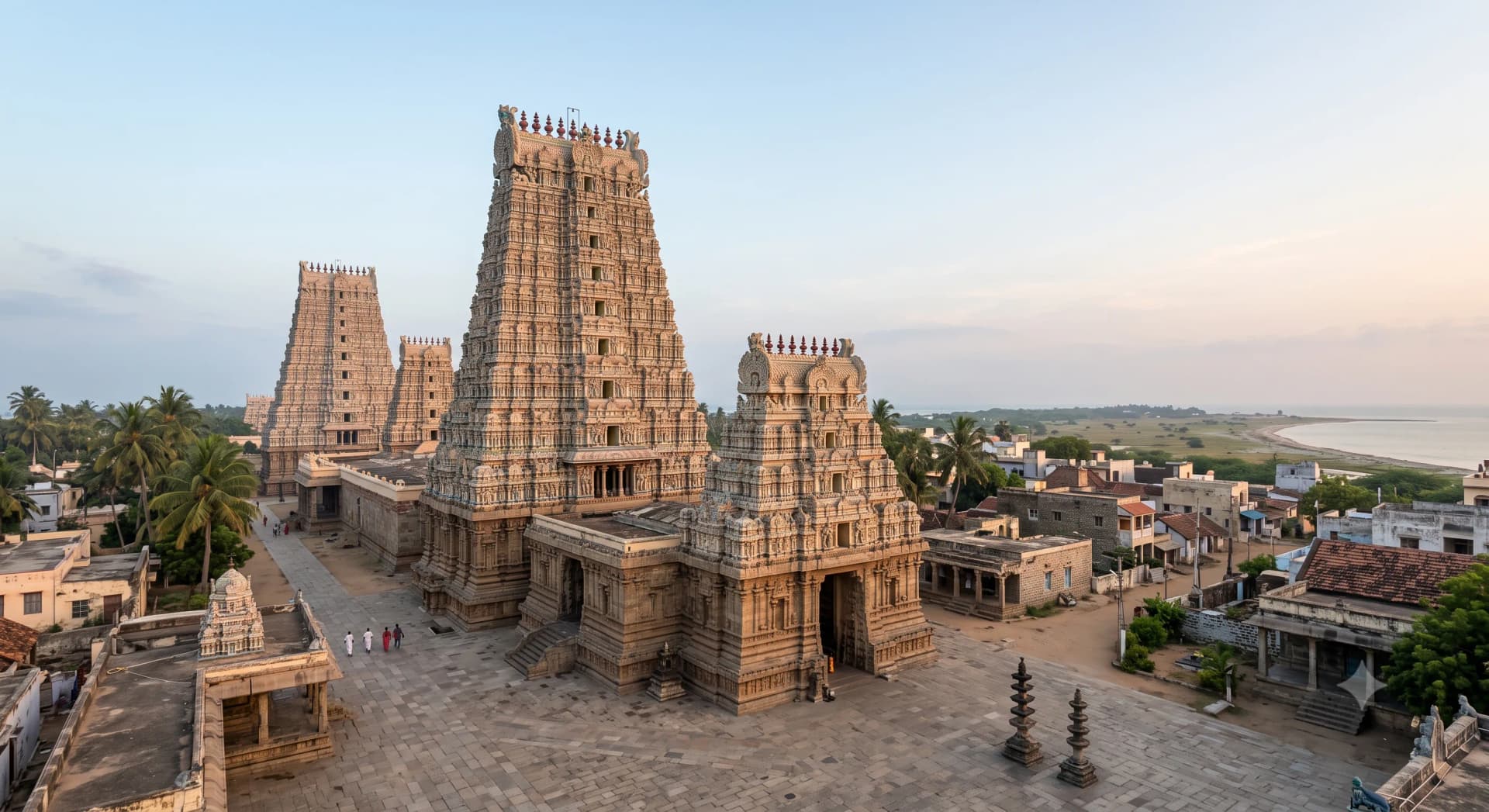
Rameswaram Island, Ramanathapuram District, Tamil Nadu
Ramanathaswamy (Rameswaram)
रामनाथस्वामी (रामेश्वरम)
The southern pillar of the pan-Indian Char Dham and the southernmost of the twelve Jyotirlingas, situated on Pamban Island where tradition recounts that Lord Rama consecrated the Shiva lingam to atone for Brahmahatya dosha after defeating Ravana.
The Sanctification by Sri Rama
प्रभु श्रीराम द्वारा स्थापना और विन्ध्येश्वर लिंग
Ramanathaswamy Temple stands on Pamban Island in the Gulf of Mannar, separated from mainland India by the Pamban Channel. The temple occupies an extraordinary theological intersection: while dedicated to Lord Shiva, it is venerated with equal intensity by Vaishnavas due to its intimate connection with Sri Rama.
According to classical accounts in the Valmiki Ramayana and the Setu Mahatmya of the Skanda Purana, Lord Rama arrived at this shoreline after slaying Ravana in Lanka. To cleanse the karmic transgression of slaying a Brahmin king (Brahmahatya dosha), Rama resolved to perform worship to Shiva. He dispatched Hanuman to Mount Kailash to fetch an authentic Shiva lingam.
When the auspicious astrological moment (muhurta) arrived and Hanuman had not yet returned across the vast distance, Sita Devi lovingly fashioned a lingam from the fine seashore sand. Rama consecrated this sand lingam, naming it Ramalingam. When Hanuman returned bearing two crystal lingams from Kailash and was heartbroken to find the installation complete, Rama compassionately installed Hanuman's lingam as the Vishwalingam beside the Ramalingam and decreed that for all time to come, the Vishwalingam must be worshipped first before the Ramalingam—a protocol scrupulously maintained by priests today.
Dravidian Architectural Grandeur and the Long Corridors
भव्य स्तंभयुक्त गलियारे और वास्तुकला
The present structural temple is a masterpiece of late Dravidian architecture, patronized extensively between the 12th and 17th centuries by the Sethupathi chieftains of Ramnad, along with rulers from the Pandya and Jaffna dynasties.
The crowning architectural wonder of Ramanathaswamy is its network of monumental pillared corridors (prakaras). The outer third corridor is among the longest temple hallways in the world, stretching approximately 197 metres east-to-west and 133 metres north-to-south, supported by more than 1,200 masterfully chiseled granite pillars. Each pillar is carved with elaborate capitals, rearing yalis (mythical leonine beasts), and intricate scrollwork. The floor is paved with polished stone, creating a perspective of rhythmic stone columns that seems to converge at infinity.
The complex is enclosed by massive granite perimeter walls measuring 865 feet by 657 feet and entered through majestic eastern and western rajagopurams that rise sharply above the palm-fringed island landscape.
The 22 Sacred Wells of Purification
बायस तीर्थ स्नान — बाइस पावन कूप
A distinctive and deeply moving dimension of the Rameswaram pilgrimage is the Snana (holy bath) in the 22 consecrated theerthams (freshwater wells) situated entirely within the temple enclosure.
Pilgrims traditionally begin their journey before dawn at Agni Theertham, the tranquil sea beach facing the eastern gateway of the temple, offering prayers and taking a ritual dip in the ocean. Returning into the temple complex, devotees proceed systematically from one well to the next—bearing names such as Mahalakshmi Theertham, Gayatri, Savitri, Saraswati, Chakra, Surya, and Koti Theertham.
Temple attendants draw water from each stone well and pour a ceremonial bucket over each pilgrim's head. Despite their close proximity to the salty waters of the ocean, every one of the 22 internal wells yields sweet, distinct freshwater of varying mineral character and temperature. The experience concludes with a change into dry clothes before entering the inner sanctum to view the Spatika (crystal) Lingam and Ramanathaswamy.
Dhanushkodi and Rama Setu
धनुषकोडी और रामसेतु की पावन सीमा
Approximately 18 kilometres south of the main temple lies Dhanushkodi, the easternmost tip of Pamban Island where the serene waters of the Bay of Bengal (Mahodadhi) meet the rough, deep currents of the Indian Ocean (Ratnakara).
Tradition holds that Sri Rama marked the starting point of the bridge to Lanka with the tip of his bow (Dhanush), giving the location its name. Satellite imagery and marine surveys document a submerged chain of limestone shoals and coral reefs extending 48 kilometres across the Palk Strait between Dhanushkodi and Talaimannar in Sri Lanka—revered for centuries in Indian tradition as Rama Setu.
The surrounding maritime landscape, punctuated by migratory bird sanctuaries and windswept sandbars, gives the pilgrim an immediate sense of the ancient geographical boundary between the Indian mainland and the ocean crossing recounted in the epic.
Darshan & Visit
Footwear must be deposited at designated counters outside the temple complex. Electronic devices and mobile phones are prohibited inside the inner corridors.
How to Reach
Driving across the Pamban Road Bridge offers sweeping panoramic vistas of the blue Gulf of Mannar and the historic cantilever railway bridge.
Nearby Sacred Sites
Rameswaram (Ramanathaswamy) is the eleventh Jyotirlinga, consecrated by Sri Rama on the southern ocean shore.
The southern pillar of the four pan-Indian Char Dhams established across the four cardinal directions.
The sacred, tide-free Bay of Bengal shoreline directly in front of the eastern gopuram where pilgrims take their first ritual bath.
The highest hillock on the island, housing a shrine with the stone imprint of Sri Rama's feet from where He scouted the ocean toward Lanka.
The dramatic sandspit at the ocean confluence where Sri Rama began the construction of the bridge to Lanka.
Ancient temple situated midway to Dhanushkodi where Vibhishana is traditionally held to have taken refuge under Sri Rama.
Temple housing an icon of five-faced Hanuman and displaying ancient floating porous stones attributed to the construction of Rama Setu.
A unique freshwater spring emerging from a stone well built directly into the salty ocean water, said to have been created by Rama's bow.
Sources
- Hindu Religious & Charitable Endowments (HR&CE) Dept, Tamil Nadu(official)
- Archaeological Survey of India (ASI), Chennai Circle(government)
- Valmiki Ramayana (Yuddha Kanda)(scripture)
- Skanda Purana (Setu Mahatmya section)(scripture)
- James Fergusson, 'History of Indian and Eastern Architecture' (1876)(historical)
Quick Links & Sacred Exploration
Explore other revered temples, Jyotirlingas, and sacred pilgrimage routes across India.