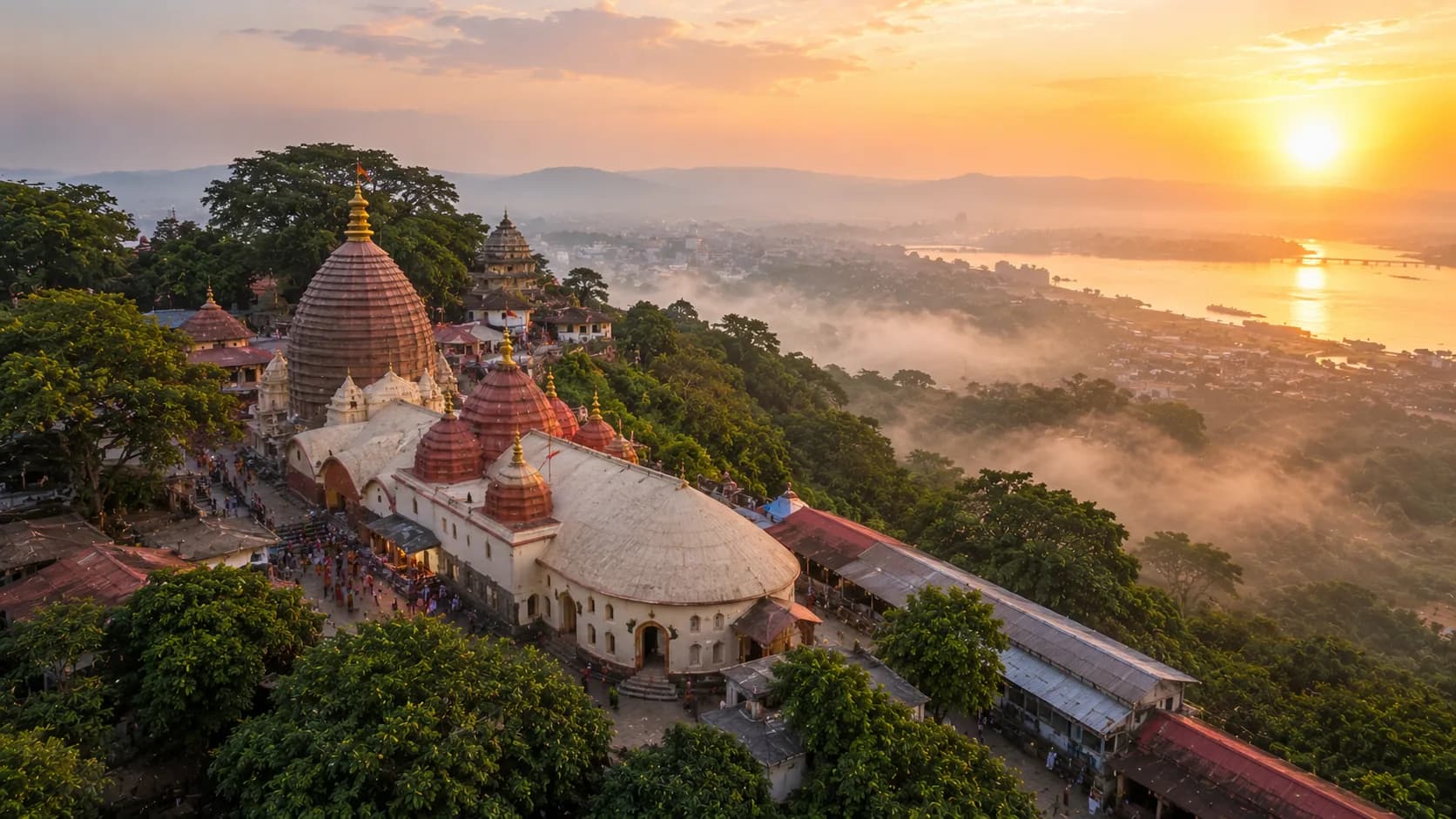
One of the most powerful Shakti Peethas in India — the goddess here is worshipped not as an idol but as a natural cleft in rock, representing the womb of Sati. Kamakhya is the pre-eminent centre of the Tantric tradition and home of the Ambubachi Mela, celebrated as the annual menstruation of the goddess.
The Hill Above the Brahmaputra
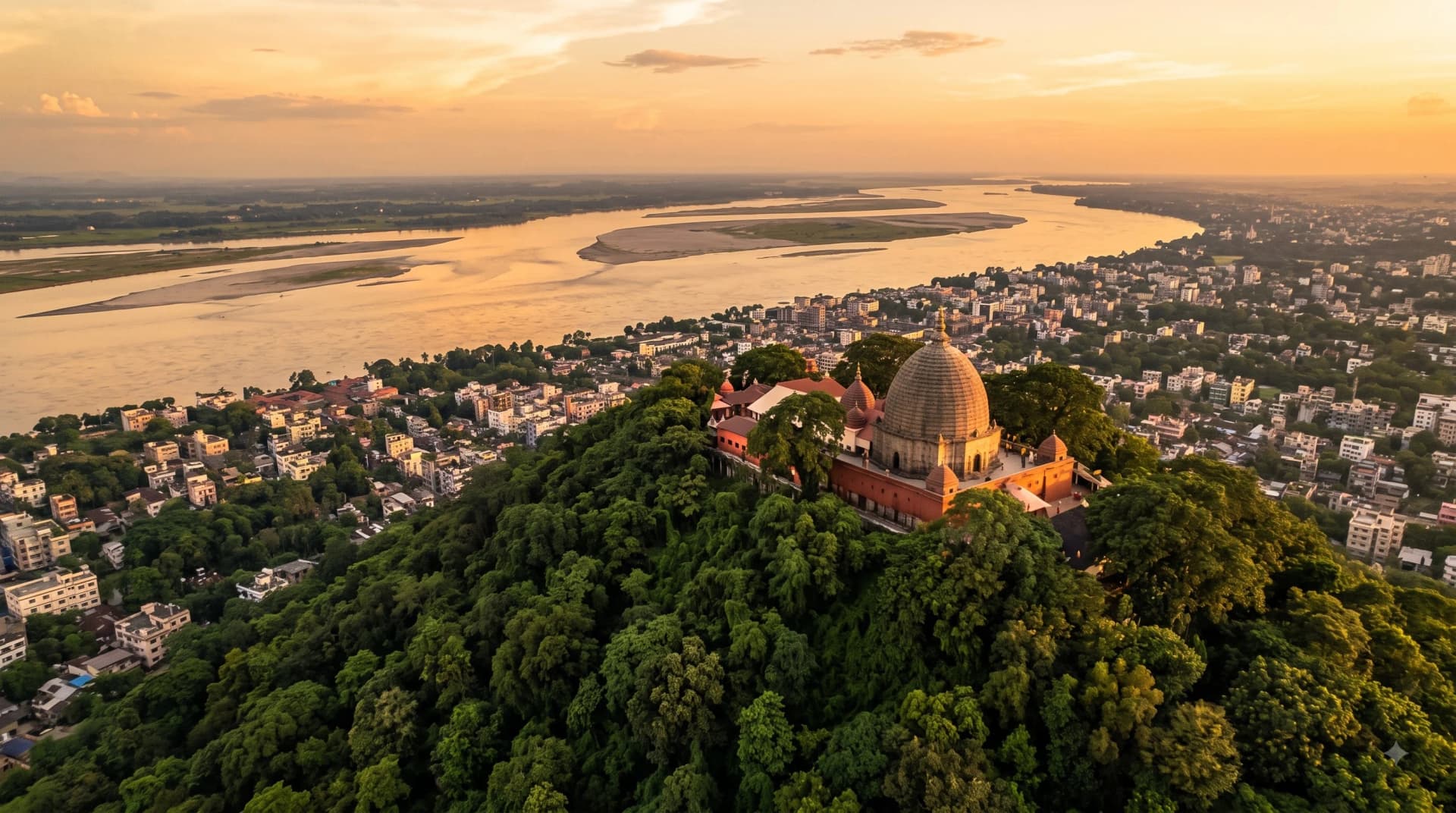
Kamakhya temple stands on the Nilachal Hill (Blue Mountain) at an elevation of approximately 800 feet above the city of Guwahati, Assam. Below the hill, the Brahmaputra river — one of the great rivers of Asia — flows wide and brown through the city. The hill is forested; the approach is through trees.
The goddess worshipped here is Kamakhya — a name interpreted variously as 'She who is desired,' 'She who fulfils desires,' or 'She who is the source of desire (Kama).' The name connects to both the Tantric concept of Shakti as the source of all energy and desire, and to the union of Shiva and Shakti at this site in traditional accounts.
Kamakhya is the most important Shakti Peetha in northeast India and a principal centre of the Tantric tradition — the tradition that works with the energies of the goddess in ritual, meditation, and practice that is more direct and less conventional than mainstream temple worship.
The Shakti Peetha
The Kalika Purana — the primary scriptural source for the Kamakhya tradition — provides the account of how this site became sacred.
When Sati (Shiva's first wife and the daughter of Daksha) died at Daksha's yagna (sacrifice), Shiva in his grief wandered the universe carrying her body. The world was disturbed by his wandering. Vishnu, to free Shiva from this grief, used his Sudarshana Chakra (discus) to cut the body of Sati into pieces as Shiva carried it. The pieces fell at different locations across India, and each location became a Shakti Peetha — a seat of the goddess.
At Kamakhya, the yoni (womb) of Sati is said to have fallen. This is not represented by an anthropomorphic idol. The goddess here is worshipped in the form of a natural cleft in the rock — believed to be the yoni itself — which is kept moist by an underground spring. The sanctum is dark, cut low into the rock of the hill, and the devotee must descend steps to reach the cleft and offer flowers, vermilion, and cloth.
The absence of a conventional idol — and the directness of what is worshipped — is deliberate. Kamakhya is emphatically a Tantric site.
Ambubachi Mela
The Ambubachi Mela, held annually in June (usually Ashadha 7–10 in the Hindu calendar), is the most significant festival at Kamakhya — and one of the most unusual festivals in any tradition.
The Ambubachi marks the annual menstruation of the goddess. For three days, the temple closes completely. In traditional interpretation, the earth itself — and the goddess who is identified with the earth — is in her menstrual period; the land is considered ritually potent but not to be disturbed (no ploughing, no major agriculture). The underground spring beneath the shrine is said to flow red during these days (attributed to iron oxide in the water; in traditional belief, to the goddess's blood).
After three days, the temple reopens. Pilgrims receive as prasad small pieces of red cloth — wet with the spring water — considered among the most potent sacred offerings in the Shakta tradition.
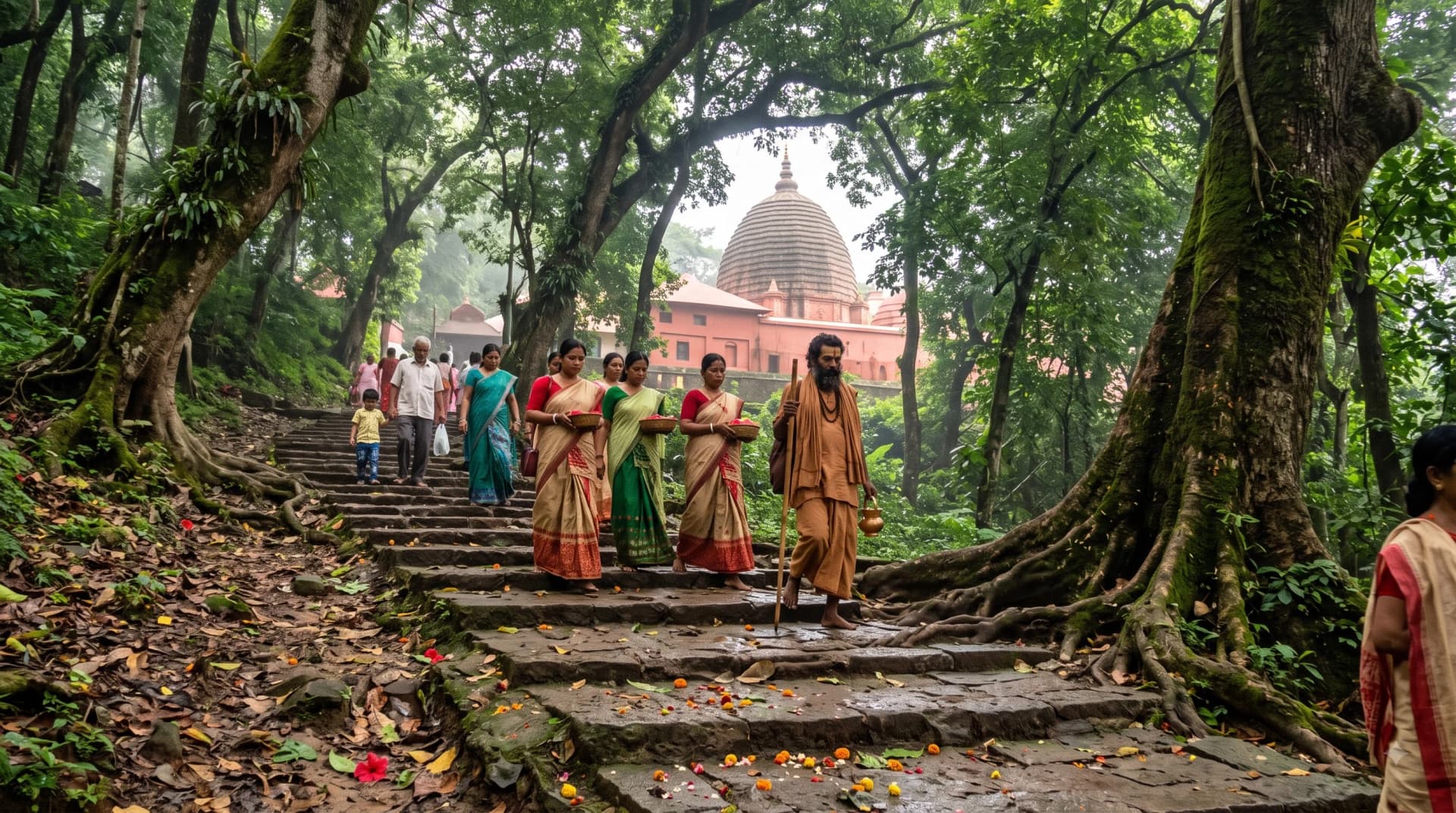
The Ambubachi Mela draws enormous numbers of Tantric practitioners (sadhus, tantriks) from across India and neighbouring countries. The festival functions as a gathering of the Tantric community, though it also draws non-practitioner pilgrims.
History and the Koch Kings
The scriptural tradition of Kamakhya is very old — the Kalika Purana, which is the most detailed text about Kamakhya, is dated by scholars to roughly the 9th–11th centuries CE, and it describes a site and tradition already ancient by that time.
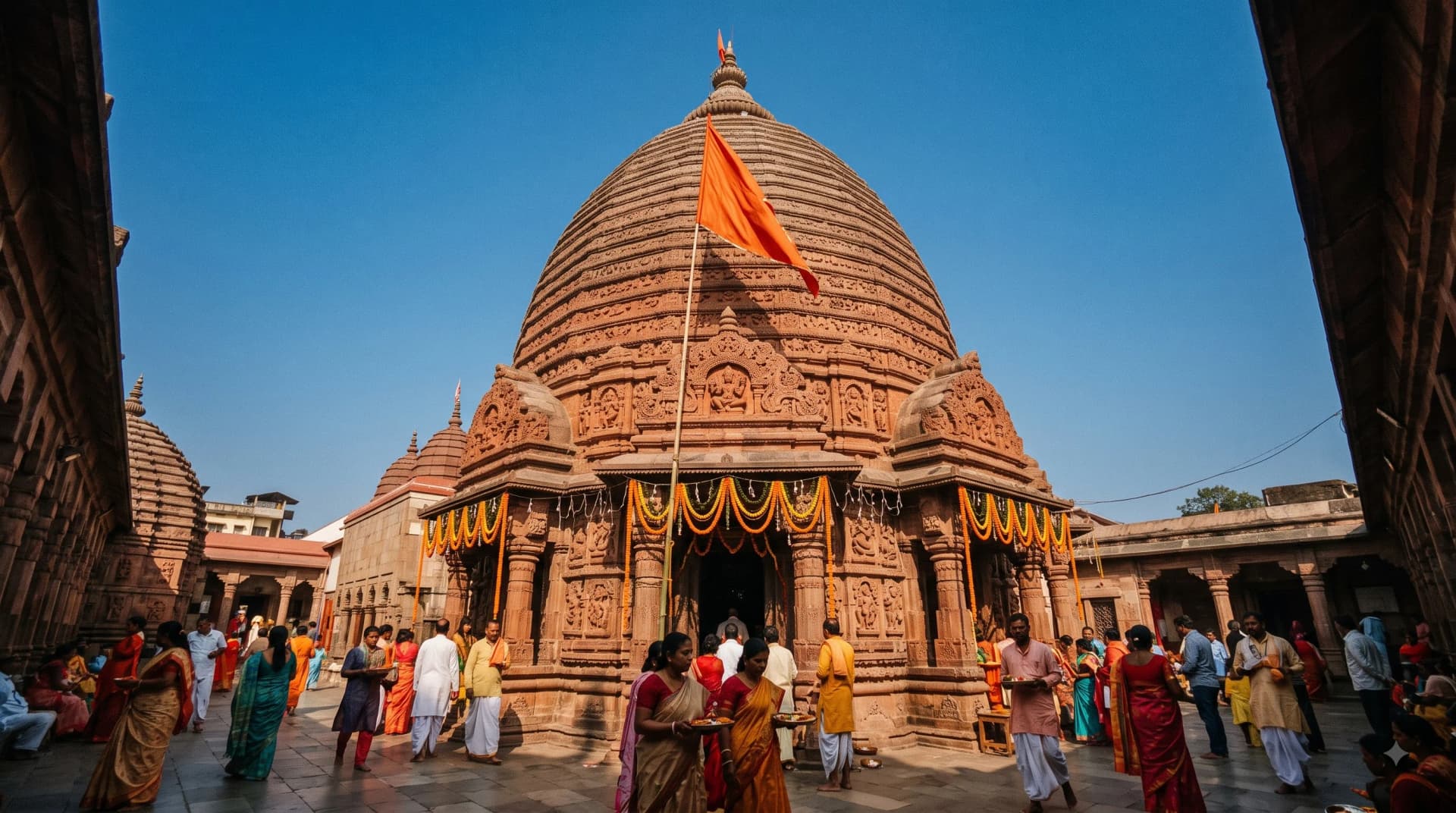
The existing temple structure, however, dates primarily to the 17th century CE. The earlier temple was destroyed in the late medieval period by the Sultan of Bengal (Hussein Shah) in approximately 1498 CE. The rebuilding was undertaken by the Koch king Naranarayana and his brother Chilarai in 1565 CE. The characteristic dome of the Kamakhya temple — the beehive or tortoise-back shape (shikhara in a style unique to Assam) — dates from this Koch period. The temple was further renovated and patronised by subsequent rulers.
The Kamakhya Temple complex includes — in addition to the main shrine — smaller temples to the ten Mahavidyas (the ten tantric forms of the goddess): Kali, Tara, Tripura Sundari, Bhuvaneshwari, Bhairavi, Chhinnamasta, Dhumavati, Bagalamukhi, Matangi, and Kamala. The full pilgrimage involves all ten shrines.
Darshan & Visit
Footwear must be removed. Photography inside the main sanctum is not permitted. The cave path to the inner sanctum is narrow and requires bending low — pilgrims should be prepared.
How to Reach
Nearby Sacred Sites
Kamakhya is celebrated as the premier Adi Shakti Peetha within the pan-Indian Shakti Peetha pilgrimage.
Shiva temple on a small island in the Brahmaputra; accessible by ferry
Another important Devi temple in the city
Ruins of ancient temple complex from the 9th–12th century CE; sometimes called the 'Khajuraho of Assam'
Temple of the nine planets — unique in Indian temple practice
Sources
- Kalika Purana (primary scriptural source for Kamakhya tradition)(scripture)
- Kamakhya Temple official (kamakhyatemple.org)(official)
- Assam State Archives — Koch dynasty inscriptions and temple records(historical)
- Archaeological Survey of India, Assam Circle(government)
- Wikipedia — Kamakhya Temple (cross-check)(reference)
Quick Links & Sacred Exploration
Explore other revered temples, Jyotirlingas, and sacred pilgrimage routes across India.