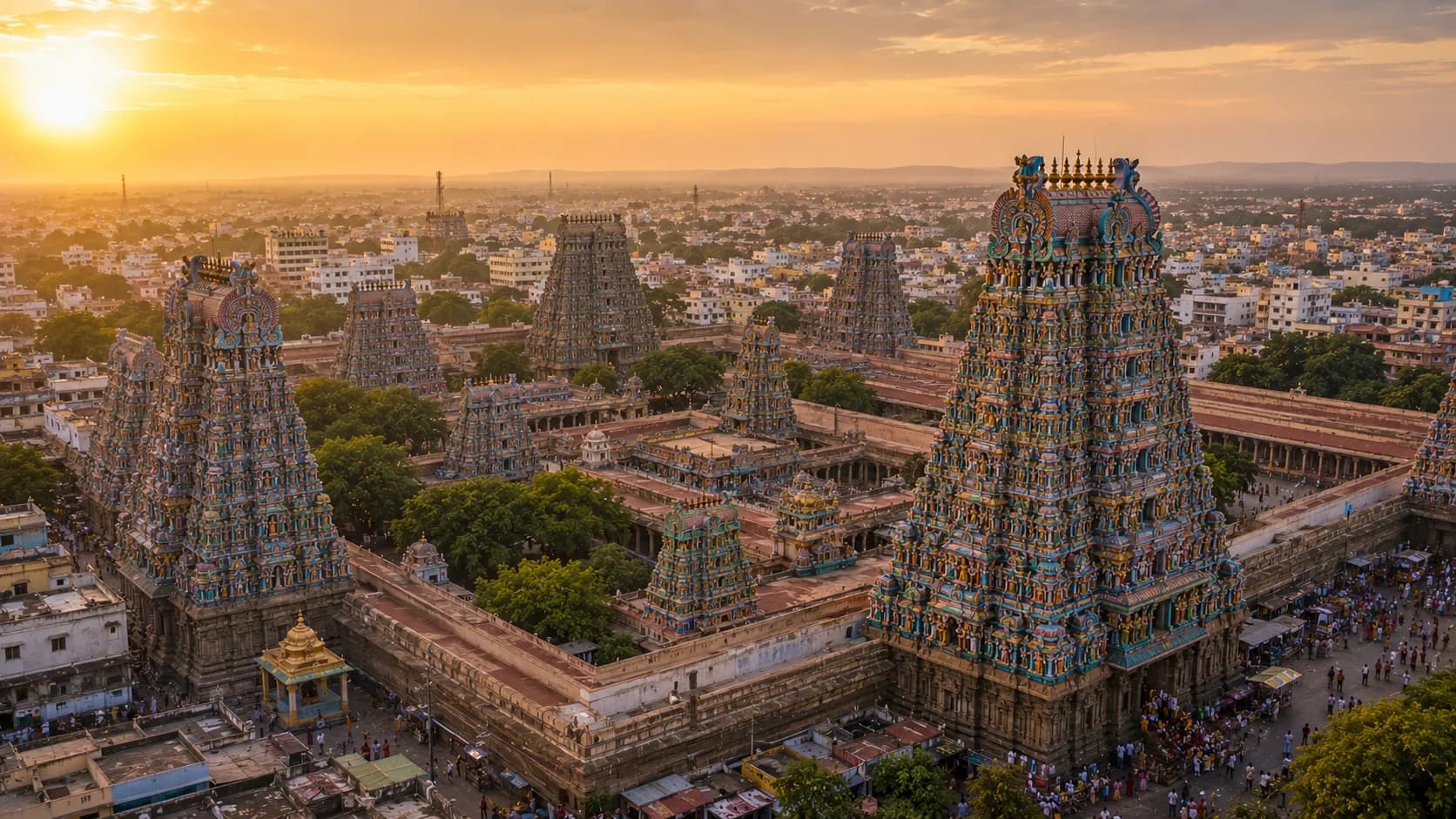
One of the oldest continuously active temples in India, Meenakshi Amman in Madurai is a masterwork of Dravidian architecture — 14 towering gopurams, thousands of sculptures, and a tradition unbroken since at least the Sangam period. The goddess Meenakshi, not her consort, is the primary deity.
The City of the Goddess
Madurai is one of the oldest cities in South Asia, with continuous habitation documented from at least the 3rd century BCE. Sangam literature — the oldest body of Tamil poetry, composed roughly between 300 BCE and 300 CE — describes Madurai as a great city, and the temple on which the city is centred has been a place of worship since at least this period.
The Meenakshi Amman Temple is unusual in that the goddess, not the god, is the primary deity. The temple has two main shrines: one for Meenakshi (a form of Parvati) and one for her consort, Sundareswarar (a form of Shiva). But Meenakshi comes first in worship, first in the daily rituals, and first in the naming of the temple. In the local tradition, Madurai is her city — Sundareswarar came here to marry her.
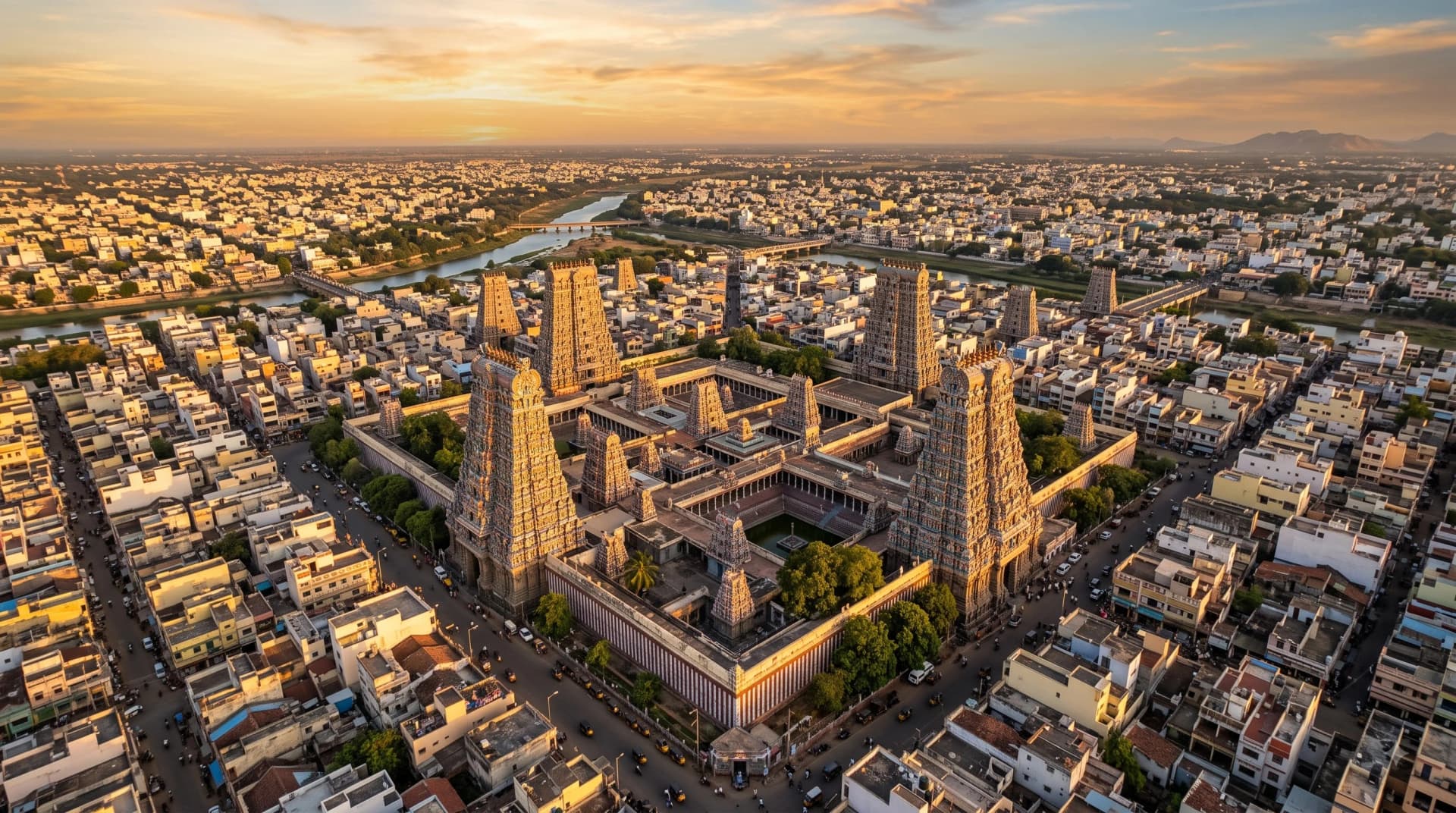
The temple complex covers approximately 6.3 hectares in the centre of the old city. It is not merely a place of worship but the organizational centre of the entire city — Madurai's roads, traditions, festivals, and community life have been structured around the temple for over two millennia.
The Legend of Meenakshi
The legend of Meenakshi is told in the Thiruvilayadal Puranam — a Tamil text devoted to the stories of Shiva in Madurai.
The Pandya king Malayadhvaja had long prayed for a child. From a ritual fire, a three-year-old girl emerged — already perfect except for one thing: she had three breasts. A voice declared that this was the princess of the Pandya kingdom; the third breast would disappear when she met her destined husband.
The princess, named Meenakshi (fish-eyed — a term of beauty in Tamil poetics), grew to adulthood and became a great warrior, conquering many kingdoms including the armies of the gods. She marched to Mount Kailash to conquer Shiva. When she saw him, the third breast vanished — Shiva was revealed as her husband.
They were married in Madurai in a ceremony of cosmic significance. The Meenakshi Thirukalyanam (divine wedding) is reenacted each year as the most important festival of the temple — a celebration that draws the largest gathering in Tamil Nadu and is one of the most elaborately performed religious dramas in India.
The Architecture
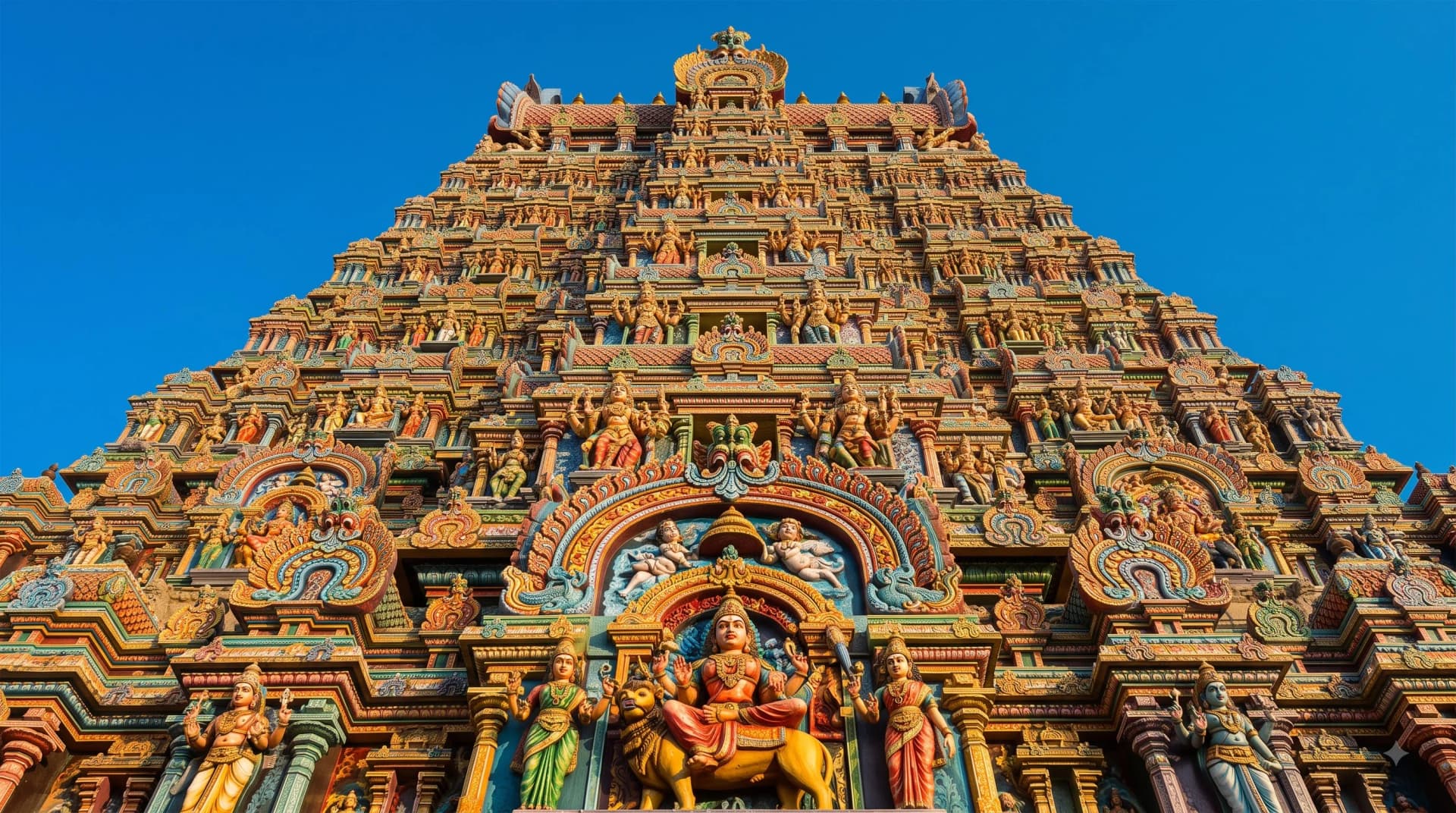
The Meenakshi Amman Temple complex has 14 gopurams (gateway towers), of which the two tallest rise to approximately 52 metres. The gopurams are covered in thousands of stucco sculptures — images of deities, attendants, divine animals, and mythological scenes — each painted in bright colours. The two oldest gopurams are from the 13th century CE; most of the current structure dates from the 16th and 17th centuries CE, when the Nayak rulers of Madurai (particularly Thirumalai Nayak) undertook major construction.
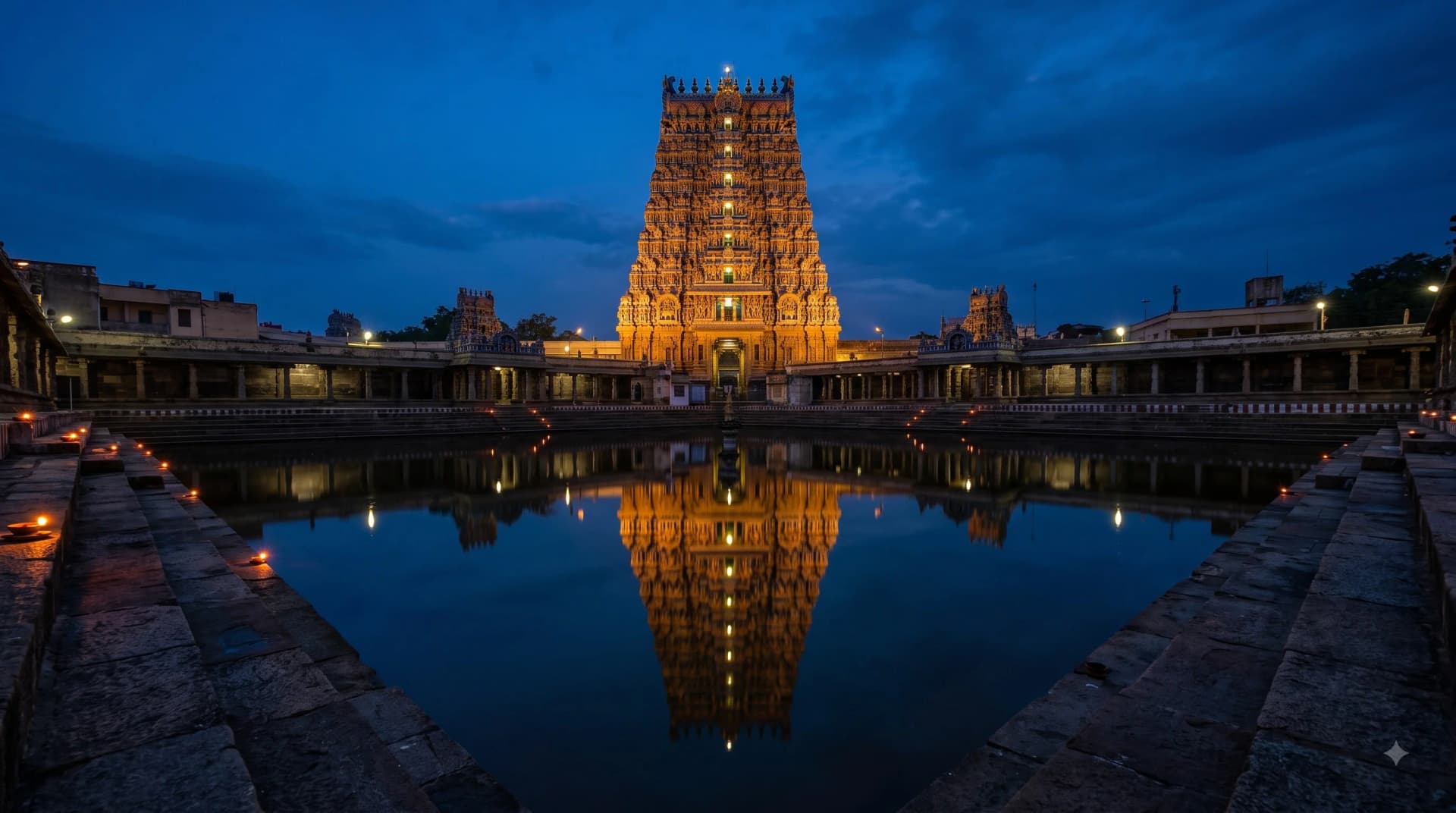
Inside the complex are two main sanctuaries (one each for Meenakshi and Sundareswarar), a series of mandapas (pillared halls), a sacred golden lotus tank (where pilgrims bathe), and the famous Hall of a Thousand Pillars (actually 985 pillars, each carved with distinct figures). The musical pillars in the hall produce different musical notes when struck.
The temple is still in active worship — it is not a museum but a functioning religious complex with tens of thousands of daily visitors. The renovation and upkeep of the gopuram sculptures is an ongoing work.
Meenakshi Thirukalyanam
The Meenakshi Thirukalyanam — the divine wedding of Meenakshi and Sundareswarar — is celebrated annually in the Tamil month of Chithirai (April–May). This is not a symbolic reenactment but a full-scale wedding ceremony conducted over multiple days with the temple rituals, processions, and all the traditions of a Tamil Brahmin wedding performed for the deities.
On the main day of the Thirukalyanam, the images of Meenakshi and Sundareswarar are brought out in procession through the city streets. The scale of attendance — hundreds of thousands of people — makes this one of the largest annual religious gatherings in Tamil Nadu.
The festival also marks the traditional New Year in the Tamil calendar, connecting the divine wedding with the renewal of the year.
Darshan & Visit
Photography is permitted in most open areas and mandapas. The main sanctuaries do not permit cameras. The Temple Museum (within the complex) displays detailed scale models and historical artefacts.
How to Reach
Nearby Sacred Sites
Ancient Vishnu temple in a forest setting — the brother of Meenakshi in local tradition; his annual procession to 'attend' her wedding is a major festival event
One of the six sacred Arupadai Veedu temples of Murugan
One of the six Murugan temples; cave temple on a rock hill
The 17th-century palace of the Nayak king who expanded the Meenakshi temple — remarkable Indo-Saracenic architecture
Sources
- Sangam literature — references to Madurai, 3rd century BCE – 3rd century CE(historical)
- Thiruvilayadal Puranam (Tamil; primary source for Meenakshi tradition)(scripture)
- Meenakshi Amman Temple Trust (maduraimeenakshi.org)(official)
- Tamil Nadu Department of Archaeology and Museums(government)
- Wikipedia — Meenakshi Amman Temple (cross-check)(reference)
Quick Links & Sacred Exploration
Explore other revered temples, Jyotirlingas, and sacred pilgrimage routes across India.