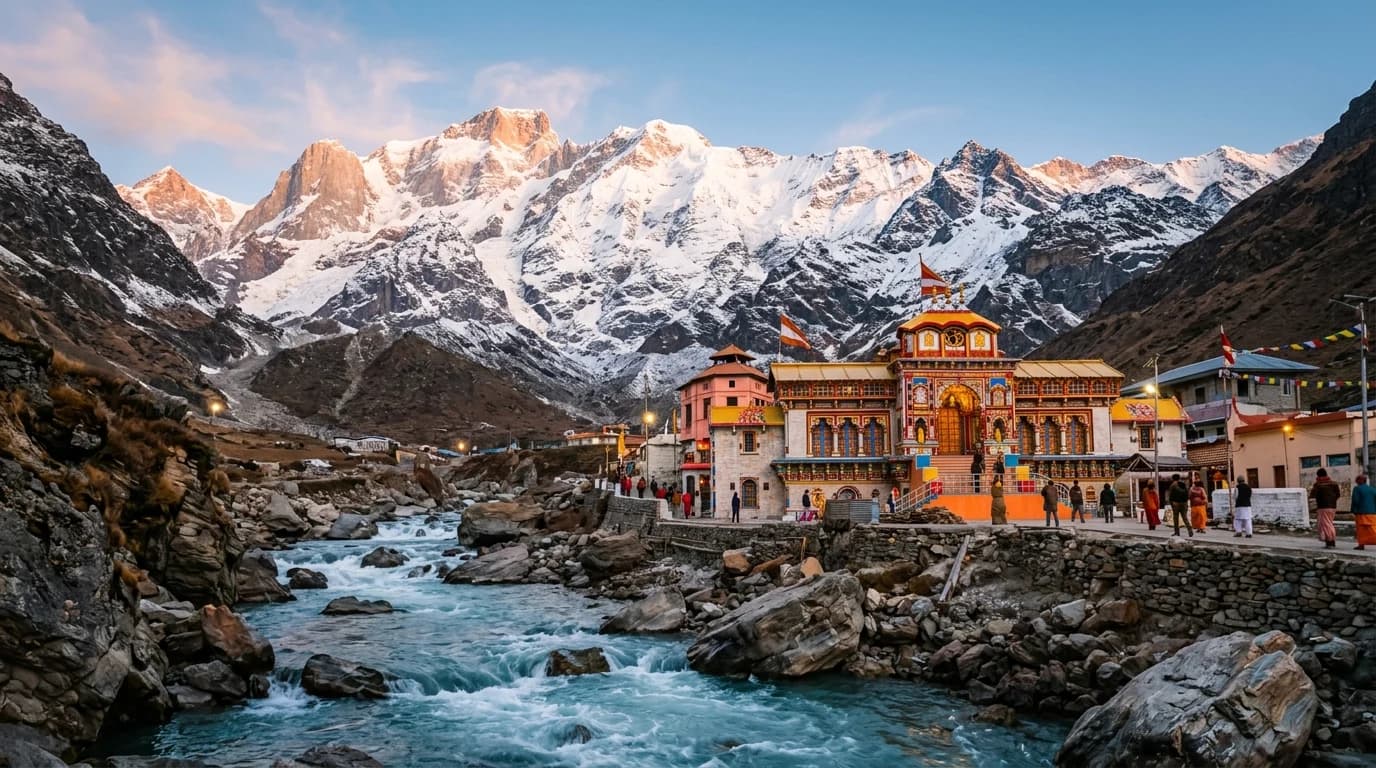
Badrinath, Chamoli District, Uttarakhand
Badrinath
बद्रीनाथ
The northern anchor of India's ancient Char Dham and the highest of the Chota Char Dham shrines, set at 3,133 metres along the Alaknanda river, where tradition reveres Lord Vishnu in the serene meditative posture of Badrinarayan.
The Valley of Nar and Narayan
नर और नारायण की पावन घाटी
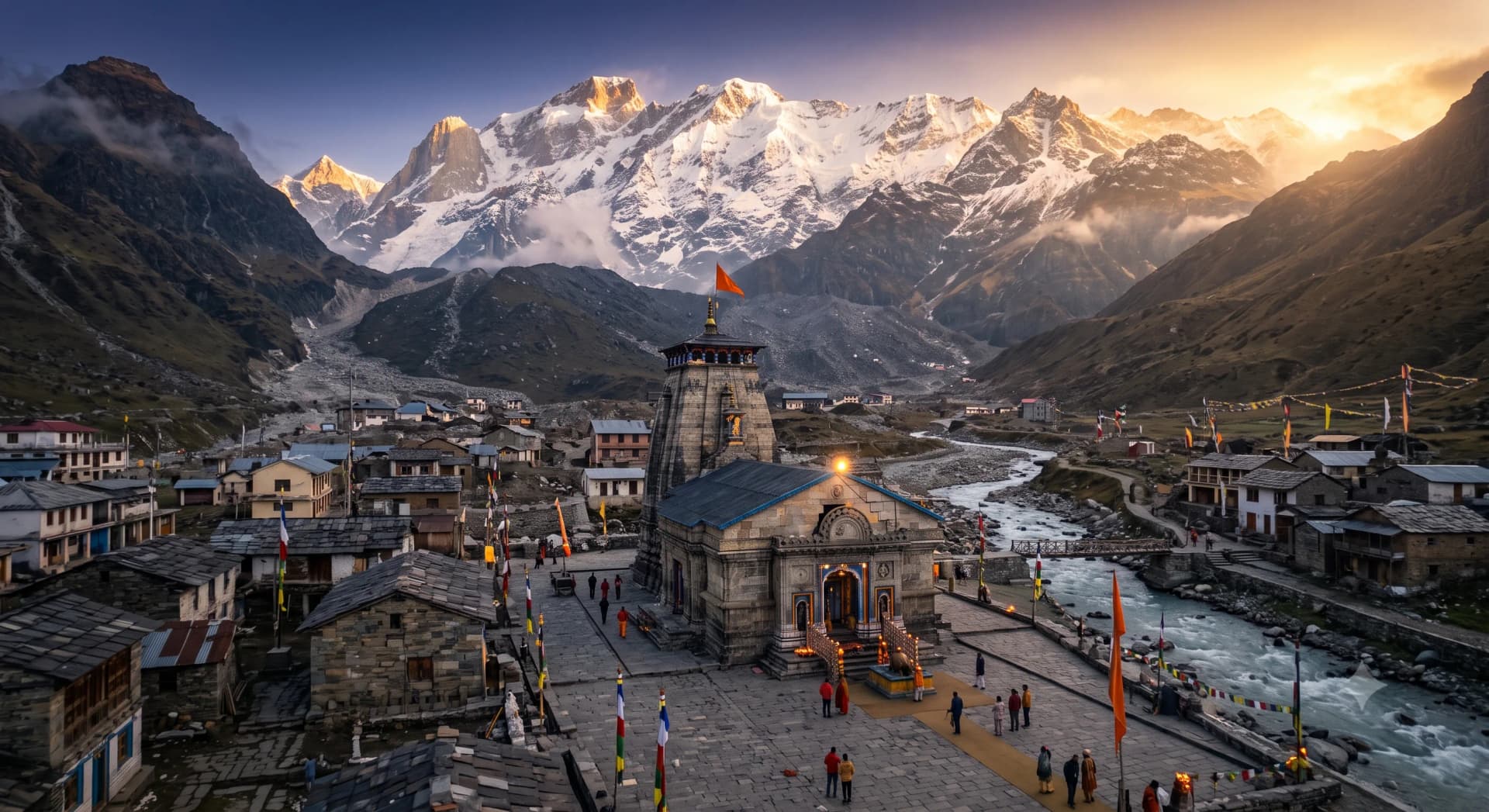
Badrinath stands at an elevation of approximately 3,133 metres (10,279 feet) in the Chamoli district of Uttarakhand, nestled in a high Himalayan valley between the twin mountain ranges of Nar and Narayan, with the formidable pyramid of Nilkantha peak rising to 6,596 metres in the background.
The sacred Alaknanda River—a major headstream of the holy Ganga—rushes directly past the temple's stone ghats. Within Hindu cosmology, this region is known as Badarikashrama or Badrikashram, a timeless sanctuary of austerities where great sages, including Vyasa and the Pandavas, are believed to have meditated.
The temple's distinctive exterior features a vibrantly painted stone facade, small arched windows, and a broad stone staircase leading to the arched entrance. Inside the sanctum sanctorum sits a self-manifested (Swayamvyakta) one-metre-tall deity of Badrinarayan, sculpted from black Shaligram stone, depicting Lord Vishnu seated in the meditative Padmasana posture under the canopy of a gold sheet Badri tree.
The Legend of the Badri Tree
बदरी वन और मां लक्ष्मी की तपस्या
Traditional lore recorded in the Puranas explains the name 'Badri-nath' as 'Lord of the Badri forest.' According to the narrative, Lord Vishnu entered deep meditation here in the freezing high-altitude wilderness. Seeing Him exposed to bitter mountain snowstorms, His consort Goddess Lakshmi assumed the form of a wild berry tree (known in Sanskrit as Badari or jujube) to stand over Him and shield His body from the snow and wind.
When Vishnu concluded His long austerities and discovered Lakshmi covered in ice and frost on His behalf, He declared that this sacred tirtha would henceforth bear her name before His own: Badari-Nath.
A complementary scriptural tradition identifies the surrounding Nar and Narayan mountains with the dual twin sages Nar and Narayana, ancient incarnations of Vishnu whose penance preserved cosmic balance, and who were later reborn in the Dwapara Yuga as Arjuna and Krishna.
Historical Restoration and the Rawal Tradition
आदि शंकराचार्य एवं रावल परंपरा
While traditional accounts trace the shrine to the Vedic epoch, historical records document that the ancient murti was retrieved from the depths of the Narad Kund pool by the philosopher-saint Adi Shankaracharya in the early 9th century CE. Shankaracharya re-established regular Vedic worship at Badrinath and instituted an extraordinary pan-Indian ritual arrangement that endures to this day.
By Shankaracharya's decree, the chief priest of Badrinath—known as the Rawal—is traditionally chosen from the Nambudiri Brahmin lineage of Kerala, in the far south of India. This centuries-old convention bridges the northernmost Himalayan sanctuary with the southern tip of the subcontinent, epitomizing the cultural and spiritual unity foundational to the Char Dham concept.
The present stone structure was expanded by the kings of Garhwal and rebuilt following severe seismic events, notably the earthquake of 1803, with patronage from the rulers of Gwalior and Jaipur.
Tapt Kund and the Sacred Pilgrimage Experience
तप्त कुंड और शीतकालीन प्रवास
Before entering the sanctum, pilgrims traditionally descend to the Tapt Kund, a group of natural thermal sulfur springs located on the riverbank just below the temple. Emerging from the rock at a constant temperature of approximately 45°C to 55°C, the mineral-rich waters provide a dramatic contrast to the near-freezing mountain air and the icy flow of the Alaknanda just steps away.
Due to severe Himalayan winter conditions and heavy snowfall, Badrinath is accessible for approximately six months each year—opening around Akshaya Tritiya (late April or early May) and closing shortly after Diwali (October or November).
On the day of closing (Kapat Bandh), an unbroken oil lamp (Akhand Jyoti) is lit inside the sealed sanctum, and the processional utsav murti of Badrinath is reverently carried down to the Vasu Deva Temple in Joshimath, where worship continues throughout the winter months until the shrine reopens in spring.
Darshan & Visit
All pilgrims are required to complete biometric/online yatra registration through the official Uttarakhand government portal prior to travel.
How to Reach
The journey traverses narrow Himalayan mountain roads subject to seasonal convoy regulations. Night driving in upper sectors is restricted by local authorities.
Nearby Sacred Sites
Thermal sulfur bath on the Alaknanda bank and the sacred pool where Adi Shankara recovered the idol.
A sacred flat stone platform on the riverbank considered the foremost site for ancestral Tarpan and Pind Daan.
Officially recognized as the first Indian village on the Indo-Tibetan border; houses Vyas Gufa and Ganesh Gufa.
The ancient rock caves where sage Veda Vyasa is traditionally held to have composed the Mahabharata with Lord Ganesha as scribe.
A massive natural stone bridge spanning the thunderous gorge where the mythical Saraswati river emerges into view.
Northern monastic seat established by Adi Shankaracharya and winter home of the Badrinath deity.
Sources
- Shri Badrinath-Kedarnath Temple Committee (BKTC)(official)
- Uttarakhand Tourism Development Board (UTDB)(government)
- Archaeological Survey of India (ASI), Dehradun Circle(government)
- Skanda Purana, Badarikashrama Mahatmya (Kedarkhanda)(scripture)
- E.T. Atkinson, 'The Himalayan Gazetteer' (1882)(historical)
Quick Links & Sacred Exploration
Explore other revered temples, Jyotirlingas, and sacred pilgrimage routes across India.