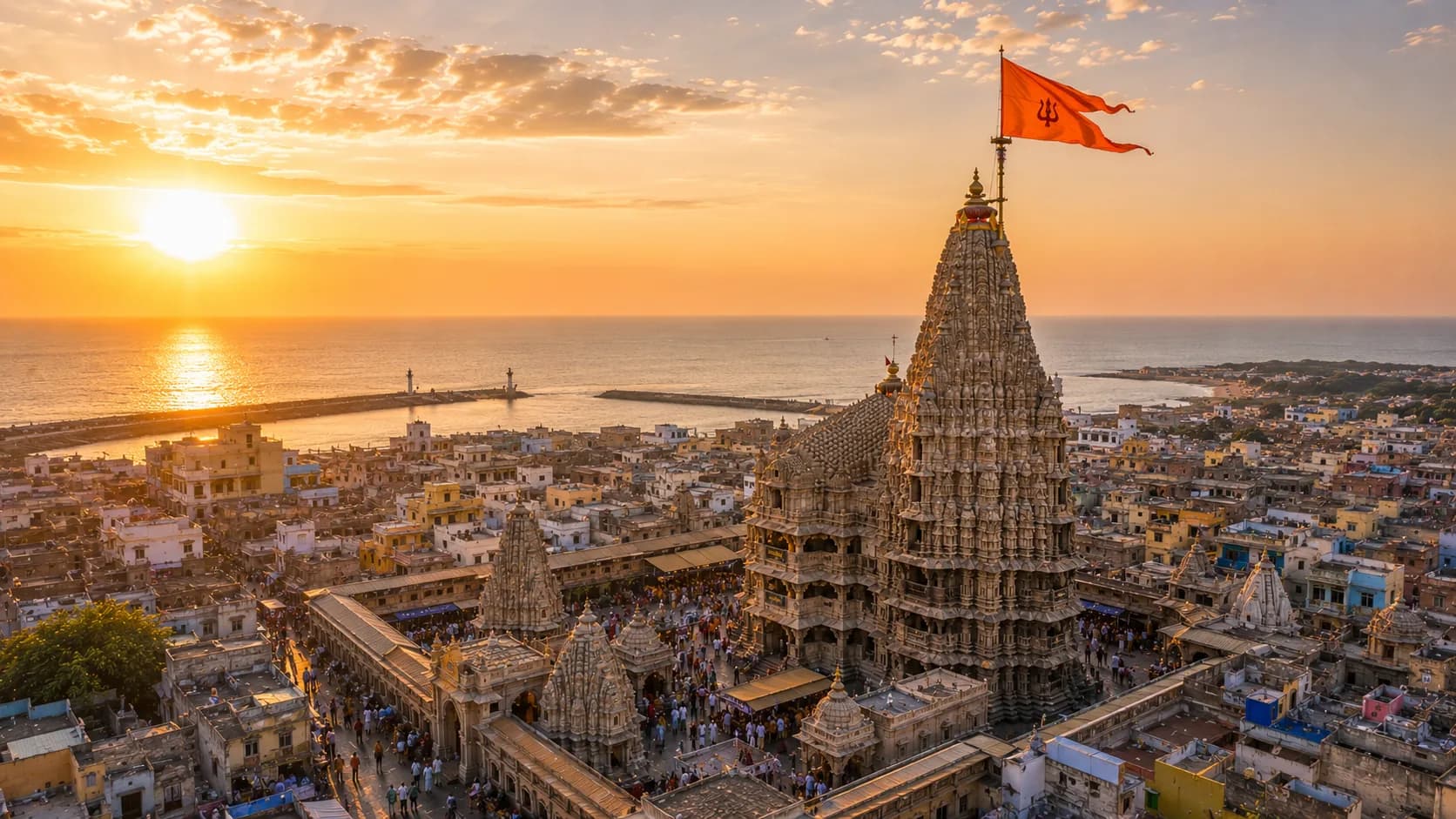
One of the four sacred Char Dhams and one of the seven Sapta Puri (sacred cities). Dwarka is the city believed to have been built by Krishna on the western tip of the Indian subcontinent — and believed to have been submerged by the sea after his departure. The Dwarkadhish temple, a 72-metre Chalukya masterpiece, stands at the point where the Gomati river meets the Arabian Sea.
The Westernmost Dham
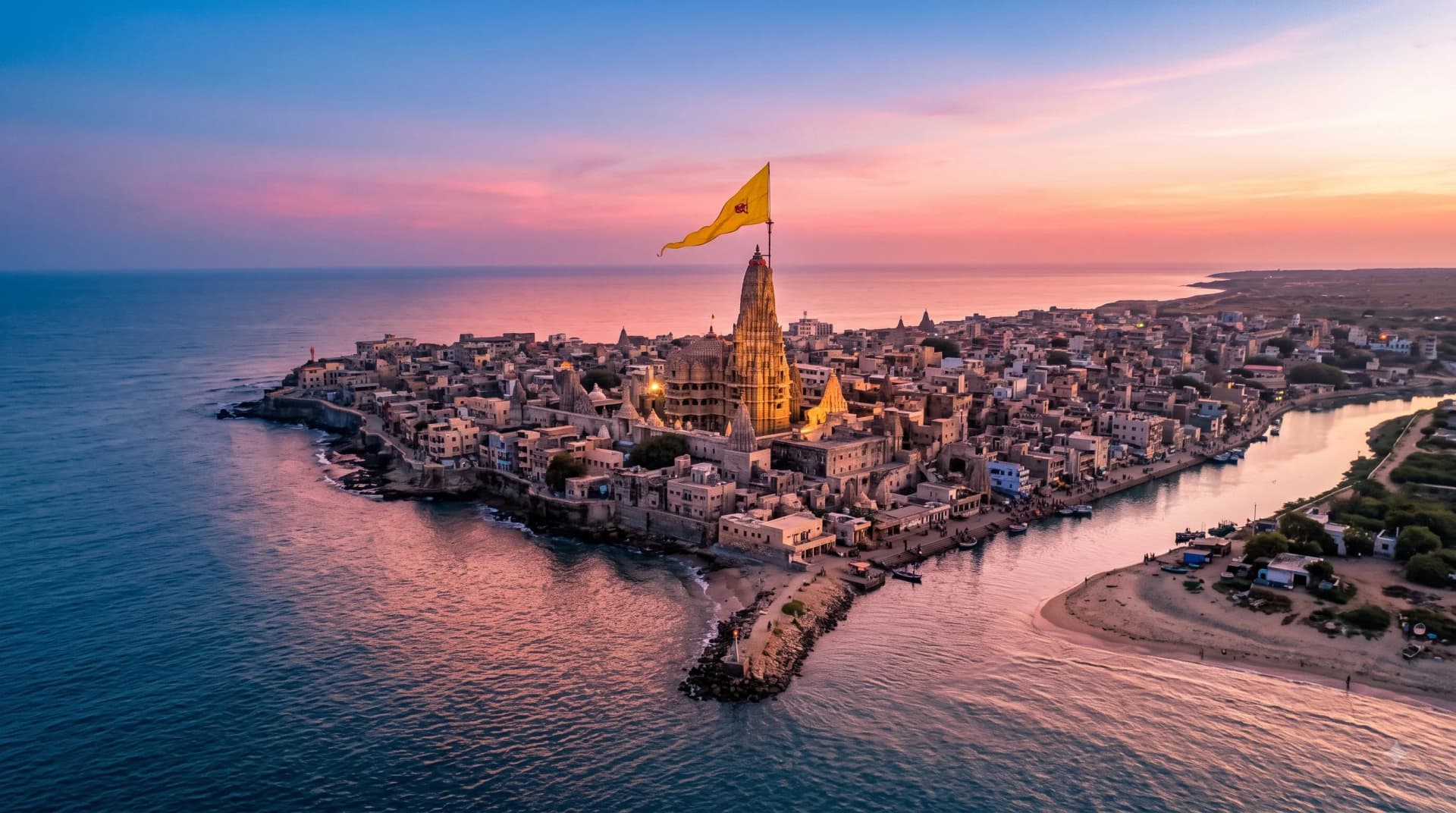
Dwarka occupies the westernmost tip of the Indian subcontinent — the point where the Arabian Sea meets the Kathiawar Peninsula in Gujarat. It is one of the four Char Dhams (with Puri to the east, Badrinath to the north, and Rameswaram to the south) and one of the seven Sapta Puri considered most sacred in Hindu tradition.
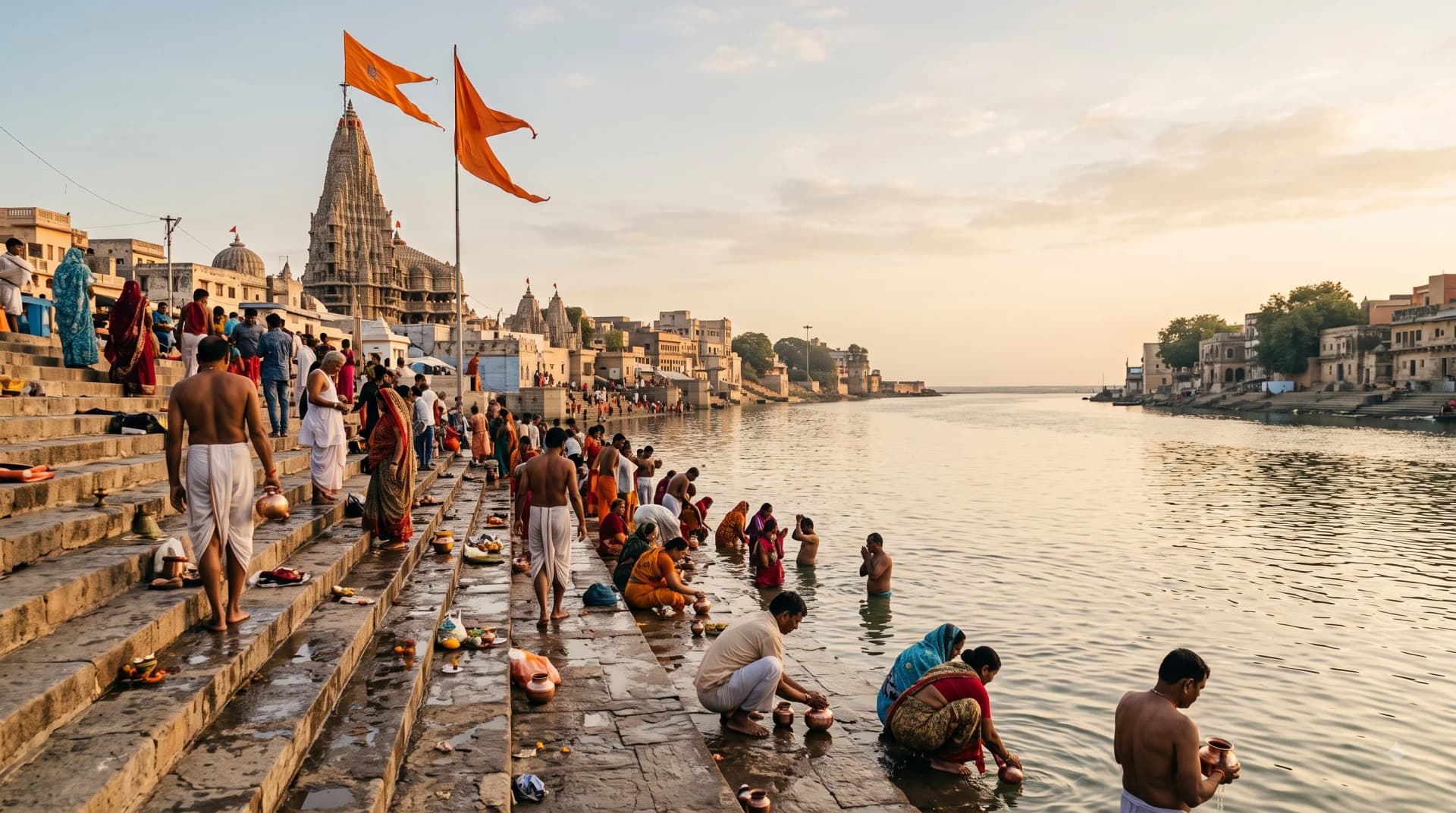
The site stands at the confluence of the Gomati river and the sea — a combination that gives it particular sanctity in the pilgrimage tradition. Pilgrims traditionally cross the Gomati river by a bridge before entering the main temple complex. The Gomati ghat is where devotees bathe before darshan.
The city of Dwarka is also the location of the Dwarkadhish temple, the Rukmini Devi temple (dedicated to Krishna's principal consort), the Nageshwar Jyotirlinga (one of the 12 Jyotirlingas), and the Bet Dwarka island — together making Dwarka one of the densest concentrations of sacred sites in India.
Krishna's Kingdom
The Harivamsha — a major supplement to the Mahabharata — provides the most detailed account of the city of Dwarka.
After killing his uncle Kansa in Mathura, Krishna learned that Kansa's father-in-law Jarasandha would wage war on Mathura repeatedly. To protect the Yadava clan, Krishna led a migration westward to the Saurashtra region of Gujarat. There, on a site given to him by the sea, he built the city of Dwaraka (the City of Gates) — described as a golden city rising from the water, with wide streets, palaces, and gardens.
Krishna ruled from Dwarka for most of his adult life as described in the epics. The Mahabharata was set during this period; the Bhagavata Purana — the most important Vaishnava scripture — contains the Bhagavad Gita and most of Krishna's divine revelations in this era. After the Kurukshetra war and the deaths of the Pandavas and Kauravas, the Harivamsha records that Dwarka was submerged by the sea after Krishna's departure from the world (his physical death or divine return, per different interpretive traditions).
This submersion is not only mythological: archaeological and marine surveys off the coast of present-day Dwarka have identified stone structures and artifacts underwater, dated variously by different researchers. The National Institute of Ocean Technology and the Archaeological Survey of India have conducted multiple surveys. The finds are not definitively identified as the mythological Dwarka, but the presence of ancient underwater structures has been documented.
The Temple
The Dwarkadhish Jagat Mandir (World Temple) is the presiding structure of Dwarka. The temple rises 72 metres (approximately 235 feet) in a Chalukya-style shikhara — one of the tallest temple towers in western India. The shikhara is topped by a flag (dhvaja) estimated to be 84 feet long, which is changed five times daily. The flag is visible from the sea.
The original temple on this site is traditionally said to have been built by Vajranabha, Krishna's great-grandson. The current structure is significantly later — the Chalukya construction and subsequent renovations date the standing temple to approximately the 16th century CE, with earlier phases documented through inscriptions. Adi Shankaracharya (8th–9th century CE) is said to have established a Sharada Peetha (seat of learning) at Dwarka, which still exists as the Dwaraka Peetham.
The temple has two entrances: the Swarga Dwar (Gate of Heaven, facing north, toward the Gomati) and the Moksha Dwar (Gate of Liberation, facing south). The 56 steps leading down from the Moksha Dwar to the Gomati ghat are among the most sacred spaces of the pilgrimage.
Bet Dwarka and the Full Pilgrimage
The complete Dwarka pilgrimage includes not only the Dwarkadhish temple but the island of Bet Dwarka (also called Shankhoddhara), accessible by boat approximately 30 minutes offshore from the Okha jetty.
Bet Dwarka is traditionally identified as the location of Krishna's residential palace — distinct from the city of Dwarka where his administrative and public life was based. The island has a temple to Krishna (Dwarkadhish on the island, distinct from the main temple on the mainland) and a cluster of smaller shrines. The boat journey across the Gulf of Kutch is itself considered part of the pilgrimage experience.
Rukmini Devi Temple (2 km from the main Dwarkadhish temple) is also considered essential to the Dwarka pilgrimage — dedicated to Krishna's consort. The Nageshwar Jyotirlinga temple is approximately 16 km from Dwarka, making a round trip that encompasses both a Char Dham and a Jyotirlinga possible in one visit.
Darshan & Visit
The complete Dwarka pilgrimage (Dwarkadhish + Bet Dwarka + Rukmini Devi + Nageshwar) requires 2 days at minimum to do without rushing. Okha is the nearest port for Bet Dwarka boats.
How to Reach
Nearby Sacred Sites
One of the 12 Jyotirlingas; combining Dwarka and Nageshwar is a common pilgrimage pairing
Temple of Krishna's principal consort; considered essential to the complete Dwarka pilgrimage
The island where Krishna's palace was traditionally located; accessible by boat from Okha jetty
Lake where the Gopis (cowherd devotees) of Krishna came when they could not find him after his departure from Vrindavan
First Jyotirlinga; a natural pairing for a Gujarat Char Dham itinerary
Sources
- Harivamsha (primary scriptural source for Dwarka narrative)(scripture)
- Dwarkadhish Temple Trust (dwarkadhish.org)(official)
- Archaeological Survey of India — Marine Archaeology Unit, Dwarka excavation reports(government)
- National Institute of Ocean Technology — underwater structures, Gulf of Kutch(government)
- Wikipedia — Dwarka (cross-check)(reference)
Quick Links & Sacred Exploration
Explore other revered temples, Jyotirlingas, and sacred pilgrimage routes across India.