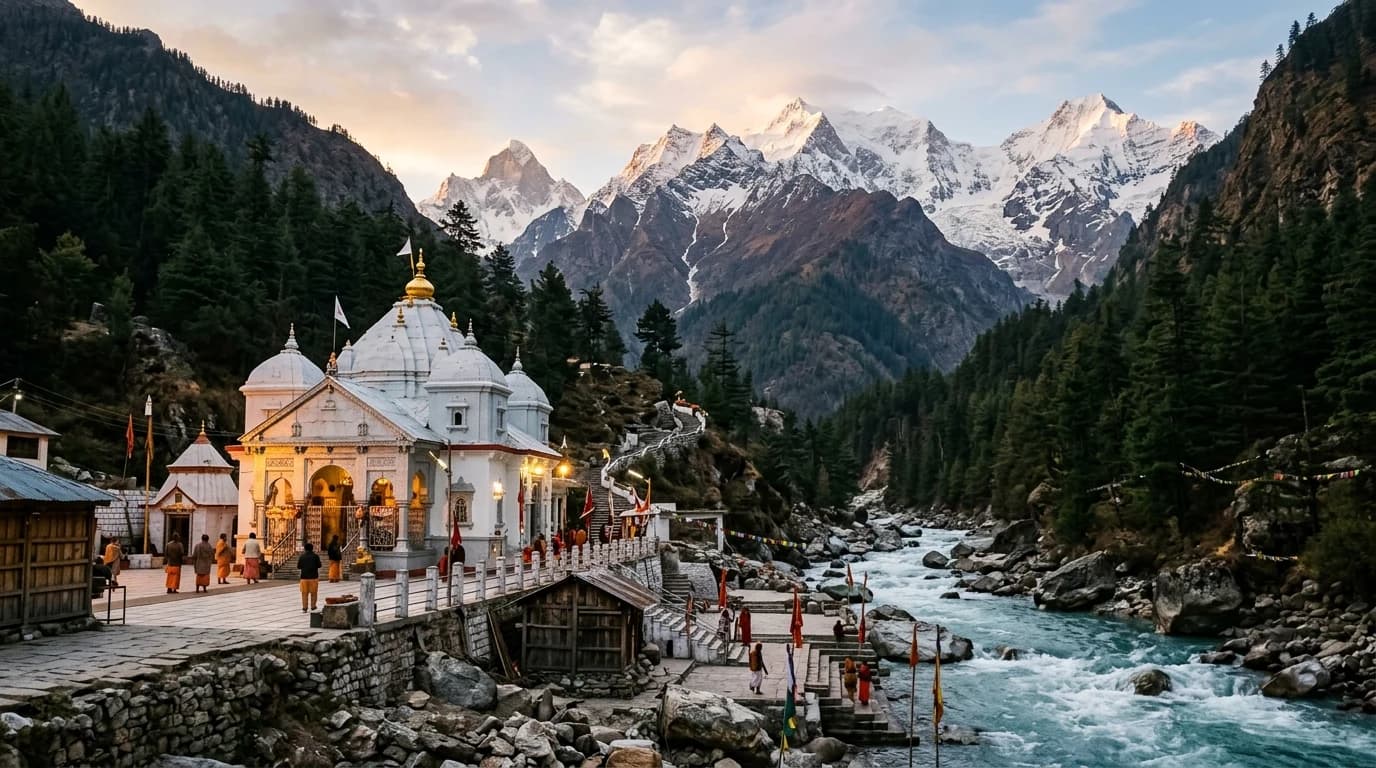
Yamunotri, Uttarkashi District, Uttarakhand
Yamunotri
यमुनोत्री
Perched at an altitude of approximately 3,291 metres against the steep face of Kalind Parvat in the western Garhwal Himalayas, Yamunotri is the revered source of the holy Yamuna river and the traditional first shrine of the Chota Char Dham pilgrimage.
The Western Pillar of the Himalayan Circuit
चार धाम यात्रा का प्रथम पावन द्वार
Yamunotri is situated in the Uttarkashi district of Uttarakhand at an elevation of 3,291 metres (10,797 feet) in the shadow of the massive Bandarpoonch mountain massif (6,316 metres). The temple clings dramatically to the steep rock wall of Kalind Parvat along the narrow gorge where the young Yamuna River cascades down from the high snowfields.
Within the sacred tradition of the Uttarakhand Chota Char Dham, Yamunotri is the traditional first stop of the pilgrimage. Pilgrims journey in a clockwise direction—from west to east—beginning with Yamunotri, proceeding eastward to Gangotri, then ascending to Kedarnath, and culminating at Badrinath.
The journey to Yamunotri concludes with an invigorating 6-kilometre steep mountain ascent from the roadhead at Janki Chatti, crossing pine-clad gorges, rushing cataracts, and winding stone stairs along the riverbank.
The Daughter of the Sun and Sister of Death
सूर्य पुत्री, शनि और यम की पावन भगिनी
In Hindu scripture, the river Yamuna—also called Kalindi—possesses a profound celestial lineage. According to the Markandeya Purana and the Mahabharata, she is the beloved daughter of Surya (the Sun God) and His consort Sanjna (consciousness), and the sister of Yama (the God of Justice and Death) and Shani (Saturn).
Because of this intimate sibling bond, traditional belief holds that anyone who bathes in the sacred waters of the Yamuna is shielded from agonizing or untimely death, and their soul is spared the harsh chastisement of Yama's court.
This tender bond between Yamuna and Yama is celebrated across India on Yama Dwitiya (Bhai Dooj), immediately following Diwali, when Yama is said to have visited his sister Yamuna, who welcomed him with delicious food and applied a tilak to his forehead. In return, Yama granted the boon that any brother who receives a sister's blessing and bathes in the Yamuna on this day shall be granted protection and long life.
Surya Kund and the Sacred Cooking of Prasad
सूर्य कुंड और दिव्य शिला का पावन अनुष्ठान
Directly adjacent to the temple, a remarkable geological phenomenon occurs: powerful natural geothermal springs emerge from the cold Himalayan rock fissures at near-boiling temperatures.
The most famous of these is Surya Kund, a rectangular stone pool whose mineral-infused waters bubble continuously at approximately 88°C (190°F). Here, pilgrims observe an ancient and fascinating ritual: devotees place raw rice, barley, and small potatoes inside small muslin cloth bags (potli) and immerse them into the steaming waters of the thermal spring.
Within five to ten minutes, the mountain heat cooks the food thoroughly. Pilgrims retrieve the hot bags and carry the cooked grains home as consecrated prasad.
Before entering the main temple, pilgrims first offer worship at the Divya Shila (Divine Rock), a reddish-brown rock pillar located beside Surya Kund that is traditionally venerated as the foundational seat of divine power before approaching the deity.
The Temple and Winter Abode at Kharsali
मंदिर का इतिहास और खरसाली शीतकालीन धाम
The physical shrine of Yamunotri was originally commissioned by King Sudarshan Shah of Tehri Garhwal in the mid-19th century. Following repeated damage caused by mountain avalanches and extreme weather, the present stone structure was restored under the patronage of Maharani Guleria of Jaipur in the late 19th century.
Inside the sanctum stands a revered black marble icon of Goddess Yamuna, depicted with a gentle countenance holding a lotus bud, flanked by Goddess Ganga in white marble.
As winter approaches and heavy snowfall blankets the gorge, the temple is formally closed on the auspicious day of Bhai Dooj (Kartik Shukla Dwitiya). In an elaborate ceremonial procession accompanied by traditional drums (dhol-damau) and horns, the sacred bronze idol of Yamuna is carried down to the ancient village of Kharsali across the river from Janki Chatti.
Kharsali serves as the winter seat of Yamunotri, housing a historic multi-tiered wooden temple dedicated to Lord Shani (the brother of Yamuna), where the Goddess receives uninterrupted worship until her spring return on Akshaya Tritiya.
Darshan & Visit
The 6 km trek from Janki Chatti involves a steep continuous gradient of about 600 vertical metres. Ponies, doli (palanquin seats carried by four bearers), and pitthu (baskets for children) are readily available for hire.
How to Reach
Barkot (approximately 45 km before Janki Chatti) serves as the primary base town where most pilgrims stay overnight before undertaking the morning trek.
Nearby Sacred Sites
The sacred rock slab consecrated at the entrance where all pilgrims offer primary worship before entering the inner sanctum.
Natural geothermal spring boiling at 88°C where pilgrims cook rice and potatoes in cloth bags as sacred prasad.
A lukewarm natural thermal spring situated just below Surya Kund, suitable for a purifying bath before darshan.
The ancient stone-and-wood village that serves as the winter seat of Yamunotri and houses an extraordinary 12th-century wooden temple to Lord Shani.
An isolated, glacial lake at 4,421 metres altitude at the base of Kalind Parvat, revered as the true physical source where the seven Vedic Rishis meditated.
Scenic base town in the valley overlooking the Bandarpoonch peaks, filled with pilgrim dharamshalas and hotels.
Sources
- Shri Yamunotri Temple Committee(official)
- Uttarakhand Tourism Development Board (UTDB)(government)
- Markandeya Purana (Genealogy of Surya, Sanjna & Yamuna)(scripture)
- Skanda Purana, Kedarkhanda (Tirthas of Garhwal)(scripture)
- Archaeological Survey of India (ASI), Dehradun Circle(government)
Quick Links & Sacred Exploration
Explore other revered temples, Jyotirlingas, and sacred pilgrimage routes across India.